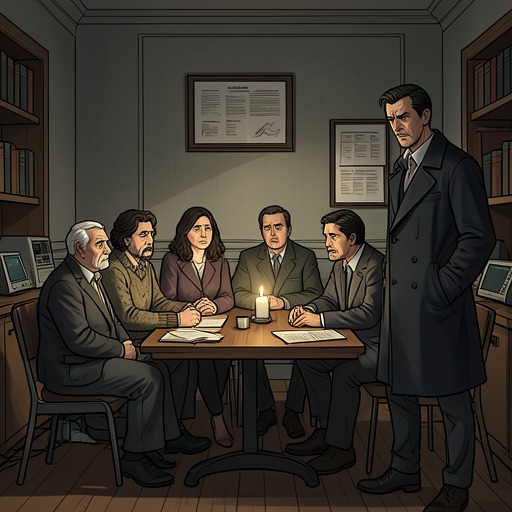
Apartment viewers are held hostage and stay to comfort the robber
Anxious PeopleApartment viewers are held hostage and stay to comfort the robber is the turning point at which a failed robbery becomes an encounter shaped less by force than by the choices of the people trapped together. The Bank robber enters an apartment viewing with a pistol and a mask, but when she finally offers to give herself up, the hostages refuse to treat her only as a threat. Their decision to remain with her transforms the immediate crisis into an improvised act of companionship.
Causes and Stakes
The Bank robber explains that she needs money for rent because her ex-husband’s lawyer may otherwise take her daughters away. She apologizes and says that taking hostages was never what she meant to do. Her account does not undo the danger or distress she has caused, but it makes the stakes personal: the attempted robbery is bound up with housing insecurity and her fear of losing her children.
The scene also places the incident within a wider account of financial vulnerability. The man who jumped from the bridge ten years earlier and the Bank robber are explicitly said never to have met and not to be connected. Their parallel is instead the idea of moral hazard: institutions can shift the consequences of risk onto individuals. The man loses his savings through supposedly secure investments and is refused a further loan when he needs help; the Bank robber’s immediate crisis, by contrast, concerns rent and the possibility of losing her daughters. The novel sets these circumstances alongside one another without making them the same story.
Police Response and Uncertainty
Outside The apartment, Jack struggles to establish contact with the Bank robber. He has taken an active-listening course, but the training feels difficult to apply to a crisis unfolding in front of him. He worries about what his superiors will say and looks up at the balcony where the Bank robber is holding the others, searching for some way to begin a conversation.
Jack also tries to find a safer way to understand what is happening before Jim approaches the building with pizzas. He considers whether he can see into the stairwell from a building across the street. His hesitation is sharpened by uncertainty over whether a suspected bomb is actually a bomb: sending his father to test that uncertainty would mean making another person bear the risk. Jim offers familiar advice about speaking to a hostage taker, such as avoiding negative phrasing, finding common ground, and learning the person’s motivation. He then makes clear that this advice did not, by itself, get someone out of an earlier hostage situation. The exchange leaves the police with techniques to try, not a reliable formula for control.
The Hostages Choose to Stay
Inside, the Real estate agent explains that she had hidden in a closet after finding the bathroom occupied while preparing herself for the viewing. She emerged after hearing an alarm that the place was being robbed. The Bank robber apologizes and tells her that the pistol is not real. The explanation reduces one immediate fear, but the group remains in a situation neither the police nor the people inside can simply resolve by pretending it is ordinary.
The change comes when the Bank robber, in tears, tells everyone they can leave while she waits for the police. She says she will surrender so that no one else gets hurt. Instead of accepting her offer and abandoning her, the hostages begin objecting and reassuring her. Estelle points out that no one has been hurt; Anna-Lena comforts her about the police; Julia suggests that they all go outside together, believing the officers will be less likely to fire if the group leaves as one. The Real estate agent observes that bidding on the apartment has not even begun, while Ro proposes waiting for the pizzas.
Estelle recasts the gathering as a chance to get to know one another and proposes eating together. The Bank robber looks around at the people she has been holding and calls them the worst hostages. She then accepts Estelle’s help setting the table and goes with her to the kitchen. The others continue their small domestic tasks: Julia tends to the fire, and Zara gives Julia her lighter. These gestures do not erase the crisis; they alter what the people inside choose to do with it.
Release, Aftermath, and Significance
The hostages’ response makes their release more than a matter of police procedure. They offer to leave alongside the Bank robber, stay for food, and treat her as a person capable of accepting help. Jim’s later decision to help her, despite her question about why a police officer would do so, extends the same tension between enforcing a role and responding to another person’s need. His memory of his late wife’s advice about planting an apple tree even when the world seems headed for disaster frames help as something worth doing without certainty about the outcome.
The crisis also brings Zara and Nadia into the same story. Zara is among the people caught up in the viewing, and the event’s aftermath is connected to the ten-year-old letter she has carried since the man’s death. When she finally lets Nadia open it, she tries to explain that she had come seeking someone who could read the letter and keep her from following the man to the bridge. Later, Jack sees the photograph in Nadia’s office of children at a summer camp for those bereaved by suicide. The camp offers the kind of companionship that lets people share grief rather than carry it in isolation.
The episode’s central reversal is not that the danger was imaginary, but that the people facing it respond to vulnerability as well as fear. The Bank robber is responsible for the hostage-taking, yet the hostages do not reduce her to that act. Their care does not guarantee an easy resolution; it creates a way for cooperation to become possible. In the novel’s broader pattern, the scene makes helping others less like a single heroic rescue than a series of limited, human decisions made while the outcome remains uncertain.