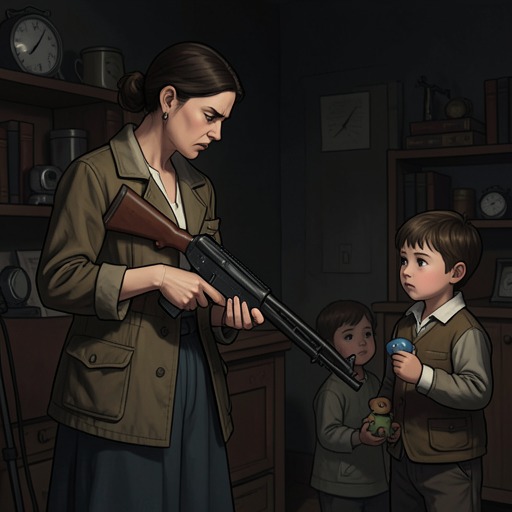
Bank robber’s daughters
Anxious PeopleThe Bank robber’s daughters are two girls whose bond with their mother remains steady through divorce, economic insecurity, and their mother’s failed bank robbery. Known within the family by the animal names monkey and frog, they do more than motivate their mother’s choices: their own gestures and stories reveal how carefully they understand the family’s distress, and how much they want her to know that she still belongs to them.
Family and circumstances
Their mother tries to be a good parent without having had an instruction manual herself. For a time, she believes that she is managing family life reasonably well. Then her husband has an affair with her boss, and the couple’s marriage ends. Because the apartment is in her husband’s name, he and the boss move in together and their mother is forced out. She tries not to create conflict or chaos for the girls, but the separation leaves her trying to provide for them in precarious circumstances.
The girls are staying with their father on New Year’s Eve. Their mother had been expected to collect them and celebrate with them, but after the robbery she cannot carry out that plan. In the conversation that follows, she connects her decision-making to her fear of conflict and her wish to shield the girls from it. Instead, she recognizes that her attempts to manage everything alone have produced more turmoil. The apartment she later shares with the girls costs 6,500 a month, and she has no clear idea how she will pay the next month’s rent. The money pressure is therefore part of their daily life, not a problem that disappears when the immediate crisis ends.
The Bank robber’s fear of losing her daughters also shapes her thoughts while she is isolated during the hostage crisis. She imagines a future in which she is imprisoned and misses the girls growing up, including learning to swim. Her imagined future makes the robbery’s consequences personal: punishment would separate her from the children she had hoped to protect, even as her choices have placed that relationship under strain.
The bridge and the padlock
A few weeks before the hostage crisis, the mother and the girls walk home from school across a bridge. The girls stop halfway across, leaving their mother about ten yards ahead before she notices. They have brought a padlock after seeing people attach locks to bridges in other towns. They explain its purpose as a way to secure love forever, so that people never stop loving one another.
Their mother initially understands the gesture through her own fear of the divorce. She thinks the girls may be afraid that she will stop loving them or cease to be their mother as family life changes. The girls patiently explain that they are not worried about losing her; they want her to know that she will never lose them. Their reassurance reverses the direction of care: the mother has been trying to protect the children from the separation, while the children are trying to protect her from believing that separation has taken their love away.
The lock clicks into place, and the girls throw its key toward the water. All three cry. The youngest then admits that she first thought the padlocks might be there because someone was afraid the bridge would be stolen, and later wondered whether someone might steal the padlock. Her older sister explains the custom without making her feel foolish. Their mother takes this small exchange as evidence that the girls can acknowledge a mistake and forgive other people for making one. The scene joins their affection to an everyday lesson in how to be wrong without being humiliated.
The princess between two kingdoms
The girls’ understanding of their parents’ separation also appears in a school assignment. One morning, while packing their backpacks, their mother finds a notebook in her eldest daughter’s bag. The girl has written a fairy tale about a princess who discovers a hidden, peaceful world beneath her bed. That world lies between two kingdoms at war, ruled by a king and a queen who are fighting over the princess. The conflict does not destroy either kingdom, but threatens everything caught between them. The princess eventually leaves so that neither side will have anything left to fight over.
Reading the story, the mother worries that her eldest daughter needs so much imaginative escape because real life feels so difficult. The tale gives the girls’ family situation a child’s startlingly clear form: the parents’ conflict surrounds a child who loves both of them, while the place of safety lies between the warring sides. The princess’s departure is not presented as a simple adventure; within the story, it is her attempt to protect both kingdoms and the vulnerable world between them.
The mother does not leave the girls’ feelings unaddressed. As they cross the bridge another day, she tells her eldest that she can be both a princess and a warrior, and insists that the divorce is not her daughter’s fault. The youngest calls for them to hurry, and the family runs after her. The mother wipes her face and suggests pizza for supper; the youngest answers with a joke. Their ordinary teasing does not erase the seriousness of the conversation, but it lets family life continue around it.
A changed home and a measure of peace
The girls and their mother eventually make a new home in Estelle’s apartment. After the children have gone to sleep there, the eldest takes her mother’s hand and reassures her that she is a good mother and should not worry so much. The daughter who had written of a princess disappearing to end a war now offers comfort directly, in a relationship where neither child has to vanish for the adults to stop fighting.
The narrative connects this reassurance to peace in the hidden realm of the eldest daughter’s story. The imagined creatures—including monkeys, frogs, and elks—can sleep safely. The image gathers the family’s animal nicknames into a small picture of belonging: the girls and their mother have not solved every financial or family difficulty, but they have found a home in which the children’s world is no longer defined solely by the parents’ separation.
Narrative significance
The daughters’ role is expressed through concrete actions rather than speeches about family loyalty. They fasten a lock to a bridge, explain that their love for their mother is secure, and create a fairy tale that exposes the emotional cost of conflict between parents. The older girl’s careful explanation to her younger sister also shows the sisters extending to each other the patience their mother recognizes as a sign of forgiveness.
Together, the bridge scene and the story of the two kingdoms complicate the mother’s fear that divorce has already failed her children. The girls are affected by the rupture, and the eldest gives that distress an unsettling fictional shape; they are not portrayed as untouched by events. Yet they also show that their attachment to their mother survives change, and that they can offer her reassurance as well as receive care from her. Their final domestic moment at Estelle’s apartment gives the novel’s image of the realm between two kingdoms a fragile, lived counterpart: not a perfect resolution, but a place where the family can rest together.