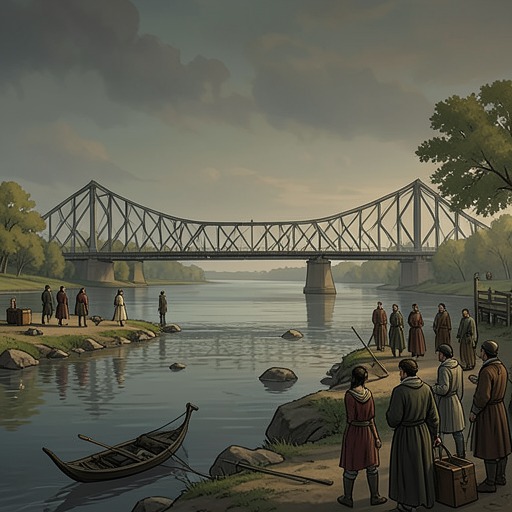
Bridges exist to bring people closer together.
Anxious PeopleBridges exist to bring people closer together is Roger’s defense of bridges after a man jumps from one. The sentence rejects the impulse to make a structure responsible for a person’s death and restores its intended purpose: connection. The novel gives that idea resonance beyond engineering, setting it alongside relationships sustained by memory, loss, and the effort to understand one another.
The remark and its occasion
Anna-Lena recalls that Roger was deeply upset by television coverage that spoke about the bridge as if it were at fault for the man who jumped. Roger was an engineer who built bridges, though not that particular one; his interest in bridges extended beyond his own work. His response, “Bridges exist to bring people closer together,” insists on the difference between what a bridge is for and the tragedy that occurs on it.
The remark does not deny the death or claim that a bridge can prevent it. Instead, it resists assigning blame to an object whose purpose is connection. Anna-Lena makes the point directly: it is not the bridge’s fault if someone jumps from it. The exchange shifts attention away from treating the bridge as a culprit and toward the human meanings attached to it—what people build it to do, and what viewers make it signify after a death.
A structure with competing meanings
For Roger, bridges are not merely engineering achievements. Their practical function carries an emotional meaning: they bring people closer. That conviction makes the televised framing especially painful to him. A structure associated with joining places and people is being reduced to the setting of a death, as though the tragedy could define the bridge’s whole purpose.
Julia finds Roger’s description both odd and romantic. Her reaction shows how readily the image can move from engineering into intimate life. She responds by recalling that she and Ro were in Australia a few years earlier, where Ro wanted to bungee jump from a bridge. The anecdote introduces another meaning for the same structure: not only a route between places, but a site approached through risk. The remark does not resolve these contrasting associations; it holds together a bridge’s intended use and the different experiences people bring to it.
Connection amid grief
Elsewhere, connection persists through the memories of people who have died. Jim’s late wife remains a bond between Jim and Jack, making them more understanding toward each other even in her absence. Jim’s wedding ring, which he toys with, is an old habit and scant comfort; Jack periodically asks whether he should take it off, and Jim says he will but never does. The repeated grammar of remembering—she was, she is—shows how love continues to shape the living even when its object is gone.
Estelle’s memories of Knut offer another, distinct image of closeness maintained after loss. She remembers how he would drop her at the door in the rain so she could wait somewhere warm while he parked, and imagines him just outside parking the car when she sees something he would have found funny. These details do not make grief disappear: after Knut’s death, she wept until she could not breathe, and her body never quite unfurled again. They show instead how an ordinary act and a shared sense of humor can remain present in memory.
The expression’s wider resonance
The bridge remark belongs to a larger pattern in which connection is made through concrete gestures and remembered habits, not abstract sentiment alone. Roger’s account names the purpose of a physical structure; Jim’s ring and Estelle’s recollections show how attachment can endure through objects, routines, and the language used to speak about the dead. The comparison is thematic rather than literal: the bridge does not erase loss, just as memory does not restore the people who are gone.
In this context, Roger’s statement is both an argument about blame and a compact statement of hope. A bridge can be associated with a death without being reduced to that death. Likewise, the people left behind remain connected, though the form of that connection changes. The sentence’s force lies in holding those truths together: tragedy is real, but it does not exhaust what bridges—or human relationships—are for.