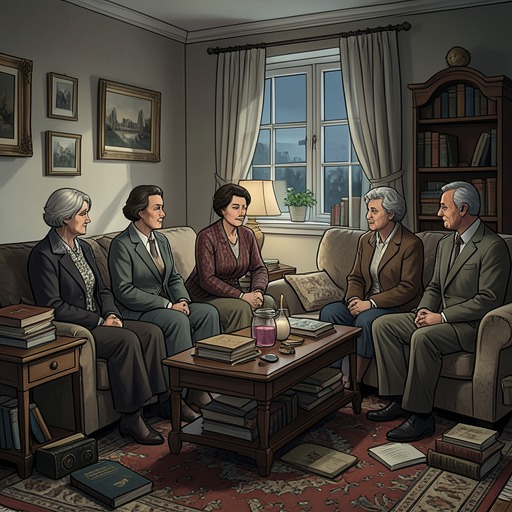
Estelle and Knut’s rules for arguing
Anxious PeopleEstelle and Knut’s rules for arguing turn disagreement into something a marriage must survive without becoming a contest. Their agreement forbids deliberate cruelty and winning for its own sake; its central irony is that Estelle cannot say whether it worked, because she and Knut never reached the stage of love in which they expected to need it.
The Agreement
Estelle tells Julia that she and Knut made their agreement when they first fell in love. Knut anticipated that the first intensity of infatuation would fade and that they would argue whether or not they wanted to. Rather than treating conflict as an exception, they prepared rules for it in advance, comparing their pact to the Geneva Convention, where rules of war are agreed upon.
The rules set two boundaries. However angry they became, neither was to say something consciously meant to wound the other; nor were they to argue merely to win. Estelle explains the reason through the danger built into victory: sooner or later, one partner would win, and she believed no marriage could survive that outcome. The agreement therefore does not promise an end to conflict. It rejects the conversion of conflict into injury or domination.
An Agreement Never Tested
Julia asks whether the arrangement worked. Estelle first answers that she does not know, then clarifies: “We never got past the first flush of infatuation.” Her answer leaves the rules suspended between a serious commitment and an untested plan. They were made in anticipation of a future stage of marriage, but Estelle cannot offer an example of how the couple followed them through a real dispute.
That qualification gives the agreement its poignancy. Its care lies in imagining how to protect a relationship once early infatuation no longer carries it; its limitation is that Estelle and Knut never experienced that later stage. The rules describe the marriage they expected to have, not a proven method for resolving arguments.
The Recurring First Flush
Later, Jim returns to the same idea while discussing a couple who are separating and selling their apartment. He complains that everything is expected to remain like “the first flush of infatuation” and that nothing can be mundane. The phrase connects Estelle’s account of a couple preparing for the end of infatuation with Jim’s criticism of a culture that seems unable to accept ordinary life after it.
The recurrence broadens the rules beyond a private marital pact. Estelle and Knut’s agreement takes the end of infatuation as a reason to prepare for conflict without trying to defeat one another; Jim’s observation presents the demand for perpetual novelty as one way people may fail to live with the mundane. In both instances, the first flush is temporary, but what follows depends on whether ordinary difficulty becomes shared life or a reason to separate.