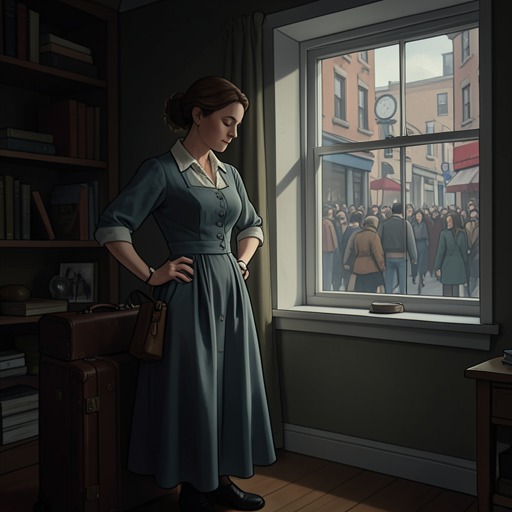
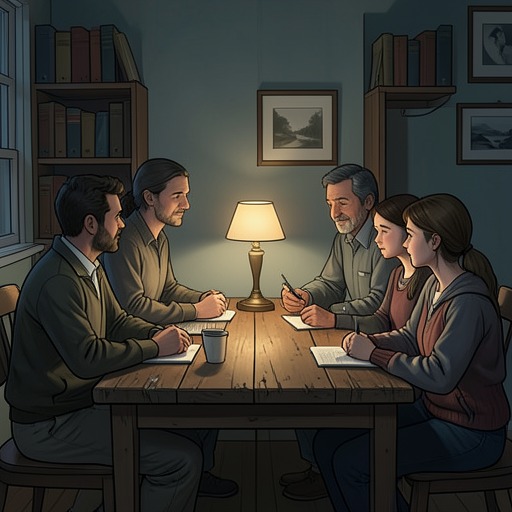
Estelle's apartment
Anxious PeopleEstelle's apartment is the setting of the hostage crisis and the place where the crisis's most consequential question becomes clear: whether a home is merely property to be sold or a place bound to the people who live in it. A viewing turns the apartment into a crowded refuge, but the event also reveals why Estelle arranged the sale in the first place and why she ultimately cannot go through with it. The rooms hold both the practical constraints of the housing market and the relationships that give a home its value.
Setting and Architecture
The apartment occupies the top floor of a building whose original large upper-floor dwelling was divided into two when an elevator was installed. That conversion left unusual features, including a double wall in the living room and an old ventilation duct above a closet. The duct had long been disregarded, though in winter air could pass down from the poorly insulated attic and make the back of the closet cold. A chest of wine stood at the back, where the draft could be noticed.
The neglected space unexpectedly becomes part of the hostage episode. Real estate agent had gone into the closet before the viewing because the bathroom was occupied and she wanted a moment to prepare herself. When the crisis began, she climbed into the ventilation opening to hide. Its narrow dimensions made the opening difficult to use: Lennart became stuck while trying to follow, and the commotion brought Real estate agent back down through the hatch. The sequence turns an architectural leftover into both a hiding place and a source of disorder. The apartment's peculiar layout is not decorative background; it shapes what the people inside can do.
The Viewing and Hostage Crisis
The apartment is being shown to prospective buyers when Bank robber takes the people there hostage. Real estate agent had been concealed in the closet and did not initially know what was happening. Once she reappears, Estelle tries to reassure her: the person holding them is Bank robber, the group has been treated well, and pizza is on the way. Bank robber also apologizes and says the pistol is not real.
As the group grows, Bank robber recognizes that every additional person seems to worsen her position. She offers to surrender and tells the others they can leave first, explaining that she never intended to take hostages. Her immediate need was rent money; she feared her former husband's lawyer would use her lack of a home and job to take her daughters away. She apologizes to the people she has frightened. Rather than treating the apartment only as the scene of a crime, the hostages respond to the distress behind her account and protest when she tries to send them away.
The room's atmosphere changes through ordinary domestic acts. Julia closes the balcony door and begins arranging wood in the fireplace, proposing that they light a fire while they wait for the pizzas. Later, the hearth is burning and Ro eats pizza while making Julia laugh; Roger and Real estate agent argue over the apartment plan, now over the importance of accurate information rather than a purchase. Zara eats a slice beside Lennart. Anna-Lena stands apart with an untouched plate, and Julia checks whether she is all right. The apartment remains marked by the crisis, but its occupants have begun to act less like strangers held together by danger and more like people sharing a room.
Why Estelle Put the Apartment on the Market
Estelle's reason for arranging the viewing is bound up with illness, family, and the strain of living alone. When Knut became ill, she and Knut transferred the apartment to their daughter, thinking she might move in with her children. The daughter had a life and home of her own, however, and the large apartment proved too much for Estelle alone. Her daughter proposed selling it and finding Estelle a smaller place that would be easier to care for.
Estelle did not want to sell without knowing who would buy the apartment. She left before Real estate agent arrived, returned after the viewing had started, and pretended to be a prospective buyer so she could meet the people considering it. To Estelle, the apartment was not simply an asset to hand over to someone passing through for profit. She wanted its next occupants to love living there as she had. The hostage crisis interrupts the commercial purpose of the viewing, but it also brings together people who understand her attachment rather than dismissing it as sentimentality.
The difficulty of finding housing gives this attachment an economic edge. In the town's rental market, someone without work or savings may be unable to rent without a deposit equal to four months' rent, while the bank will not lend to someone who has no money. Bank robber's plea for rent money and fear of losing her children make those barriers immediate. The apartment is at once Estelle's home, an object being sold, and the kind of secure place another person cannot easily obtain. The story's contrast is not between money and emotion in the abstract, but between the requirements of housing transactions and the need for somewhere to live.
Home After the Sale Is Abandoned
Estelle finally tells the people in the apartment that she has changed her mind about selling. She apologizes to Real estate agent for reversing the arrangement and explains that the place is home. Real estate agent accepts the decision as understandable. The viewing therefore ends not with a sale but with Estelle asserting that the apartment's value cannot be measured solely by a transaction.
Estelle does not return to living entirely alone there. She calls her daughter and says not to worry about either the hostage crisis or her living by herself in the large apartment: she will not be alone. A young woman rents the apartment from Estelle's daughter, while Estelle rents a room from her for the same amount, 6,500. The new arrangement changes how the apartment is occupied without making Estelle give it up. She must also stop smoking, because the young tenant will not let her smoke in the closet.
The apartment's later life is described through recurring family routines. A crumpled drawing of a monkey, a frog, and an elk hangs on the refrigerator. Every other week, the children have breakfast with their mother in Estelle's kitchen; for years, they watch the New Year's fireworks together from its window. After Estelle's death, Ro proposes a humorous inscription for her gravestone, Julia keeps Estelle's books and wine bottles, and the children eventually smoke secretly in the closet. These details extend the apartment beyond the day of the hostage crisis: its rooms remain part of the family's habits and memories. The closet that once concealed people becomes, in the next generation's life, a place for a small act of rebellion.