Give children your shoulders to stand on
Anxious PeopleGive children your shoulders to stand on is a metaphor for parental care as both practical provision and emotional support. It describes the work of helping children gain a wider view of the world, reach beyond what they could manage alone, and find support when they stumble. The novel complicates that ideal through parents who cannot control what happens to their children, and through children who eventually carry some of the burden back.
The Metaphor of Parental Support
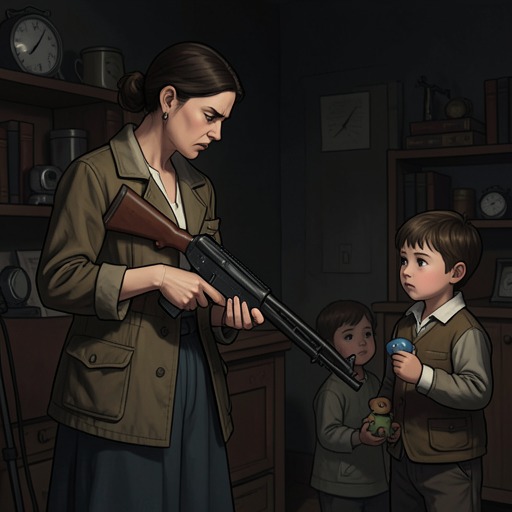
In the man’s account, providing shoulders is a parent’s job. A young child can sit on them to see the world; an older child can stand on them to reach the clouds; and a child who feels unsure can lean against them. The image makes care continuous rather than confined to one act: support changes form as a child grows, but the parent remains a point of reliance.
That responsibility is also frightening. The man says parents pretend to know what they are doing because their children trust them, even though the trust can feel crushing. He recalls the small questions his children asked when they were young, then the embarrassment that came when they grew reluctant to hold his hand. The physical image of a child’s fingertips in a parent’s palm holds a closeness that the passage contrasts with the later fear that a child will measure a parent by everything that went wrong.
Provision and Its Limits
The man tried to provide for his children materially as well as emotionally. He had a good job, established a relatively successful business, and bought an apartment. Hoping his children would have better jobs and better homes, and would not have to live exhausted with a pocket calculator, he invested his savings in shares in a real-estate development company. Experts assured him property values would not fall; they did. His effort to build a secure platform for his children therefore became part of his financial ruin, exposing the gap between a parent’s responsibility to prepare the way and the parent’s power to predict what lies ahead.
The wider account of his parenthood gives that failure a personal edge: parents may do countless things right and still fear being defined by one mistake. The shoulders metaphor does not promise that children will be protected from hardship, or that parental sacrifice will produce the future intended. It names the attempt to help, while leaving room for the fact that neither money nor good intentions can guarantee safety.
Jim and Jack: Care Across Generations
Jim and Jack’s relationship extends the metaphor into a father-and-son bond marked by grief and unfinished conversations. Jim’s wife, who was also Jack’s mother, remains a connection between them after her death. Jack remembers her laughter and the way it made the two men more understanding toward each other; after she died, he held his father as they mourned. He had already promised his mother he would take care of Jim. In this reversal, the child who once depended on a parent’s support becomes a source of support for the parent.
Their different responses to Jack’s older sister show another strain on that family care. Jim hopes she will come home for Christmas and calls her ill; Jack knows she is addicted to heroin. When Jack paid for her treatment at an exclusive clinic, she left after two weeks. Later, after asking him for money for a plane ticket, she did not come home. Jack and Jim nevertheless continue to send money when she promises to return. Their shared hope sustains them, but it also keeps them exposed to repeated disappointment. The account presents parental care not as a simple rescue but as a difficult, recurring effort to remain available when help cannot make another person well.
Support Under Pressure
The father-and-son bond also appears in their work as police officers during the hostage crisis. Neither has handled such a situation before. Jim reminds Jack of his active-listening course and encourages him to use what he learned, while Jack worries that asking Stockholm for help will make the local force look incapable. When a possible bomb makes it dangerous to send Jim into the stairwell with pizzas, Jack searches for another way to assess the situation, proposing to look from a building across the street. The relationship contains both directions of care: Jim offers experience and encouragement, while Jack tries to keep his father from bearing an unnecessary risk.
Their private fears remain harder to voice than their work. Jack dreams that he saved the man who jumped from the bridge; Jim dreams that it was Jack who jumped. Those opposed dreams reveal how each carries the other’s vulnerability even when the two struggle to talk about it. In this sense, the shoulders image is not a promise that parents can prevent every fall. It is an account of care passing between people over time: parents support children as best they can, and children may later steady the parents who once tried to steady them.