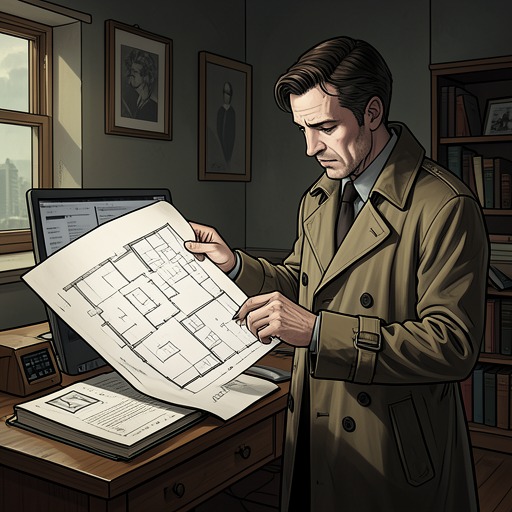
Hostage apartment
Anxious PeopleThe Hostage apartment begins as a property being shown to prospective buyers and becomes the confined center of the novel’s hostage crisis. A chance opening lets the Bank robber flee into it; hours later, the hostages leave, police enter, and the apartment appears inexplicably empty. The space holds the story’s central reversal: a home presented for inspection becomes a scene of danger, then a puzzle about who could have helped the Bank robber disappear.
Setting and function
The apartment is on the top floor of a building, up a stairwell the Bank robber enters while fleeing the street. Its door stands open because the home is for sale and a viewing is in progress. Inside, prospective buyers have taken off their shoes; the many shoes in the hall make clear that this is an ordinary viewing rather than a place prepared for a crisis. A Real estate agent is present with the buyers. The Bank robber stumbles in wearing a ski mask and holding a pistol, having chosen the first open door available after mistakenly believing the police are close behind.
The apartment’s accessibility is what changes the failed bank robbery into a hostage event. The Bank robber had meant to flee, not to enter a viewing, but the people inside see the pistol and understand the situation as a robbery. The Bank robber then struggles to explain that the buyers are not the intended victims, before acknowledging that the situation has become a hostage crisis. The apartment’s original purpose—as a home offered for inspection—does not disappear; instead, the viewing is abruptly transformed into an encounter in which strangers must make sense of a shared danger.
The viewing becomes a hostage crisis
The opening scene is remembered through the contrast between the apartment’s mundane signs of a sale and the weapon at its center. In one account, a woman sees the pistol and cries out that they are being robbed. In a later return to the moment, Zara is the first person in the room to notice the Bank robber and realizes what is about to happen before the others do. Anna-Lena then recognizes the ski-masked figure and calls out. The pause before anyone can respond makes the apartment feel briefly suspended: the people gathered to evaluate a property have to register that they are now trapped together.
The Bank robber’s own account of the entrance is confused and apologetic. The first words are an attempted denial that this is a robbery; the explanation shifts, under pressure, to an admission that it may now be a hostage situation. That uncertainty matters to the room’s character. The Bank robber did not arrive with a plan to take the viewing hostage, yet the people inside cannot treat the pistol as harmless. The apartment becomes the place where an improvised flight acquires consequences for seven prospective buyers and the Real estate agent.
The narrative also places a small, personal object outside the apartment’s immediate drama. As the Bank robber closes the door, a child’s drawing of a monkey, a frog, and an elk falls from a coat pocket into the stairwell. It is a clue to a life beyond the viewing, not just a detail of the escape route. Much later, the novel reveals that the pistol appeared real because it was real, and that there was blood on the apartment’s rug. These disclosures revise the apparent scale of the incident: what began as a chaotic intrusion carried a more serious danger than the Bank robber’s halting explanation suggested.
The empty-room mystery
The crisis lasts for several hours. Police surround the building, reporters arrive, and the story reaches television news. Eventually the Bank robber gives up and all eight hostages—the seven buyers and the Real estate agent—are released together. A police officer stands guard in the stairwell as they emerge. They close the apartment door, walk calmly downstairs, and leave in waiting police cars. The officer remains outside, expecting colleagues to arrive before the police enter.
When officers finally storm the Hostage apartment, it is empty. The balcony door is locked, the windows are closed, and the police find no other exit. The sequence turns the apartment into a physical contradiction: the hostages have all been accounted for, the police have watched the only apparent route out, and yet the Bank robber is nowhere inside. At first the police believe the perpetrator must still be in the apartment. The details of the release suggest another possibility: one of the hostages may have helped the Bank robber escape, unless the Bank robber never left the apartment at all. The room’s ordinary boundaries—door, windows, balcony—become the limits against which the mystery is measured.
Housing and the neighboring apartment
The apartment’s role also sits within the novel’s sustained attention to housing as both shelter and commodity. It is on the market at a time when buying a home is closely tied to loans, security, and financial risk. The novel links the wider financial crisis to people who were encouraged to borrow against supposedly secure investments, only to find that their savings and homes were at risk. For the Bank robber, the practical barriers are immediate: without a job or savings, buying is out of reach, while renting requires a substantial deposit. The viewing therefore takes place in a world where a home can be publicly displayed and priced even as stable housing remains inaccessible to someone in acute need.
Later, the Real estate agent lets slip that the apartment opposite, on the other side of the elevator, is also available. It has a slightly smaller closet than the Hostage apartment, excellent mobile reception, no furniture except a juicer, and a color she considers terrible. Its owners are separating, and the Real estate agent has not yet listed it online because offering two apartments at once could reduce the price of both. The neighboring unit is not the Hostage apartment, but its sale reveals the calculations surrounding the viewing: rooms, reception, closets, timing, and price are all treated as marketable qualities. Against that appraisal, the hostage crisis makes the apartment a place where people are forced to encounter one another as more than prospective buyers. The same property that is meant to be valued and sold becomes a setting for fear, cooperation, and an unresolved escape.