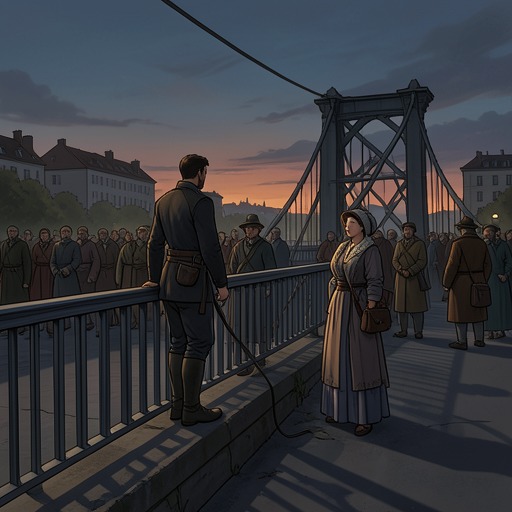
Jack fails to save the man on the bridge
Anxious PeopleJack’s attempt to save the Man on the bridge ends in a failure that shapes the rest of his life: the man pauses, steps back, and tells a teenager about his children, but then jumps. The encounter begins Jack’s resolve to become a police officer and leaves him with recurring nightmares, a persistent sense of responsibility, and an instinct to search for another person who might be at risk. Its later echoes connect the bridge to Nadia, Zara, and the apartment hostage crisis, while the story insists that the desire to help cannot guarantee rescue.
The encounter on The bridge
Ten years before the apartment hostage crisis, Jack is a teenage boy raised to regard helping people as an obligation. His mother is a priest and his father, Jim, a police officer; in this family, stepping in when someone needs help is not an abstract virtue. When Jack sees the Man on the bridge, he runs out and calls to him. Uncertain what to do next, he tries to establish trust through conversation and encourages the man to take small steps away from danger.
The man tells Jack that he has two children. He speaks of the painful way a parent can come to feel defined by a single mistake, however many things they have done well. Jack may not fully understand the man’s account, but he listens as the man describes the responsibility of trying to give children support and security. The man has wanted his children to have easier lives than his own and has tried to provide for them, even as he concealed how little control he had over events.
The family’s financial collapse helps explain the crisis that brought him to the railing. The man had a successful business and had invested his savings in a property-development company, relying on assurances that the investment was safe. He also borrowed against those investments and took out further loans to repay earlier ones. When the market collapsed, his savings disappeared and his debts remained. He had sought another loan to save his business and home, explaining to the bank that he had two children, but the bank refused. The financial failure was not simply a lost investment: it overturned the security he had believed he was building for his family.
After the call from his lawyer, the man drives his children to school as if nothing has changed, tells them he loves them, and then drives toward the water. He leaves his car and its keys and climbs onto the railing. By the time Jack reaches him, the man has already turned the circumstances of his life into a story he can tell a stranger. His account gives Jack reason to hope that the man will step away, and the man does take half a step back. For Jack, whose hands are shaking as he looks over the side, that small movement briefly feels immense. It is not enough: after telling Jack about his children and his losses, the Man on the bridge jumps.
The failed rescue and its immediate meaning
The sequence turns on a devastating reversal. Jack has managed to stop the man momentarily and to draw him into conversation, but the pause does not become a rescue. The story does not present Jack as having failed to find the right technique; he is a frightened teenager confronting a situation he cannot control. His effort matters, but it cannot determine the other person’s final action.
The man’s explanation about parenthood gives the scene a particular weight. He fears that his children will remember him through his failures, even as he has tried to give them protection and possibility. His decision to speak about how much he loves them can make Jack believe that the danger has passed. The jump immediately overturns that belief. In retrospect, the scene distinguishes understanding someone’s pain from being able to prevent what happens next, and care from control.
What Jack carries away
The encounter does not end for Jack when he leaves The bridge. Ten years later, he still has nightmares of the wind at his jacket, the sound of the man’s shoes on the railing, and his own scream. The memory remains bodily and immediate rather than settling into a completed episode in the past. Jack’s mother observes that part of him may never have returned from The bridge, still trying to save the man. Jack does not test that interpretation; he continues to live with the dreams and with the unresolved shock.
His later life as a police officer gives the experience an outward consequence. Jack has worked hard at the station, though his efforts win praise from everyone but Jim, and he finds it difficult to stop working. The story links this work to the earlier realization that he could make a difference, without suggesting that the profession has cured his grief. When the hostages are released and a pistol shot sounds in the apartment, Jack is the first officer inside. He rushes through the living room and opens the balcony door, fearing that someone has jumped. The bank robber has disappeared; no one is below. Jack is left alone on the balcony, looking toward The bridge, then standing at the police station unable to wipe the blood from his shoes.
Echoes, relationships, and legacy
Jack’s family gives the failed rescue a continuing moral context. Years earlier, his mother had answered his question about how she could sit with dying people she could not save by explaining that help comes one bit at a time: people do what they can when they have the chance, then try to live with what remains beyond their power. Jack cannot save his sister, either, and the family’s repeated attempts to help her do not make her recovery something they can command. His mother’s counsel does not erase the losses; it offers a way to continue acting without pretending that every effort succeeds.
The bridge also becomes the site of another rescue, one Jack does not witness again. The week after the Man on the bridge’s death, Zara sees Nadia climb onto the same railing and sees a boy pull her down. Zara finds Nadia’s wallet and learns her name, then watches Nadia’s life from a distance for years. Nadia later becomes a psychologist, in part because she has tried to understand the difference between herself and the man who died. Jack never meets her again after the first rescue, and he does not return to The bridge.
The man’s death also leaves a letter that Zara carries for ten years. When she finally brings the envelope to Nadia, she struggles to explain that she came to the psychologist because of the letter and because she fears what learning the truth might do to her. Nadia opens it and finds a four-word handwritten message. The letter’s eventual arrival connects the man’s last encounter with Jack to Zara’s guilt and Nadia’s survival, without changing the fact that Jack could not save him. Across these linked events, the failed rescue remains neither a simple lesson in successful intervention nor proof that trying is pointless: it is the source of Jack’s vocation and pain, and one strand in a story about lives that touch briefly and continue to affect one another.