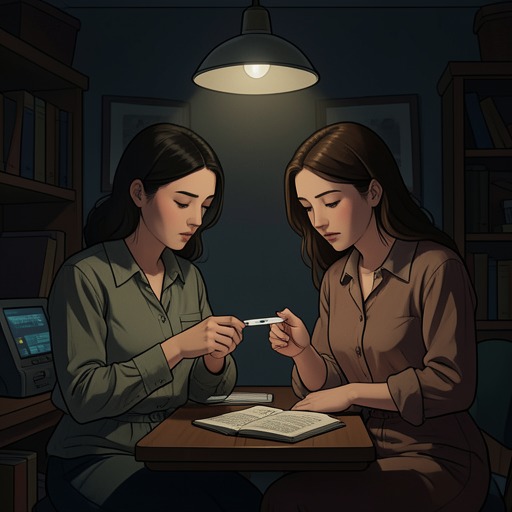
Julia and Ro buy the neighboring apartment
Anxious PeopleJulia and Ro buy the neighboring apartment after all—not the apartment everyone had assumed they might buy, but the one beside Estelle’s. The choice gives a practical transaction an intimate consequence: Estelle will have Julia next door, and the two women make a plan to meet and exchange books in the elevator. The purchase is presented not only as a decision about property, but as the opening of a relationship and a future home.
The Choice of Apartment
The decision emerges at the end of a gathering on the steps. Julia hugs everyone, receiving each embrace in return. When she reaches Estelle, the young woman and the much older one hold each other’s gaze for a long moment. Estelle offers Julia a book by her favorite poet, a small gesture that gives their connection a personal shape before either woman has explained what it might become.
Julia answers with a possibility rather than a promise: perhaps they could meet now and then and exchange books in the elevator. Estelle asks what she means. Julia turns to the Real estate agent and asks her to sort out the paperwork. The order matters. A tentative invitation becomes an actual arrangement through the apartment purchase; the future visits will not depend on an accidental encounter, because Julia and Ro have chosen to live just across the landing from Estelle.
A Reversal at the Closing
Roger asks whether Julia and Ro bought the apartment after all and whether they got a good price. Julia shakes her head: they did not buy that apartment; they bought the other one. The answer overturns the assumption embedded in Roger’s question. The important point is not a bargain or a favorable price, but which home the couple chose. The purchase redirects the ending from a conventional transaction toward the particular connection it makes possible.
The Real estate agent nods so enthusiastically that she begins to jump. Roger grins, and then laughs aloud. His laughter has been absent for a while; its return makes Anna-Lena so happy that she has to sit down on the steps, in the middle of winter. The decision therefore changes the mood of the gathering as well as the neighbors’ future arrangements. News of the purchase passes through the group as a chain of visible reactions: the agent’s exuberance, Roger’s laughter, and Anna-Lena’s bodily response to his happiness.
Neighbors, Books, and the New Home
The closing passage confirms that Julia and Ro will live in the apartment on the other side of the landing from Estelle. Estelle takes several deep, happy breaths at the thought of becoming Julia’s neighbor. Their proposed book exchange now has a place and a repeated occasion: they can meet in the elevator. Estelle plans to give Julia a book by her favorite poet, marking a page by folding its corner and underlining words she treasures. Julia, in turn, will give Estelle a very different kind of book: a guidebook about Stockholm. The exchange joins private literary affection to practical knowledge of the city, without requiring the two women to share the same tastes.
This future is set against the idea that apartments are merely units to be bought and sold. The purchase matters because it establishes proximity and makes ordinary contact possible. The elevator, the landing, and the borrowed books are modest details, but they give neighborliness a form that can recur. The home is not described only through its price or paperwork; its significance lies in who will be close enough to knock, talk, or pass a book from hand to hand.
The Future the Purchase Makes Possible
The narrative extends beyond the immediate decision to sketch the family life Julia and Ro will build there. Ro will lose her father and visit him every week; her mother will find the strength to cope with that loss after another man shows her that life goes on. Julia will give birth to a child while gripping Ro’s fingers so tightly that the nurses have to give both mothers painkillers, one before the birth and the other afterward. These details make the apartment purchase part of a larger prospect of shared life, including grief, care, and parenthood.
The imagined future is not effortless or untouched by loss. Ro will sleep beside the child without fear, and the narration presents Julia and Ro as parents who will be good enough. That qualification keeps the ending grounded in human limits rather than perfection. The neighboring apartment is not a guarantee against hardship; it is the setting in which the couple’s life together, and Estelle’s new companionship with Julia, can unfold. What begins as a surprising answer about which apartment they bought becomes a concrete choice for closeness: a home beside someone who has already offered a book, and a future in which the two women can keep meeting in the elevator.