The bank robber’s escape
Anxious PeopleThe bank robber’s escape is the turning point at which Jim abandons the ordinary logic of arrest and uses his knowledge of police procedure to help her disappear. Rather than pursue her through the neighboring apartment, he makes the hostages’ safe release and her chance to get away parts of the same plan. The escape leaves Jack to face the public consequences of a police failure his father helped create.
Causes and Stakes
By the time Jim speaks to the bank robber, she has admitted that fear of conflict shaped her choices. She had hoped to keep trouble from her husband and daughters by sorting out her problems alone; instead, her attempt to prevent chaos has brought a bank holdup and a hostage crisis. She calls herself an idiot, accepts blame, and promises to release everyone. She also says the pistol is not real, although Jim knows it is. Her confession does not erase the danger or the likely punishment she faces if arrested.
Jim understands that the legal consequences are real. He has already told her that releasing the hostages will not spare her prison, and that carrying a firearm and robbing a bank cannot simply go unpunished. Yet he cannot look at her only as a criminal: her situation calls his daughter to mind. He decides that the way to prevent her punishment is not to catch her. His choice is not a formal change in police policy; it is a personal decision to let this particular suspect escape.
The scene also sits against the bank robber’s long experience of being asked to bear responsibility for circumstances shaped by others. As a child, she gave her mother the money she had earned selling Christmas magazines to buy food, only to hear her mother say that losing it was not her fault and that the child should not have given it to her. The memory helps frame the robber’s own repeated attempts to explain, excuse, or contain consequences. In the hostage apartment, however, she stops at least briefly at an explicit admission of fault, even as Jim responds by offering a way out.
Jim’s Escape Plan
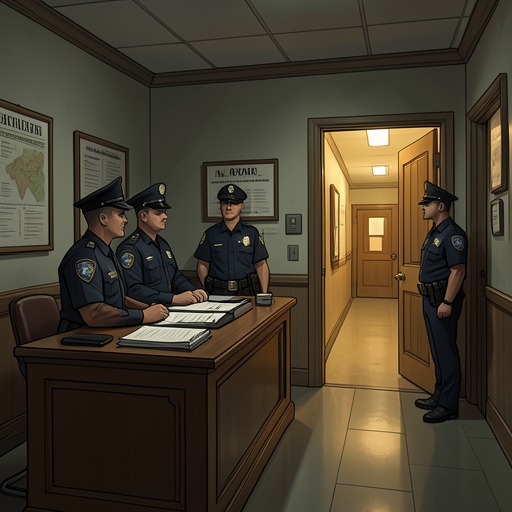
Jim proposes that the bank robber hide in The neighboring apartment. The Real estate agent may have its keys, he explains, and the police are unlikely to break into every apartment while concentrating on getting the hostages out. If the robber tells the hostages to close the door behind them, officers will assume she remains inside the Hostage apartment. When police discover she is gone, they will first have to take the witnesses to the Local police station and collect their statements. Only later would they have reason to search elsewhere. Jim even points out that, because officers have assumed the robber is a man, she could claim to live in the other apartment if someone found her there.
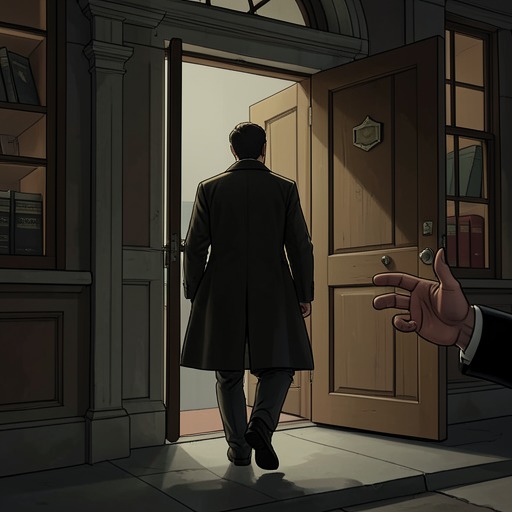
The plan depends on the priority of the rescue, the limits of the search, and the police force’s own procedural habits. Jim explains the bureaucracy plainly: officers cannot start smashing in the doors of every apartment without causing trouble. His advice turns those constraints into cover. The robber initially struggles to understand why he would help her, but she has the key. Once the hostages are safely on their way out, she shows it to Jim and leaves through the door. He tells her to hurry; when she hesitates, he pushes her toward the elevator and wishes her luck.
The Disappearance
Inside The neighboring apartment, the bank robber locks the door. Jim remains alone in the stairwell, with a moment to think of his late wife and hope she would be proud of him—or at least not too angry. The escape is therefore also an act of disloyalty to the role he is supposed to perform: he has knowingly helped a suspect evade the police, and he knows his son and colleagues may have to answer for what follows.
The evidence left behind makes the disappearance look like a conventional search problem. The bank robber wipes the pistol before leaving it beside the special phone on the small three-legged table. She burns the ski mask, after Roger warns that police could recover DNA or other evidence from it. The telephone, which Ro had found in a pizza box and then forgotten while eating, remains behind. When the hostages are gone, Jim has been left with a scene that still points toward a robber who ought to be in the Hostage apartment. He and the bank robber exchange a quick glance in the landing; she shows him the key, and he lets her go.
Aftermath and Significance
At the Local police station, Jim tells Jack the truth. Jack has little time to be angry: after arranging for the witnesses to leave through the back, he goes to the front entrance and tells reporters that he was responsible for the police response and that the perpetrator has been lost. He accepts the blame publicly, leaving his father inside, distressed and alone. Jim has chosen to protect the bank robber; Jack’s next choice protects Jim, though it makes Jack the face of the failure.
The investigators from Stockholm arrive early the next morning, on New Year’s Eve. They review statements and evidence and say they lack the resources to do more. Since nobody was hurt and nothing was stolen, they argue that there are no real victims and that their attention is needed elsewhere. Their dismissal does not undo the escape or resolve the question of responsibility. Instead, it exposes the gap between the official measure of harm and the personal choices made during the crisis: Jim knowingly bends his duty, while Jack absorbs the public cost rather than expose him.
The escape is thus neither a clean victory nor a straightforward act of justice. The hostages get out safely, but the bank robber remains beyond the police’s reach, and the father and son carry different parts of the resulting failure. Jim’s plan turns the police response itself into a hiding place; Jack’s confession to the press turns its consequences into a burden he will bear alone.