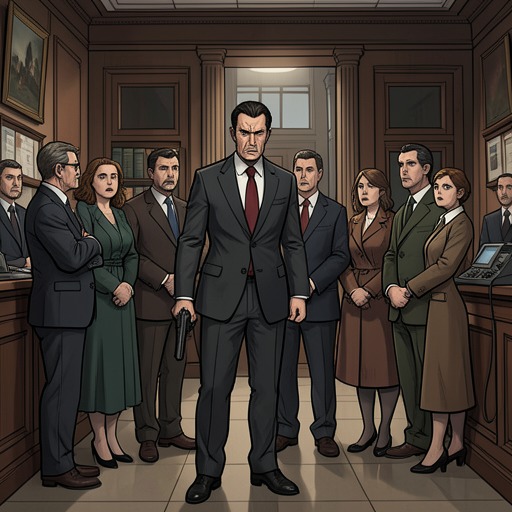
The bank robber’s pistol
Anxious PeopleThe bank robber’s pistol is the object on which the apartment hostage crisis turns: it looks so much like a toy that the Real estate agent assumes it is one, yet it is a real firearm. That gap between appearance and fact shapes the Bank robber’s attempted robbery, the hostages’ understanding of their danger, and the delayed revelation of what happened after their release.
From discarded object to desperate resource
The pistol enters the Bank robber’s story not as a weapon she acquires for a planned crime, but as an object found beneath borrowed blankets in a neighbor’s unlocked storeroom. After her marriage ends, she has no home, job, or savings, and fears losing custody of her daughters. Unable to afford an apartment or meet the requirements for renting one, she sleeps in the basement storeroom. She takes the blankets to keep warm and finds the pistol underneath them.
At first, she keeps it as a way to frighten off a possible burglar. The thought changes when she realizes that, with nowhere secure to sleep, she is herself the person who might be treated as an intruder. She returns the blankets but keeps the pistol, carrying it through a week in which she does not know where she will spend the next night. Its imagined usefulness as protection thus turns into an uneasy reminder of her own precariousness.
When rent is due and a lawyer’s letter threatens her efforts to remain with her daughters, she makes the pistol part of an improvised plan. She cuts holes in a black woolly hat and enters a bank intending to obtain 6,500 kronor, the amount she needs for rent. She tells herself she will return the money once she is paid, though she has no workable means of doing so. The pistol’s presence makes her attempt a bank robbery, even as her immediate aim is to buy enough time to find work and keep her family’s situation from worsening.
The robbery and the apartment viewing
The same pistol accompanies the Bank robber when she later enters an apartment viewing and takes the people there hostage. Her history makes the object part of a chain of events shaped by housing insecurity: the inability to secure a home contributes to her desperation, while the pistol turns that desperation into an armed crime. The story’s contrast is not between a carefully prepared criminal and an ordinary person untouched by danger, but between an impulsive plan and consequences she cannot control.
At the viewing, the Real estate agent believes the pistol is a toy. When police ask whether the Bank robber appeared nervous or experienced with firearms, the agent answers that the pistol was not real and insists that it looked obviously fake. The answer frustrates the officers’ attempt to assess the danger and reveals how completely the object’s appearance has misled her. The agent is not joking; the policeman recognizes that she genuinely believes what she is saying.
That misunderstanding also distinguishes what the hostages think they have endured from what the police know. Jim understands that the pistol is real, and warns that the Bank robber would face punishment even if it were not. The threat is therefore not simply the idea of a firearm: the object has legal and physical force that its toy-like appearance does not cancel. Its status remains hidden from the Real estate agent, however, until after the immediate crisis has passed.
The delayed revelation
After the Bank robber releases the hostages, they are taken away while police gather in the stairwell. A special negotiator calls the apartment, but the Bank robber does not answer; a single pistol shot follows. By the time officers break into the apartment, it is too late. The hostages, already separated from the scene, do not know what occurred between their release and the police entry.
The pistol’s reality is finally made explicit when the Real estate agent is interviewed at the station. She repeats that it was a toy, only for an older officer to interrupt the younger policeman and tell her that the Bank robber shot herself. The agent’s earlier confidence collapses into shock as she understands that the object she dismissed as harmless was real. What had seemed to her a small discrepancy about an imitation weapon becomes the missing fact that changes the meaning of the hostage incident and its aftermath.
Significance
The pistol’s changing meaning is central to its force as an object. In the basement, it is treated as a possible defense against an imagined burglar; in the Bank robber’s desperate plan, it is a means of demanding money; at the apartment, it is mistaken for a prop; and after the hostages’ release, it is tied to the fatal shot. The object does not change, but each person’s knowledge of it does. Its ordinary, toy-like appearance keeps its actual capacity out of view until the consequences are irreversible.
That reversal also makes the pistol a material measure of the distance between intention and outcome. The Bank robber begins with the hope of obtaining one month’s rent and keeping a chance to resolve her family’s crisis. The agent sees no real weapon, while the police understand that the pistol makes the situation more dangerous and the attempted robbery a serious crime. By the time its true nature reaches the agent, the hostages are safe but the crisis has ended in death. The pistol binds private desperation, public misjudgment, and irreversible consequence into a single object.