The financial crisis
Anxious PeopleThe financial crisis is presented not as an abstract market downturn but as a rupture that carries its costs into people’s homes, work, and family lives. It exposes the danger of treating investments and property as secure assets, while the banks and markets implicated in the collapse remain standing. Its consequences recur in the story years later, where insecure housing and restricted access to credit help shape the Bank robber’s desperation.
Borrowing against security
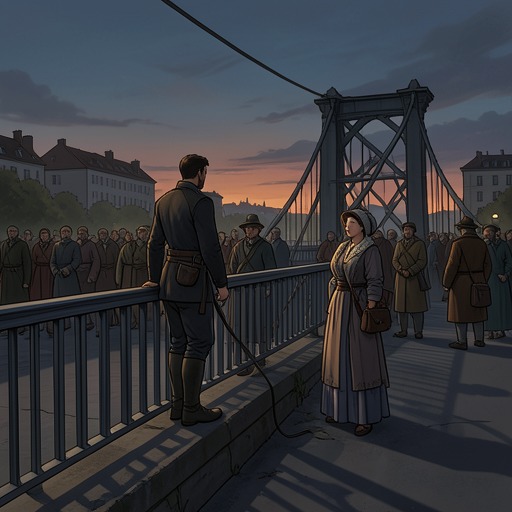
The man on the bridge had placed his savings in a bank for what he understood to be secure investments. He then used those investments as security for loans and took out further loans to repay earlier ones, trusting the bank’s assurance that this was ordinary practice. When the financial markets crashed, the investments ceased to be secure: his savings were gone, while the debts remained. The story describes the event as a crisis for the markets and a crash for the banks, then turns that language around: institutions survive, but individuals are the ones whose lives collapse.
The man seeks another loan to keep his business and home, explaining that he has two children. A bank employee calls his predicament moral hazard, defining it as a situation in which one party is protected from the negative consequences of its own actions. The bank refuses the loan. In the episode’s image of two people on a creaking branch, the bank holds the saw while the customer bears the danger: the institution has not lost its own money, but the man has entrusted it with his. The financial crisis thus appears not only as a collapse in value but as an unequal distribution of responsibility and risk.
Property, credit, and the meaning of home
The novel connects the crisis to housing as both a place to live and an asset within a borrowing system. Zara links a property-market crash a decade earlier to the man’s death from the bridge, and argues that innocent people lost their jobs while those responsible received bonuses. In her account, an economy built by people has become too powerful for them to control, in part because it accommodates greed and depends on borrowing.
The story also describes a divide between people who can borrow and those who cannot. People may earn very different amounts yet still worry about money at the end of the month, comparing themselves with neighbors and financing more expensive versions of what they already own through debt. A character wonders whether the cycle of trying to recover losses helps explain crashes in the stock and housing markets. The financial crisis is therefore associated with a wider pattern in which borrowing can extend apparent security while increasing exposure to loss.
That contradiction becomes concrete in the housing market. After the Bank robber’s marriage ends, the apartment remains in the other parent’s name, and she does not contest the arrangement because she wants to avoid a fight in front of her daughters. With no home, job, or savings, buying an apartment is out of reach; renting requires four months’ rent as a deposit. Even a small sublet near the apartment where her daughters live costs 6,500 a month. The market’s requirements make housing hardest to secure precisely when she most needs it.
Consequences that persist
The Bank robber’s later crisis is not presented as the same event as the man’s loss, nor are the two people connected. The novel explicitly distinguishes their lives while placing them within the same moral pattern: financial systems can protect institutions from consequences that individuals must bear. The man’s savings disappear in the earlier collapse; years afterward, the Bank robber faces the loss of a home and the possibility of losing custody of her daughters amid job and money insecurity.
After finding work, the Bank robber learns that her first month’s wages will be withheld until she has worked two months. The job is not permanent, so a bank will not lend her the money needed to live through that unpaid month. With rent due and a lawyer’s letter threatening her relationship with her children, she decides to seek 6,500 kronor from a bank. The crisis does not by itself explain or excuse the attempted robbery; rather, the narrative shows how debt, rental barriers, delayed wages, and limited access to credit narrow the choices she can see.
A continuing measure of risk
The financial crisis remains a reference point in the story’s arguments about what counts as security. A bank can describe investments as safe, then place responsibility on the person who trusted that description; a housing market can treat apartments as assets while people struggle to obtain a place to live. Against those institutional measures, the consequences are personal and specific: lost savings, threatened livelihoods, insecure shelter, and family plans put at risk.
The contrast between the man on the bridge and the Bank robber gives the crisis its longer reach. Their circumstances are different, and the novel says they never met, but both encounters expose the gap between financial language and lived vulnerability. The market’s losses are spoken of as a crash; the people left to carry those losses must find somewhere to live and a way to continue.