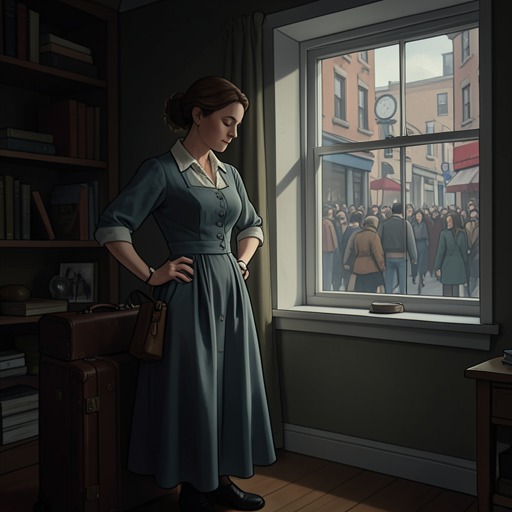
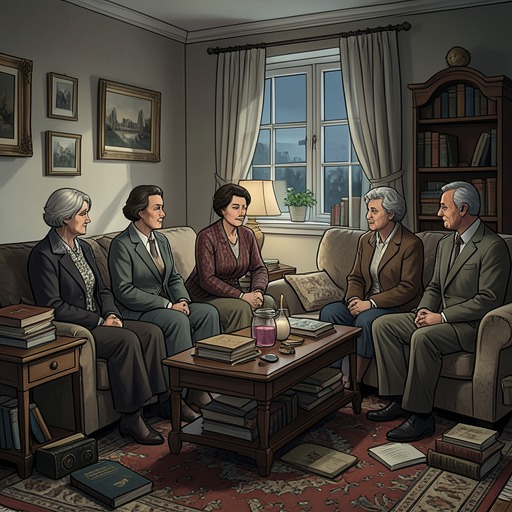
The hardest thing about death is the grammar.
Anxious PeopleThe hardest thing about death is the grammar is the expression through which Jim’s grief becomes a problem of tense: his wife is gone, but the habits and memories that make her vivid remain present. The phrase gives bereavement a precise linguistic shape. It is not simply that Jim misses her; it is that every sentence about her requires him to say what no part of his daily life has made feel settled—that she was, and is no longer.
Meaning and tense
Jim’s reflection begins in the immediate strain of a conversation. He has just admitted to the Real estate agent that he knows something, while Jack paces in the corridor, striking the walls with his fists and insisting that the Real estate agent must be responsible. Jim toys with his wedding ring, an old habit that offers little comfort. The ring remains on his hand although his wife has been dead for years: Jack reminds him about it roughly every six months, and Jim promises to take it off, then never does. The object makes the gap between knowledge and acceptance visible. Jim knows the fact of the death, but the gesture of a married man’s hand has not caught up with it.
The expression names that disjunction through grammar. Jim imagines his wife’s response to his buying a new sofa without consulting her. She will not be angry when she sees it; she will not see it at all. She is not on her way home. She was. The shift is brutally small on the page and immense in consequence: a present-tense expectation becomes a past-tense memory. The sofa is especially painful because the imagined argument depends on an ordinary future that can no longer happen. The grammar is hard not because the rules are obscure, but because following them means acknowledging the finality they encode.
A person held in remembered habits
Jim’s wife returns in sharply particular recollections, not as an abstract emblem of loss. She could travel halfway around the world to places of extreme disorder, yet expected home to remain exactly as it was. She put onion flakes on breakfast cereal and béarnaise sauce on popcorn. If Jim yawned beside her, she would put a finger in his mouth to see whether she could pull it out before he closed it. She hid cornflakes in Jim’s shoes and pieces of boiled egg and anchovies in Jack’s pockets, enjoying their reactions more each time.
These memories explain why tense cannot be a neutral matter for Jim. Her quirks are funny because they belonged to a living relationship, full of repeated provocations, arguments, and recognisable pleasures. Remembering them does not make the loss gentler: it sharpens the contrast between the person who used to do these things and the person who cannot return to do them again. The thought moves between “She was” and “she is,” language briefly preserving both the continuing force of memory and the fact that she is dead. Jim’s grief lies in being unable to make those two truths sit comfortably together.
Language, irony, and misunderstanding
Elsewhere, Jack’s interviews repeatedly show how words can fail or require explanation. London insists that Jack record her ironic finger gestures with “perverted commas,” so readers of his notes will not mistake irony for stupidity; Jack corrects her with “inverted commas.” The exchange is comic, but it also makes the reader’s interpretation depend on whether a tone survives its transcription. Zara, asked how many prospective buyers were in the apartment, first challenges the category itself by asking Jack to define prospective buyers. In another interview, Jack insists on speaking to two witnesses separately because that is how it has to be, then gets tangled in a question about how long they were in a closet and when they came out of it.
These moments do not equate everyday verbal confusion with bereavement. Rather, they establish a book in which meaning is often tested through the exact wording of questions, answers, corrections, and records. Against those comic failures of communication, Jim’s phrase identifies a failure no clarification can fix: the correct tense remains painful even when it is understood. His wife’s eccentric habits can be told clearly, but no wording can turn them back into present action.
Grief and the impulse to help
Jim’s difficulty with the past tense also shapes what he wants for Jack. He longs for his son to solve the crisis and save everyone, although he can see that this is not working. The wish does not undo his own loss; it reveals how urgently he wants Jack to succeed at preserving other people from catastrophe. When Jim later acknowledges Jack’s apology, he says, “Now your turn.” The bank robber asks what he means, and Jim invites her to tell the story of how she ended up there.
That invitation gives the expression a quiet consequence. Jim cannot change the tense in which he must speak of his wife, but he can turn toward a living person and make room for her account. The movement is not a cure for grief or a denial of death. It is a small act of attention made possible alongside grief: the dead remain in memory, while someone still present is asked to speak.