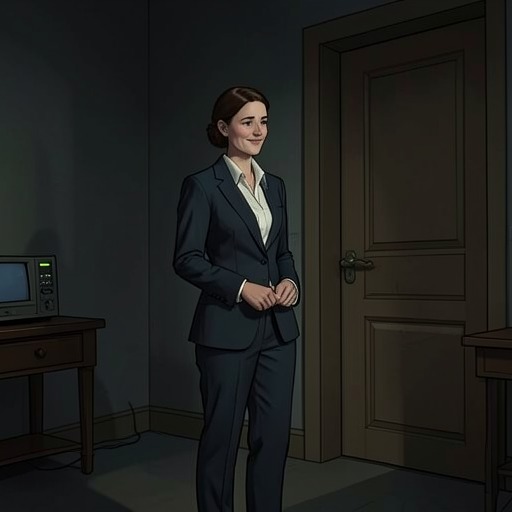
Zara stops the robber from killing herself
Anxious PeopleZara stops the Bank robber from killing herself during the apartment hostage crisis by approaching her in the hall and lowering the pistol without tearing it from her grasp. The intervention is small in gesture but decisive in its immediate consequence: the Bank robber does not pull the trigger, and the two women share a moment that neither had expected. Zara’s response grows out of her own long history of witnessing, guilt, and efforts to understand how people endure pain.
The crisis in the hall
The Bank robber sits apart from the hostages, hearing their voices but feeling separated from them and from the person she had been earlier that day. She imagines what awaits once the others leave the apartment: they will be victims, while she will be a criminal facing arrest and years in prison. She fears she will grow old in a cell and never see her daughters learn to swim. In this narrowed view of the future, the girls are not simply absent; she imagines that they may have to lie about their mother rather than tell others what she has done.
She removes her mask, recognizing that it can no longer hide her from the police. Holding the pistol, she gradually tightens her grip until her finger reaches for the trigger. Her question to herself is whether she would have shot herself if the pistol were real. Before she can finish considering it, someone’s fingers close around hers. The person does not wrench the weapon away, but guides it down. It is Zara, standing beside her without an expression of sympathy or alarm and keeping her hand on the pistol.
Zara’s history of witnessing
The encounter draws force from what Zara has carried for ten years. She witnessed a girl climb onto the bridge railing and a boy rescue her; she remained hidden and still while the ambulance took the girl to hospital. Afterward, Zara found the girl’s wallet and identification, learning that she was Nadia. The boy disappeared. Zara did not approach either of them, but the scene stayed with her as a source of fear and unresolved responsibility.
Zara subsequently followed Nadia’s life and education from a distance, without daring to make contact. She also kept returning to apartment viewings with balconies from which she could see the bridge. The dead man’s letter remained in her handbag, still unopened. These habits were not merely a hobby: they organized years of avoidance around the bridge, the girl who had been rescued, and the question of what separates one person’s fate from another’s. In the apartment hall, the sight of the Bank robber alone with the pistol breaks through Zara’s practiced effort to keep thoughts at bay.
The intervention
Zara recalls a discussion with Nadia about anxiety and the impulse to answer chaos with further disorder. The insight gives her no elaborate plan and does not make the crisis safe; it helps her recognize the danger of allowing the Bank robber’s desperation to continue unchecked. Zara puts a hand around the pistol and tells her, in effect, not to do anything foolish. The appeal is brief rather than a speech or a negotiated promise. Its force lies in the fact that Zara remains physically present, holding the weapon down without taking it away by force.
The Bank robber looks at Zara with an emptied, distant expression, but does not act on the suicidal impulse. She manages a weak smile, an unexpected response for both women. Zara then turns and walks quickly back to the balcony, frightened by the encounter, puts on her headphones, and closes her eyes. The episode does not resolve the larger hostage crisis or erase the consequences the Bank robber faces; it interrupts one immediate danger within it.
Significance and aftermath
The scene makes Zara’s private history consequential in the present. For years, she has watched Nadia from a distance while fearing that approaching the bridge or learning the truth about herself might bring her closer to a similar crisis. Here, rather than remaining a hidden observer, she reaches toward a person at the point of danger. Her action is not presented as a cure for the Bank robber’s distress or as proof that Zara has settled her own guilt. It is a limited intervention, grounded in attention and restraint, that keeps the moment from becoming irreversible.
The encounter also echoes a principle Nadia has expressed about kindness: people may be difficult, but their burdens are often unseen. Zara does not need to approve of the Bank robber’s actions to recognize the person in front of her. The pistol remains in the Bank robber’s hand, and the future she fears has not vanished; nevertheless, the weak smile marks a change from isolation to a brief acknowledgment between two strangers. Zara’s response gives concrete shape to the idea that help may begin with one small act, even when no one can promise what will follow.