Detroit
Are We Having Fun YetDetroit becomes, for Kay Willis, an unexpected threshold between professional independence and family attachment. On October 31, 1984, the city receives her not through the familiar routines of Rutherford, New Jersey, but through the Hotel Pontchartrain, where an extravagant room, a view across the water toward Canada, and a day devoted entirely to public work make travel feel briefly like a personal liberation.
Setting and First Impressions
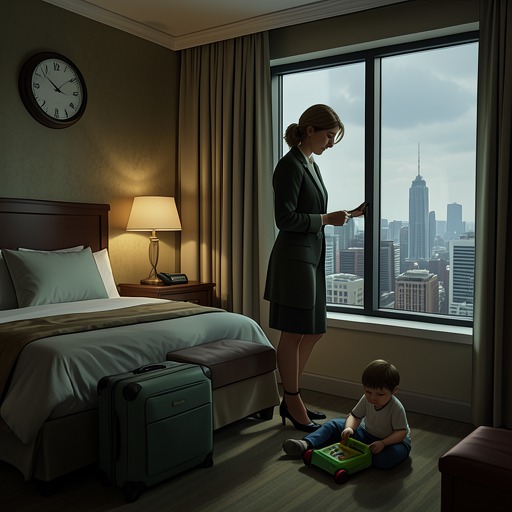
Kay Willis had never heard of the Hotel Pontchartrain before arriving in Detroit, where she was escorted to a room designed in pale aqua shades and described as prettier than she had expected. Its expansive view overlooked Canada on the opposite shore, and a bellhop suggested leaving the draperies open so that the lights could be enjoyed while she slept. The room’s scale and furnishings emphasized how far it stood from the ordinary economy of family travel: it contained a king-size bed, an armoire concealing the television, two wing chairs, a sofa, a coffee table, a desk, and three telephones, including one in the bathroom.
The abundance is sharpened by comparison. The last motel Kay Willis had shared with her husband had been a Motel 6 visited on the way to Notre Dame, an economical stop with a phone booth outside the door. In Detroit, by contrast, the room seemed so spacious and improbable that she was tempted to telephone home and ask several relatives to come and share the pleasure. She could not recall ever having stayed alone in a hotel room; most of her previous travel had consisted of frequent trips to Florida to visit her aging parents.
The Professional Tour
Detroit is also the site of Kay Willis’s new public role. After unpacking, she went to the dining room to meet Phil, the young publicist traveling with her during her new career as a spokesperson. The tour was for Fisher-Price Toys, and the work centered on the value of play and toys. Detroit therefore represents more than a stop on an itinerary: it is one of the first places where her experience and convictions are treated as professional knowledge beyond the household.
The rewards of the assignment were both public and intensely practical. Kay Willis was paid to travel and to be interviewed for television, radio, and newspapers. On that day she appeared on two television broadcasts and a radio show, while lunch was spent with a newspaper columnist who appreciated what she had to say. The city’s hospitality extended into the dining room, where she could order whatever she wanted without cooking, washing dishes, or cleaning up, and could eat an entire sumptuous dinner without having to cut anyone’s meat.
A young woman playing the harp completed the scene’s almost unreal atmosphere. Entering the dining room and noticing the harpist, Kay Willis felt as though she had died and gone to heaven. Detroit thus gathers luxury, recognition, leisure, and service into a temporary world in which the obligations that ordinarily define her domestic identity are suspended.
Halloween and the Return of Home
The city’s promise of escape does not erase home; it makes home newly visible. In the elevator on the way back to her room, Kay Willis felt the first pangs of homesickness. It was the first Halloween since her marriage that she had not been home in Rutherford, and Halloween had always been one of her favorite celebrations. The date that made the hotel experience feel magical also made her absence from family life unmistakable.
Her thoughts turned especially to her first grandchild, Jamie, who was six years old at the time. Kay Willis hated missing his excited reports about trick-or-treating. The emotional movement is not a simple rejection of Detroit’s pleasures. She had genuinely enjoyed the paid travel, the interviews, the elegant room, the harp, and the freedom from household work. Yet the very completeness of the temporary escape exposed what the escape could not replace: participation in a family ritual and the intimate knowledge of a child’s excitement.
The Hotel Door and the City’s Irony
Back in her room, Kay Willis encountered a small comic reversal. A maid knocked and presented her with a miniature shopping bag bearing the hotel’s seal, then asked whether she would like a mint. Because it was Halloween and because the surroundings seemed so sophisticated, Kay Willis impulsively exclaimed, “I can’t believe a hotel this sophisticated is handing out Halloween candy. How nice!” The maid hesitated, then laughed and admitted, “For a minute I thought you were serious.”
The exchange gives Detroit a distinctive narrative significance. The hotel’s polished luxury briefly permits Kay Willis to imagine that even its smallest courtesy might be a Halloween treat, but the joke also exposes the distance between institutional service and family celebration. A mint in a sealed hotel bag cannot stand in for trick-or-treating, Jamie’s reports, or the crowded domestic life she has left behind. Detroit remains memorable precisely because it offers both sides of the contrast: a heavenly professional freedom and the homesickness that follows when freedom is measured against belonging.