Family dinner hour
Are We Having Fun YetFamily dinner hour is the central domestic ritual of the Willis family, not merely a time to eat. In Kay Willis's account, the daily table creates a level place where parents and children can see one another, exchange the events of the day, take part in family decisions, and recover a sense of belonging amid the enormous labor of household life. Its importance becomes clearest when contrasted with hurried meals, absent parents, sibling conflict, and the pressure of a sixteen-hour maternal workday: dinner is the recurring practice that gathers the family back together.
Definition and Domestic Setting
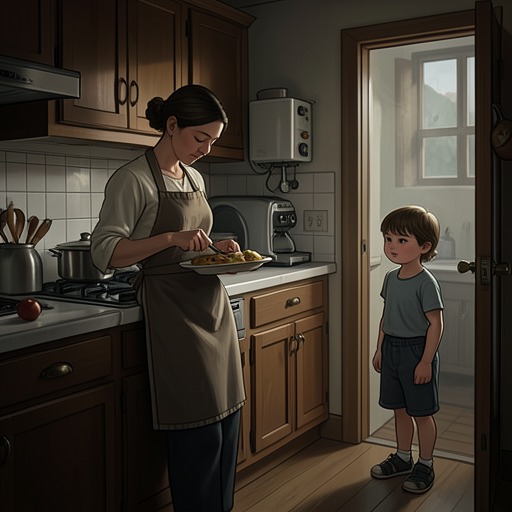
Family dinner hour is treated as a measure of a household's emotional climate. In Mothers Matter sessions, Kay Willis asks what it is like in a home at dinnertime and repeatedly hears that the house is a madhouse. Her response is that such an atmosphere should be fixed, because children experience the home through the climate adults create there. The question is therefore not simply whether food is served, but whether mealtimes are rushed occasions in which everyone is told to hurry up and eat, or relaxing family gatherings in which people actually share a space and attention.
The practice is also defined by presence. Kay Willis asks whether a family has a dinner hour at all, whether adults sit down with children when a father is away, and whether the meal remains a gathering rather than a logistical interval. This emphasis acknowledges that families differ: not every household includes a mother and father, and many women raise children alone or function as single parents for much of the week when husbands work exceptionally long hours. Even so, the ideal described in the book is one in which two parents share both the responsibilities and the joys of childraising. Dinner gives that shared responsibility a visible, repeated form.
The Willis Dinner Table
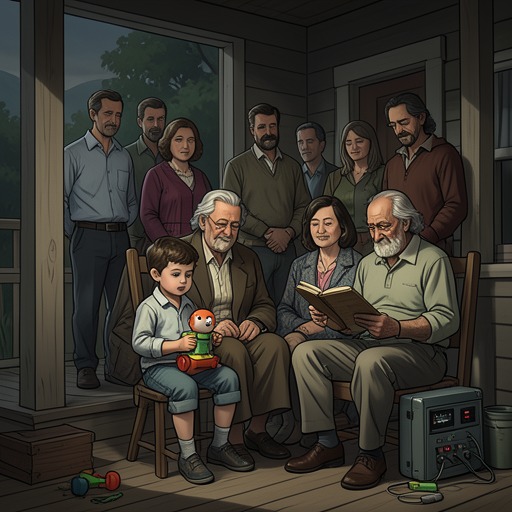
In the Willis household, Bub Willis insisted on returning home for dinner with his ten children, even when the workday had been stressful. When Kay Willis considered feeding the children early and preparing a quiet meal for the two adults, Bub objected because he worked hard in order to come home and be with them. Kay Willis called him “St. Grumpy,” since spilled milk and the noise of a large family could make him roar like a lion, but he was home for dinner on almost every evening. The regularity mattered more than the occasional irritation. Looking back, Kay Willis regards those meals as a major contribution to the family's strong connection: much was learned, much was shared, and humor was common.
The meal had a deliberate conversational structure. Because Kay Willis and the children had been together for much of the day, Bub Willis had the first turn to speak and answer the question “How was your day?” He gave a genuine account of his own day rather than treating the question as a formality. Each family member then took a turn describing something that had happened. The arrangement made listening reciprocal: children were expected to hear one another, but they were also invited to report their own experiences and opinions.
The table also functioned as a small civic institution. The ten children were included in important family matters, encouraged to voice opinions, and taught to listen to one another. At dinner, age differences did not erase participation. An infant seat could occupy the center of the table while a toddler sat in a high chair, allowing everyone to make eye contact with everyone else. Sharing food thus became a physical arrangement of mutual visibility, placing babies, toddlers, parents, and older children within one circle.
The Willis table was large enough to seat eighteen, twenty, or even more diners, and its scale became part of the family's public identity. High-school friends, college classmates, and later adult acquaintances regarded the household with wonder and amusement when they joined a meal. Kay Willis once turned that curiosity into a charity performance at a school talent show, using oversized platters, exaggerated bowls, a huge table, and amplified noise to parody the Willis dinner hour. The teenagers were mortified and wanted no part of the charade, but Kay Willis insisted that the performance served charity and would be fun. Her later recognition that she heard their objections without listening to their feelings reveals that even the family's comic abundance could contain failures of attention.
Time, Labor, and Participation
The dinner hour acquires its force because it interrupts the fragmented schedule of parenting. Kay Willis describes a typical mother's day as sixteen hours, or 112 hours across seven days. The parenting day is divided among cleaning children and house, laundry, cooking, shopping, transportation, medical appointments, homework, discipline, school involvement, fund-raisers, bake sales, teacher conferences, work, and telephone time. Against that many-piece structure, a shared meal is a recurring point at which the family can stop performing separate tasks and become a group.
That pause is not presented as effortless. Kay Willis argues that parents must save time to do nothing, simplify obligations, and let chores wait when necessary. Laundry may remain unfinished, and cereal may stay on the kitchen floor, while an adult gets down on the children's level to play. The same principle protects dinner from becoming another test of domestic perfection: the food is less important than the candles, quiet, and settled attention. For restless preschoolers, Kay Willis recommends a warm tub around 4:30 p.m., conversation during the bath, and then a candlelight family dinner; pizza or breakfast food is acceptable because calm and shared presence matter more than an elaborate menu.
Dinner also shows that meaningful time is not restricted to special outings. When strangers ask how Kay Willis spent time with each of ten children, she acknowledges that she did not always create the kind of memorable occasion that would fit a conventional list of quality-time examples. Dirty dishes could bring family members together just as readily as an excursion to New York City to see Christmas decorations. The work surrounding a meal is therefore not automatically the enemy of intimacy. Under the right conditions, dish duty becomes a shared activity through which family members occupy the same time and place.
Family Systems and Consequences
The dinner hour stabilizes a family system that otherwise contains exhaustion, uneven schedules, and recurring conflict. Kay Willis credits the help of her mother and Bub Willis for making it possible to enjoy being the mother of ten children. Their support included regular opportunities for her to leave the house and refuel, because exhaustion impaired judgment and made obvious solutions difficult to see. Dinner belongs to the same system of care: it is one of the structures that makes the family legible to itself, while rest and shared responsibility keep the structure from becoming an additional burden on the mother.
Its effects extend to conflict among siblings. Kay Willis recalls years in which she had to stand literally between Ben Willis and Tim Willis during their adolescent fights. Their rivalry was not a brief phase, and she feared they might permanently scar one another. Things improved perhaps when they played varsity football on the same high-school team, and perhaps later when college placed them in separate states. The eventual happy turn came when Ben Willis's wife, Madeleine, gave birth in a New York City hospital and the brothers' wider family gathered at a favorite Irish pub to wonder which brother would become the baby's godfather. The dinner table does not single-handedly resolve such rivalries, but the family culture of shared voice, repeated gathering, and collective memory provides a background against which relationships can change.
The ritual also carries an intergenerational meaning. One mother remembers that during summer she came home only for meals and snacks, suggesting that dinner was one of the dependable anchors of childhood even when the rest of the day was spent elsewhere. In Kay Willis's own family, the table becomes an inherited image of what family connection can look like: crowded, noisy, occasionally exasperating, but organized around return.
Narrative Significance
Kay Willis ultimately calls the dinner table the core of the family unit and thanks Bub Willis for insisting that everyone meet there every day. Her deliberately extravagant claim that, if elected president of the United States, she would make family dinner hour mandatory for the whole country turns a private household rule into a national argument. The exaggeration is comic, but the underlying proposition is serious: a family cannot rely only on affection as an abstract ideal; it needs repeated practices that make affection visible, teach participation, and preserve contact.
Family dinner hour therefore stands for a broader theory of parenting. It does not demand a flawless mother, a permanently calm father, gourmet food, or uninterrupted conversation. It asks adults to protect a common interval from the centrifugal forces of work, chores, transport, fatigue, and conflict. In the Willis family, the daily meal becomes both setting and method: the place where the household's problems are heard, where children learn to speak and listen, where humor survives spilled milk, and where ten separate lives are repeatedly brought back into one family story.