Fatherhood
Are We Having Fun YetFatherhood is defined as an active form of parenthood whose central measure is presence, not income or resemblance to maternal care. The book treats fathers as essential participants in children’s emotional development and argues that a father’s distinctive contribution is created through time, attention, affection, and involvement rather than through provision alone.
Definition and Social Context
Fatherhood appears against a long cultural history in which childrearing was treated as women’s work. Mothers were regarded as the real parents, while men were imagined as returning from employment, putting on their slippers, retreating into newspapers, and occupying a separate plane from women and children. The book identifies this arrangement as a social pattern rather than an inevitable definition of paternal identity.
That pattern began to change as fathers entered hospital delivery rooms and could participate in a child’s life from its beginning. The return of many mothers to full-time employment outside the home also brought fathers into closer contact with their children through necessity. Even so, the book notes that the ideal of equal participation was difficult to establish across generations, including both the 1920s and 1996. Fatherhood is therefore shown as a role being renegotiated between inherited expectations and contemporary family demands.
Fathers as Active Participants
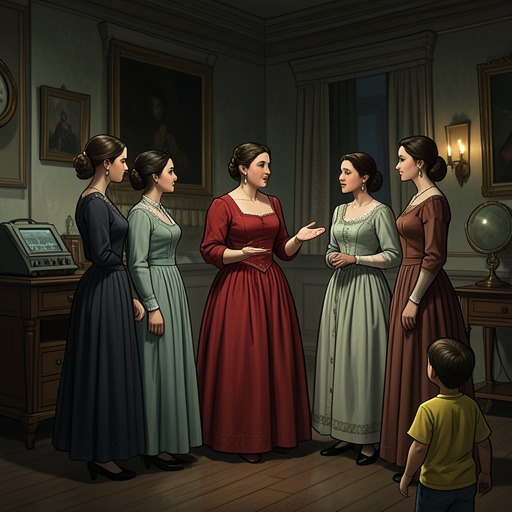
The argument is dramatized during the fifth session of Mothers Matter, held on a Monday evening at 7:30 in the basement library of a grammar school. Hesitant fathers sit around a conference table; some have come reluctantly to accompany their wives, while others are curious about Kay Willis. Three women arrive without men. Coffee, tea, and cakes are offered, but Kay quickly turns the meeting toward fatherhood.
Kay asks the fathers whether they know how important they are. The apparent obviousness of the question gives way to a troubling statistic: even average, loving fathers spend less than eight minutes a day interacting with their children. The issue is not that these men necessarily lack affection, but that affection cannot leave a lasting impression without contact. Money, the book insists, is not a true measure of a father’s worth because a child can be influenced only by someone sufficiently present to participate in the child’s life.
Kay makes the point personal by asking the men to recall happy memories with their own fathers. The room becomes quiet, and one man begins to cry. His father has recently died, yet the only memory he can retrieve is a long walk after dinner one night. The smallness of that memory gives it force: a single period of shared presence can become a child’s durable emotional inheritance, while material provision may leave no comparable image behind.
Difference from Motherhood
Fatherhood is not presented as substitute motherhood. The book explicitly rejects the idea that dads are substitute mothers, babysitters, or pinch hitters. A father’s task is not to reproduce a woman’s care in a less efficient form. Fathers complement and supplement maternal care, and their participation enriches family life through a contribution that is their own.
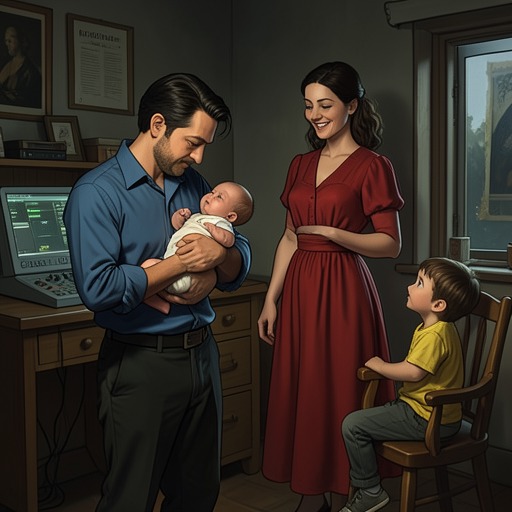
This distinction also challenges the assumption that fathers are merely providers. Above all, fathers are described as enrichers, not simply providers. The role includes the ordinary physical work of early care: giving bottles, bathing infants, changing diapers, and rocking them. Such tasks are not decorative gestures added after “real” parenting; they are part of every new father’s initiation into parenthood and provide the repeated contact through which confidence and attachment develop.
The book also recognizes that fathers may feel awkward and inadequate. Men who never held infants while growing up, particularly those raised by absentee fathers, may not know what to do with a newborn. Yet mothers can intensify that insecurity when their own efficiency leads them to restrict men to assistant-parent status or send them away on errands instead of allowing them more practice. Fatherhood becomes stronger through participation, not through waiting until competence appears fully formed.
Presence, Partnership, and Development
The book locates fatherhood within a two-parent partnership in which each sex brings a different balance to the work of raising a child. Parenting is difficult enough to make cooperation valuable, but the claim is not that fathers and mothers must perform identical tasks. Their care can overlap while remaining nonidentical; the paternal role gains significance precisely because it is not a carbon copy of maternal care.
A child who truly knows a father, connects with him, and feels loved by two parents is portrayed as better equipped to move toward personal goals. This confidence develops through a show-and-tell process: children learn to believe in their fathers because fathers are there for them, and they learn to believe in themselves through the security of that relationship. The emotional bond is thus reciprocal in effect even when the adult bears the greater responsibility for sustaining it.
Fatherhood also affects the wider atmosphere of the home. The book observes that mothers are usually the principal crafters of the family’s emotional climate, while fathers certainly contribute. This formulation gives mothers a major responsibility but does not make fathers peripheral; it places paternal involvement within the atmosphere that shapes children physically and emotionally. A father’s presence can therefore supplement not only an individual child’s experience but the emotional environment of the entire household.
Narrative and Cultural Significance
Fatherhood serves as a corrective to a narrow account of family value based on wages, authority, or occasional assistance. Its decisive test is repeated relational presence: being available, learning the practical work of care, remembering that children need attention rather than only resources, and allowing children to know the person behind the provider’s role.
The discussion also reveals a tension in the book’s gender framework. It challenges the old exclusion of fathers from daily care and insists that men are indispensable as parents, yet it continues to describe mothers as the usual architects of the home atmosphere and frames parental contribution through sex-based complementarity. Fatherhood is therefore both a revision of traditional domestic roles and a reformulation of them. Its strongest principle remains clear: fathers matter not because they imitate mothers or finance families, but because their sustained presence makes a particular human relationship possible.