Halloween
Are We Having Fun YetHalloween occupies two sharply contrasting worlds in the book: the crowded, improvised world of family life and the polished, unfamiliar world of professional travel. It is therefore more than a seasonal observance. Through Halloween, Kay Willis measures belonging, remembers the pleasures of domestic comedy, and discovers that a successful new career cannot make absence from home emotionally weightless.
A Family Celebration
Halloween appears first through the comic resourcefulness of family life. Kay Willis recalls that her mother once dressed Jerry as a lamp, using corrugated cardboard and taping a lampshade to his head. The costume is deliberately homemade and absurd, but the memory carries a larger lesson: Kay’s mother could defuse tension with quick wit, and she taught Kay the value of preserving humor through stressful personal, professional, and financial circumstances.
The Halloween story also belongs to a childhood shaped by a large and stable neighborhood community. Kay remembers growing up in a family of ten on Wood Street, where thirty or more children might unofficially close the block for massive games of kickball, football, or whatever the children invented. Against that background, Halloween is associated not with expensive production but with collective play, improvised objects, and the comic energy of children moving through a densely inhabited family world.
The Holiday and Kay’s Public Career
Halloween later becomes the setting for a decisive stage in Kay Willis’s professional life. After she argued that her experience as a mother made her suitable to represent Fisher-Price, she learned that the company was seeking a camera expert to travel across the United States for television and radio interviews about a preschool camera. She challenged the company by betting that she could sell more toy cameras than its chosen expert unless that expert was also a mother. Fisher-Price called her two days later, and the president hired her after her humorous reply that she spent so much money on toys each year that she had been putting Fisher-Price on her tax return for years.
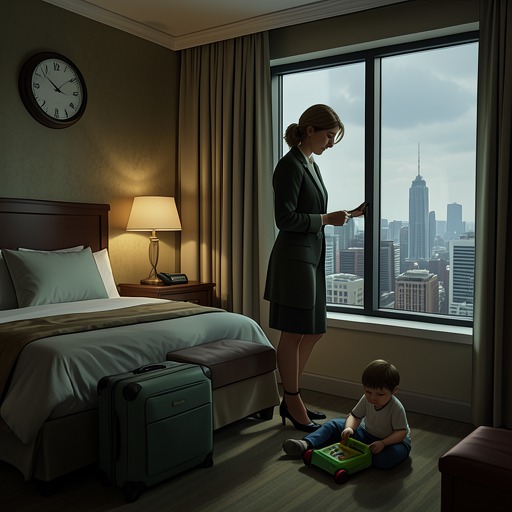
That career transforms Halloween into an emblem of mobility. On October 31, 1984, Kay Willis stayed at the Hotel Pontchartrain in Detroit while touring as a Fisher-Price spokesperson. She was being paid to travel and to speak on television, radio, and in newspapers about the value of play and toys. The day included two television broadcasts, a radio appearance, and lunch with a newspaper columnist, followed by a sumptuous dinner with no cooking, dishes, cleanup, or children’s meals to manage.
The Hotel Misunderstanding
The hotel represented a world far removed from Kay’s ordinary domestic experience. Her room was decorated in pale aqua shades, overlooked Canada across the water, contained three telephones, and included a king-size bed, an armoire, wing chairs, a sofa, a coffee table, and a desk. Kay was tempted to telephone home and send for relatives to share the pleasure. She could not recall ever having stayed alone in a hotel room; before this career, her travel had chiefly consisted of trips to Florida to visit her aging parents.
The holiday made the separation immediately personal. In the elevator after dinner, Kay felt the first pangs of homesickness because it was the first Halloween since her marriage that she had not been home in Rutherford. Halloween was one of her favorite celebrations, and she especially regretted missing the excited reports of her first grandchild, Jamie, who was six at the time and was presumably out trick-or-treating.
Back in her room, Kay opened the door to a maid holding a miniature shopping bag with the hotel’s seal. When the maid offered her a mint, Kay exclaimed, “I can’t believe a hotel this sophisticated is handing out Halloween candy. How nice!” The maid hesitated, then laughed and admitted that she had briefly thought Kay was serious. The misunderstanding revealed how completely Kay’s expectations remained shaped by family holidays: even in a sophisticated hotel, she instinctively interpreted a small gift as Halloween candy for a guest.
The embarrassment deepened the following night, when Kay returned to find her bed turned down and a mint placed on the pillow as part of the hotel’s nightly routine. She recognized that the supposed Halloween treat had only been standard hospitality. Her private self-mockery about having straw in her hair marks the comic return of domestic common sense inside an unfamiliar luxury setting.
Meaning and Emotional Contrast
Halloween thus joins humor to homesickness. At home, its pleasures arise from family participation, handmade costumes, children’s excitement, and the ability to turn limited materials into memorable play. On the Fisher-Price tour, the holiday surrounds Kay with professional recognition, travel, hotel luxury, and media attention, yet these advantages sharpen rather than remove her longing for Rutherford.
The contrast also reinforces the book’s broader argument about play and parenting. Kay’s public authority comes from lived experience with children, not from detached technical expertise. Her memories of the lamp costume and neighborhood games show why play is valuable as a shared family practice, while the hotel episode shows that the emotional meaning of a celebration cannot be reproduced by a branded object or an impersonal courtesy. Halloween remains significant because it points Kay back toward the people with whom the occasion has its meaning: her family, her grandchildren, and the home from which her new career temporarily carries her away.