Hotel Pontchartrain
Are We Having Fun YetHotel Pontchartrain is the Detroit setting of Kay Willis’s “A Heavenly Halloween,” a place whose luxury gives her an unfamiliar taste of professional freedom while its isolation makes her miss home. The hotel turns a business trip into a revealing threshold: Kay is treated as a traveling spokesperson, enjoys comforts unavailable in her ordinary domestic routine, and then recognizes that the pleasure of independence does not cancel her attachment to family, tradition, and the memories created at home.
Setting and Arrival
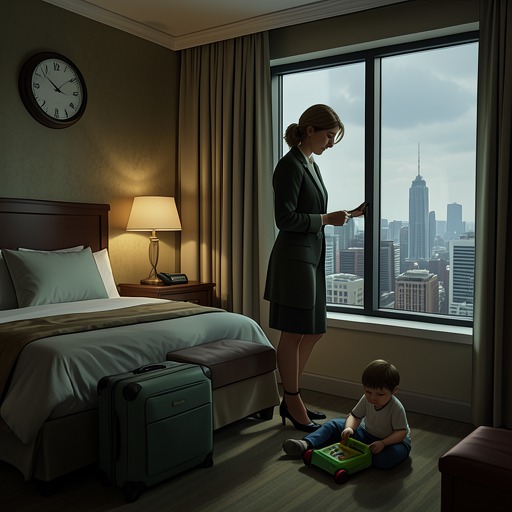
Hotel Pontchartrain first appears on October 31, 1984, when Kay is escorted to her room after arriving in Detroit. She has never heard of the hotel before, and its appearance immediately exceeds her expectations. The room is decorated in pale aqua shades and seems unmistakably designed for a woman. Its expansive view reaches across the water toward Canada, and the bellhop recommends leaving the draperies open while she sleeps so that the distant lights can remain visible.
The room’s scale and furnishings establish a sharp contrast with Kay’s previous experience of travel. The last motel room she had shared with her husband was a Motel 6 on the way to Notre Dame, an economy stop with a phone booth outside the door. At Hotel Pontchartrain, she finds three telephones—one in the bathroom, one beside the bed, and one next to the sofa—along with a king-size bed, an armoire concealing the television, two wing chairs, a sofa, a coffee table, and a desk. The excess is so unfamiliar that she imagines telephoning home and inviting several relatives to share the experience.
Professional Independence
The hotel is the base for Kay’s new career as a spokesperson. After unpacking, she goes to the dining room to meet Phil, the young publicist traveling with her on a tour for Fisher-Price Toys. The hotel’s dining room, with a young blond-haired woman playing the harp, completes the atmosphere of improbable abundance; Kay feels as though she has died and gone to heaven.
Her work in this setting is not merely a change of address. She is paid to travel and to discuss the value of play and toys on television, radio, and in newspapers. During the day, she appears on two television broadcasts and a radio program, and she shares lunch with a newspaper columnist who responds enthusiastically to her ideas. The hotel and the tour together make her feel professionally visible and unusually free. She can order whatever she wants from the menu, and the ordinary domestic sequence of cooking, washing dishes, and cleaning up disappears from consideration. No one interrupts her during the meal, and she does not have to cut anyone’s meat. These details make the hotel a temporary world without the practical demands of motherhood.
Halloween and Homesickness
The hotel’s promise of independence changes as soon as Kay returns upstairs after dinner. In the elevator, the first pangs of homesickness arrive. It is the first Halloween since her marriage that she has not been at home in Rutherford, and Halloween is one of her favorite celebrations. The distance becomes personal through her first grandchild, Jamie, who is six years old at the time. Kay particularly hates missing his excited reports about trick-or-treating, so the hotel’s elegance cannot prevent the holiday from becoming a reminder of what she has left behind.
The emotional reversal is intensified by a small misunderstanding at her door. A maid arrives with a miniature shopping bag bearing the hotel’s seal and asks whether Kay would like a mint. Kay, apparently mistaking the hotel’s polished hospitality for a gesture of Halloween generosity, exclaims, “I can’t believe a hotel this sophisticated is handing out Halloween candy. How nice!” The maid hesitates, then laughs and explains that she briefly thought Kay was serious. The moment is comic, but it also punctures the fantasy of belonging that the hotel has created. Kay is not receiving family holiday candy; she is encountering a routine service in a world whose codes she does not yet understand.
Luxury, Routine, and Recognition
The following night supplies the correction. Kay returns to her room and finds the bed turned down, with a mint placed on the pillow as part of the hotel’s nightly routine. Only then does she become fully embarrassed by the previous evening’s mistake. The mint, initially interpreted as a special Halloween offering, is revealed to be an impersonal sign of hotel custom. The same object therefore carries two meanings: for Kay, it briefly suggests festive care and connection; within the hotel, it is simply part of repeated service.
Kay’s self-reproach takes the form of an inward admonition: “Mother often, take the straw out of your hair,” followed by the recognition that she has entered “the ‘other’ world.” Hotel Pontchartrain is “other” because it reverses the familiar conditions of her life. It offers paid travel instead of household duty, restaurant service instead of cooking and cleanup, uninterrupted attention instead of family interruption, and a room designed for solitary pleasure instead of a shared domestic space. Yet the hotel does not permanently transform her. Its difference is temporary, and her homesickness proves that the domestic world she has escaped remains the world to which her feelings return.
Narrative Significance
Hotel Pontchartrain functions as both a setting and a test of Kay’s developing identity. It gives concrete form to the possibilities opened by her new public role: she can travel alone, speak with authority about play, appear across several media, and inhabit surroundings that feel almost fantastical compared with the family trips and economy motels she remembers. The hotel’s three phones, harp music, Canadian view, and nightly mint make professional success tangible through objects and routines rather than abstract claims.
At the same time, the hotel exposes the limits of treating freedom as simple escape. Kay enjoys the absence of cooking, dishes, cleanup, interruptions, and the need to cut anyone’s meat, but Halloween restores the emotional weight of home. Her memory of Jamie’s trick-or-treating links the hotel room to the family celebrations occurring elsewhere, while the mint episode turns cultural unfamiliarity into a small lesson in self-awareness. The hotel becomes a threshold between two lives rather than a replacement for one: Kay can enter the “other” world and continue finding it, but the pleasure of creating and remembering happy family moments remains part of what gives that independence meaning.