JoEllen Willis
Are We Having Fun YetJoEllen Willis is the eldest of Kay Willis’s six daughters and one of the ten children whose presence formed the personal foundation of Kay’s public work on parenting. Born in April 1951, she entered the Willis family nine months and twenty-three days after Kay’s wedding to Bub Willis. Her significance lies in the way she connects several dimensions of the narrative: she is a daughter within an unusually large family, a participant in its household culture, and an early helper in the creation of Mothers Matter.
Identity and Family Background
JoEllen Willis was the first child in a sequence of six daughters born within seven years. Kim Willis followed in August 1952, Patty Willis in December 1953, Maureen Willis in May 1955, Fran Willis in October 1956, and Jeane Willis in February 1958. The family’s rapid growth made JoEllen part of a demanding domestic system in which children were numerous, closely spaced, and expected to function within shared routines. Kay Willis remembered the period as tiring and sometimes confining, but she also described herself as genuinely enjoying motherhood, attributing much of that capacity to the support of her mother and Bub Willis.
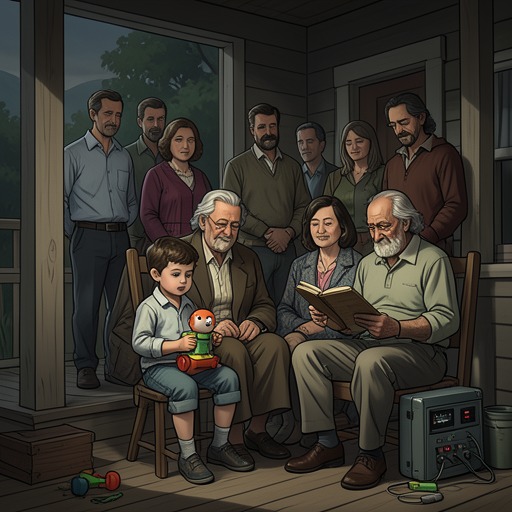
The children’s lives were marked by visible togetherness. JoEllen belonged to the group that traveled in the Willis station wagon while other cars slowed to count the passengers, occupied the whole pew at St. Mary’s Church, wore matching outfits for holidays, and relied on hand-me-down clothing. In the high-school corridors, the sisters could recognize their own former sweaters on one another. These details make JoEllen’s childhood less an isolated parent-child story than an experience of collective identity, shared possessions, and constant proximity.
Role in Mothers Matter
JoEllen became an early practical contributor to Kay Willis’s work. Mothers Matter began when Diane Jones, a young mother and neighbor, sought support while raising three preschoolers. The first session brought seven mothers into Kay’s living room for two hours of candid conversation, humor, complaints, and serious mutual support. As more groups formed and word spread, Kay contacted the local YWCA and was listed in the adult school’s mailing.
JoEllen helped give this expanding effort its public identity. Her sister Patty Willis helped coin the name Mothers Matter, while JoEllen proofread Kay’s brochure. The proofreading episode also reveals her awareness of how Kay’s identity would be received outside the home: when the brochure identified Kay as a mother of ten children, JoEllen sighed and questioned whether anyone would want to listen to someone who had chosen such a large family. Kay, by contrast, regarded her enjoyment of motherhood and her ten children as her strongest credentials. JoEllen’s intervention therefore belonged to the transition from private family experience to organized public authority.
Kay’s later reputation extended through seminars, parenting programs, and extensive media appearances, including Good Housekeeping, Good Morning America, The Today Show, The CBS Morning Show, The Home Show, CNN, and The Joan Rivers Show. The family history represented by JoEllen helped make that authority concrete: Kay did not present parenting as an abstract specialty but as work learned through years of daily practice. JoEllen’s presence in the dedication to Kay’s book, among the ten children named as Kay’s “board of directors,” reinforces that family members were treated as enduring participants in, rather than merely subjects of, her parenting philosophy.
Household Culture and Shared Rituals
JoEllen grew up within a family whose scale generated both inconvenience and a distinctive social education. The Willis dinner table became a central institution. Bub Willis insisted on coming home to eat with all ten children, even when the week had been stressful and Kay was tempted to feed the children early and prepare a quiet meal for the two of them. Although Kay called him “St. Grumpy” because spilled milk and domestic chaos could provoke a roar, he was home for dinner with rare exceptions.
At those meals, the children were included in important family matters, encouraged to state their opinions, and taught to listen to one another. Because Kay and the children had spent much of the day together, Bub had the first opportunity to describe his day, after which each person contributed something that had happened. JoEllen’s childhood therefore included a repeated practice of public speech within the family. Kay later suggested that this may have been where she first learned to be heard in a crowd, a formative link between the noisy dinner table and the mother’s public voice that eventually addressed audiences beyond the home.
The family also cultivated deliberate celebrations outside ordinary school and church routines. For several years, the children used December 8, a holy day, for an annual trip to New York to see the Christmas sights. When the crowds and long lines made the occasion less enjoyable, Kay created Willis Family Day instead, choosing a day on which the children could leave school under the explanation of a family matter. JoEllen remembered the pleasure and status of being taken out of school for a day of family fun, while also recalling holiday costumes from F.A.O. Schwarz and the children wearing them over red footed pajamas. These rituals show how Kay converted the logistical challenges of a large family into shared conspiracies, memories, and a sense of belonging.
Narrative Role and Significance
JoEllen’s role is quiet but structurally important. She is not presented through a separate dramatic plot; instead, she helps document the family network that made Kay Willis’s understanding of parenting credible. Her birth marks the beginning of the closely packed sequence of children, and her later assistance with the Mothers Matter brochure marks the family’s contribution to transforming domestic experience into a public program.
Her position also illustrates the reciprocal nature of Kay Willis’s maternal identity. Kay cared for ten children while insisting that mothers required care and support themselves, and JoEllen appears among the people who helped sustain and test that identity. The children were not simply recipients of their mother’s labor. They proofread, named, remembered, challenged, participated in family decisions, and became the living evidence behind Kay’s claim that motherhood could be both difficult work and a source of joy.
Through JoEllen, the book presents the Willis family as a system whose intimacy was built through repetition: shared dinners, shared clothes, shared travel, shared celebrations, and shared embarrassment about the family’s size. That system produced noise and inconvenience, but it also trained its members in cooperation, humor, and the confidence to speak. JoEllen consequently embodies the bridge between Kay’s private life as a mother and her public identity as a parenting authority.