Kay Willis–Bub Willis marriage and parenting partnership
Are We Having Fun YetKay Willis–Bub Willis marriage and parenting partnership was the sustaining structure behind Kay Willis’s account of family life: a marriage in which Benedict Patrick Willis Jr. supported Kay Willis’s work of raising ten children, treated her own well-being as essential rather than optional, and made his presence as a father matter as much as his income. The partnership became both the source of Kay’s confidence and the lived evidence behind her public teaching about atmosphere, self-care, listening, resentment, and the emotional consequences of parental attention.
Marriage and a Growing Family
Kay Willis and Benedict Patrick Willis Jr. built their family at remarkable speed. Their daughter JoEllen Willis was born in April 1951, nine months and twenty-three days after the wedding; Kim Willis followed in August 1952, Patty Willis in December 1953, Maureen Willis in May 1955, Fran Willis in October 1956, and Jeane Willis in February 1958. Six daughters arrived in seven years, while the family ultimately grew to ten children. When people asked whether the couple was trying for a boy, they were not; Bub Willis joked that he could only imagine what might have happened if they had been.
The scale of the household did not make Kay describe motherhood as uniformly easy. She remembered feeling tired and trapped, and pregnancy brought severe morning sickness. During those periods, she and the girls played a game called EMERGENCY: when Kay called out, the children stopped what they were doing and sat still until her nausea passed. The children came to associate an emergency, even an emergency vehicle passing the house, with their mother being sick. Yet Kay also insisted that she genuinely enjoyed being the mother of ten children, not because she was an unusually gifted parent or failed to understand the burden, but because Bub and her mother gave her practical and emotional support.
Shared Care and Maternal Recovery
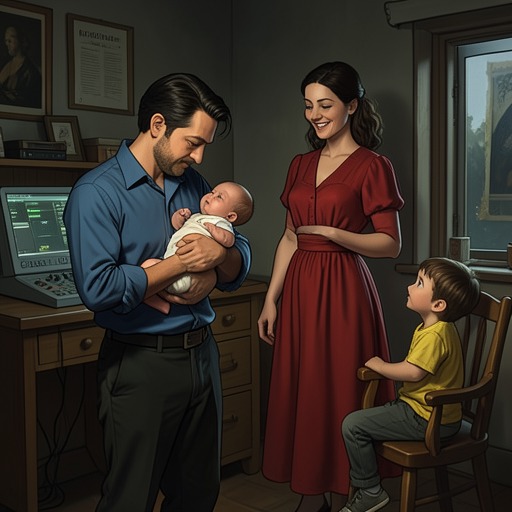
Bub Willis’s contribution was not limited to earning money. He bathed the babies every night and, when the children were small, followed a rule that made his solidarity unmistakable: “I won’t sit down until you can sit down.” The rule sometimes delayed household chores because Bub looked more exhausted than Kay, but its emotional effect was decisive. Kay did not claim that everything was completed; she remembered instead that she felt loved. His care converted domestic partnership from an abstract ideal into a repeated bodily practice of noticing when Kay needed to stop.
Kay’s mother also protected the marriage and family system by protecting Kay’s time away from it. She required Kay to have every Thursday afternoon off, arguing that if anything happened to her, a whole squad would have to replace her. The break was treated not as a reward Kay had to earn but as preventive medicine. By Thursday, after whatever had accumulated on Monday, Tuesday, and Wednesday, Kay could walk away, refuel, and return restored. The family came to expect her absence, and Kay came to relish it; regular time off became part of the household’s ordinary fabric rather than a crisis measure.
This arrangement gave concrete form to Kay’s later insistence that caregivers must care for themselves when nobody else will. In her account, fatigue impaired judgment, narrowed perception, and made ordinary problems harder to solve. The partnership with Bub therefore rested on reciprocal recognition: the children needed care, but the person doing the caring also needed replenishment. The marriage helped prevent the family’s demands from being treated as a moral reason for Kay to disappear into them.
Fatherhood Beyond Earning Power
Bub Willis was remembered as thoughtful, generous, and more serious than Kay. He reassured her through every physical stage of motherhood, even telling her in the ninth month of pregnancy that her eyes were beautiful. His compliments and willingness to do anything for Kay and the children made her feel that she remained visible within the consuming work of family life. That emotional reassurance mattered because Kay’s public arguments about parenting begin with the conviction that parental atmosphere affects children more deeply than a display of flawless performance.
The family later tested the difference between earning power and active fatherhood. Bub, a senior executive in a large corporation, lost his job after a managerial shake-up following a takeover, just as the couple’s first daughter began college. Months of searching exhausted the family’s resources, and even after Bub returned to work, accumulated debts made tuition a critical concern. The crisis threatened the financial plan on which the couple had relied, but it did not erase the children’s opportunities. All ten eventually attended college, including Jerry Willis, who was preparing to graduate from Cook College of Rutgers University when Bub’s illness reached its final stage.
Kay attributed this outcome not simply to later financial recovery but to the time Bub had given the children while they were growing up. His confidence in their abilities empowered them to find ways around financial obstacles and reach some of the country’s leading colleges and universities. In this account, fatherhood is measured not only by the capacity to provide, but by the confidence, attention, and participation that children carry with them when material security falters.
Pressure, Atmosphere, and Emotional Labor
The partnership also illuminates the pressure Kay placed on parents to manage the emotional climate of the home. She argued that mothers are usually the principal crafters of family atmosphere, while acknowledging that fathers contribute. A household’s atmosphere and the parent’s attitude were, in her formulation, the two As of parenting; together they shaped the physical and emotional environment in which children developed. Bub’s support made that demand more sustainable, but it did not make the demand disappear.
Kay repeatedly linked parental attention to the ability to listen. A crowded mind leaves no room for a child’s words, so a parent must set chores aside, concentrate on the speaker, and acknowledge the child’s feelings. The same logic governed her warnings about resentment. When an exhausted parent answers a persistently whining toddler with an angry outburst, the problem is not only the isolated tone; resentment spreads through the atmosphere the family depends on. It can spoil otherwise devoted work, blind a parent to a generous act, and damage the marriage itself because anger and love do not easily survive side by side.
The marriage thus supplied a counterweight to the emotional labor demanded of Kay. Bub’s attentiveness, nightly bathing, compliments, and insistence that she rest offered an alternative to the fantasy of the self-sufficient mother who must remain cheerful while carrying every task. The family’s later message that children need more than love also followed from this experience: parents must be able to enjoy their children’s company, and that enjoyment is more possible when the marriage shares the weight rather than leaving one adult to absorb it alone.
Illness, Death, and Continuing Presence
Bub Willis died of cancer in 1988, but the account of his death emphasizes the family’s accumulated relationship rather than only the loss. Two nights before he died, all ten children gathered around his bed at home. Kay chose the house because ten people could not fit into a hospital room; there, the family would have been forced to divide itself between those entering and those leaving. Jerry arrived after taking his final senior examination, shortly before his graduation from Cook College of Rutgers University. The family knew Bub would not die in the middle of those examinations, a small detail that shows how his final illness remained interwoven with the children’s separate lives.
The gathering became a collective act of remembrance. The children took turns recalling holidays, birthdays, vacations, Christmases, family dinners, and other high and low points. They remembered personal moments, including a first car accident when their father arrived and simply hugged one of them. They cried, but they also laughed and expressed gratitude for his life. Football fight songs and church hymns filled the room, giving the farewell the shared music of Bub’s interests and history. Thirty-six hours later, their beloved father died.
Kay’s account makes those memories an extension of Bub’s parenting rather than a consolation detached from it. Because he had been present, the children possessed a store of particular experiences to bring to his bedside and later to their own special occasions. Even years after his death, Bub’s presence remained strongly felt through those happy memories. The marriage and parenting partnership therefore ends in bereavement but not disappearance: its final proof is the family’s ability to gather, remember, laugh, say goodbye, and continue carrying the father’s active presence into the future.