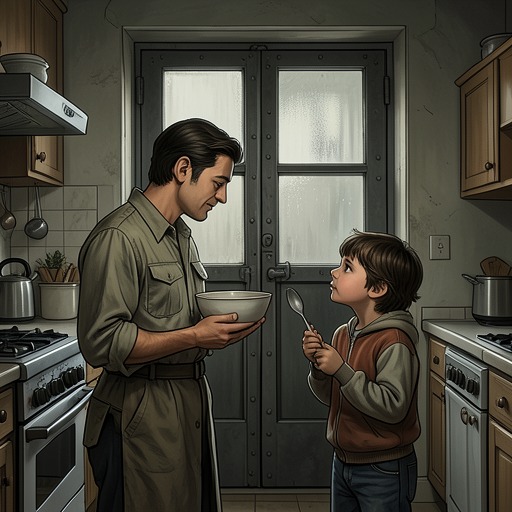
Leftover you
Are We Having Fun Yet“Leftover you” names the version of a parent that reaches children only after work, housework, errands, institutions, appointments, and other people’s demands have taken the best of the day. The expression is presented as a warning: when family members receive only what remains, love may still be present, but attention, patience, play, and emotional availability have been exhausted.
Definition and Context
The expression appears as a direct challenge to the assumption that constant sacrifice proves parental devotion. Parents may fear that their families will consider them selfish if they go away alone, or worry that others will object because they have always done everything for them. Against those fears, the book asks whether a parent is “serving your family leftover you?” The question exposes a moral inversion in which relief is treated as wrongdoing while depletion is treated as virtue.
This condition is not restricted to mothers who earn money outside the home. Stay-at-home mothers and part-time workers can also become trapped by commitments to churches, schools, clubs, charities, and health organizations. The recommended response is practical rather than ornamental: eliminate unnecessary obligations, prioritize, and refuse the belief that every available hour must be assigned to someone else.
Emotional and Familial Consequences
Time away from a demanding routine is compared with money deposited in an emotional bank account. Those reserves can later be borrowed when life becomes disappointing, overwhelming, or confining. Without them, ordinary drudgery and unexpected difficulties become harder to bear, and the parent has less capacity to laugh at personal mistakes or share laughter with a child.
The expression also connects depletion with resentment. A mother who has worked through an endless list of obligations may answer a persistent toddler in a tone sharpened by exhaustion. The book describes resentment as something audible in that tone and argues that it can spoil otherwise devoted work: a negative mood permeates the atmosphere in which the family is being raised. Resentment can also blind an overtired parent to a good thing, as illustrated by a mother who resented her husband’s surprise plan for a family vacation in Hawaii because she did not want to fly so far with children. In the book’s larger account of family life, anger and love cannot easily coexist, making emotional replenishment consequential not only for parenting but also for marriage.
Attention, Atmosphere, and Enjoyment
“Leftover you” is especially damaging because children need more than supervision or formal instruction. The book states that loving children is insufficient if their company is not enjoyed. Children who do not receive enough attention may seek it through negative behavior, which can produce a cycle in which distress receives a quicker parental response than calm interaction.
The remedy begins with presence. Parents are urged to save time to do nothing, create a reserve of fun, and make unstructured, silly, lighthearted play part of daily life rather than waiting for experts to authorize it. Laundry can wait, cereal can remain on the kitchen floor, and adults can get down on a child’s level to play. Joining the What the Hell Club means treating fun as more important than completing every item on a to-do list.
The same principle governs listening. A good listener must bring both mind and body to the exchange, but “crowded brain syndrome” leaves no room for another person’s words. Setting chores aside, concentrating on the speaker, and acknowledging a child’s feelings are forms of attention that cannot be supplied by a depleted remainder. The parent’s emotional state also helps create the home atmosphere in which children grow physically and emotionally; although fathers contribute, the book says mothers more often shape the emotional climate. The atmosphere and attitude of parenting therefore matter more than the appearance of having completed everything.
Practical Replenishment
The book offers concrete ways to interrupt the cycle of exhaustion. A warm bath at the end of a late day may not extend sleep, but it may make sleep sounder. For restless preschoolers, a warm tub around 4:30 P.M. followed by a candlelight family dinner can quiet the household; the meal need not be elaborate, since pizza or breakfast is acceptable when candles, darkness, and conversation provide the atmosphere.
These suggestions share a logic: reduce performance, preserve connection, and make ordinary time emotionally usable. A parent who stops treating every chore as urgent can recover the patience required for eye contact, soft answers, listening, and play. Self-relief is consequently framed not as withdrawal from family responsibility but as an investment in the quality of the parent’s return.
Significance in the Parenting Argument
“Leftover you” condenses the book’s broader criticism of parenting organized around guilt, overwork, and specialization. Parents are encouraged to train, discipline, and prepare children for every possible future, while tutors, coaches, camps, and other specialists absorb more and more of family time. The result can be a household full of services and activities but short of unhurried parental presence.
The expression also complicates gender expectations. Fathers are described as neither substitute mothers nor babysitters, but as enrichers rather than simply providers. Yet the discussion acknowledges that mothers have historically been treated as the real parents and often remain responsible for the home’s emotional climate. “Leftover you” thus identifies a burden produced by unequal expectations while insisting that the answer cannot be endless female self-erasure. Its decisive claim is that children need a parent who is emotionally available, not merely a parent who has successfully finished everything else.