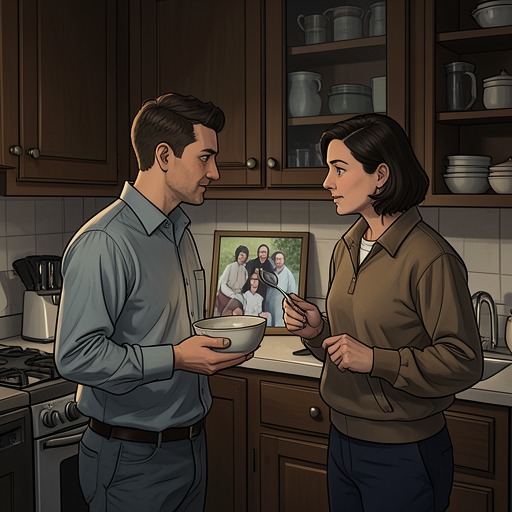
Marriage
Are We Having Fun YetMarriage is presented as a living partnership whose health directly affects the emotional climate of family life. Parenthood can deepen that partnership when spouses share both responsibilities and joys, but it can also crowd the relationship with exhaustion, anger, chores, and postponed intimacy. The book therefore treats marriage not as something secured once and for all, but as a relationship requiring regular attention, listening, pleasure, and repair.
Marriage and Shared Parenthood
The book distinguishes an ideal marriage from the many family arrangements that exist in practice. Not every family has both a mother and a father, and many women raise children alone or function as single parents for much of the week because their husbands work extraordinarily long hours. Even so, the book identifies the ideal as two parents who are happily sharing the responsibilities and joys of raising children. This formulation makes marriage consequential not because a particular household structure is universally required, but because cooperation gives children access to a wider field of care and gives each parent relief from carrying the entire work of family life.
That partnership also challenges older expectations about gender. Fathers are not described as substitute mothers, babysitters, or occasional pinch hitters; they are treated as full parents and as Most Valuable Players in family life. Earlier generations often regarded childrearing as women’s work, leaving men to retreat behind newspapers after returning from employment. The book contrasts that history with changes that brought fathers closer to parenting, including their admission to hospital delivery rooms and the increasing number of mothers working full-time outside the home. Marriage consequently becomes a site where inherited roles can either be repeated or renegotiated.
The marriage between Kay Willis and Bub Willis offers a concrete example of shared family responsibility. Kay’s enjoyment of raising ten children did not arise from exceptional gifts or ignorance of the difficulties. She attributes it to the practical and emotional support of her mother and Bub, who repeatedly insisted that she mattered and that no one else could do what she was doing. Their support illustrates a central principle of the book: care for others cannot remain healthy when the primary caregiver receives no care herself.
Everyday Strain and Emotional Climate
Marriage is affected by the atmosphere created inside the home. Mothers are usually described as the principal crafters of that atmosphere, although fathers contribute to it as well, and the emotional climate surrounding children is treated as one of the most important influences on their eventual happiness and success. The marital relationship is therefore never isolated from domestic feeling. A spouse’s irritation, exhaustion, or generosity circulates through the household and becomes part of the environment in which children develop.
Listening is one of the book’s practical tests of marital and family presence. A good listener must bring both mind and body to the conversation, setting aside chores and other competing thoughts. The warning about crowded brain syndrome applies especially to parents whose attention is divided among endless demands. When a spouse or child is speaking, concentration is required not only to hear information but also to understand and acknowledge feeling. Marriage deteriorates when physical proximity is mistaken for emotional availability.
Resentment is the most corrosive form of this strain. It appears in the tone used with a child who repeatedly demands attention, but its effects extend directly into marriage. The book calls resentment a spoiler because even diligent work is negated when the worker’s negative mood permeates the family atmosphere. It can blind an exhausted parent to a spouse’s good intentions, as in the example of a mother who resented a husband’s effort to arrange a family vacation because she did not want to fly with the children. Resentment is also described as a romance killer: anger and love do not easily survive side by side, and sustained resentment can become physically damaging as well as emotionally destructive.
The book’s insistence that parents should enjoy their children’s company extends to spouses. Loving a family is not presented as sufficient if daily companionship has become purely dutiful. In a marriage crowded by tasks, the partners must remain capable of experiencing one another as sources of pleasure rather than only as co-managers of an exhausting household.
Family Rituals and Mutual Belonging
The Willis family dinner hour shows how marriage can be reinforced through a repeated communal practice. When Bub had a particularly stressful week, Kay sometimes fed the children early and prepared a quiet meal for the two of them. Bub objected because he worked hard in order to come home and be with the children. His protest reveals that he understood the evening meal not simply as nourishment or routine but as a central expression of family belonging.
Bub was sometimes called St. Grumpy because spilled milk and domestic disorder could provoke him to roar like a lion. Yet, with rare exceptions, he came home for dinner every evening. The contradiction matters: family connection did not depend on perfect calm or on a parent who never became irritable. It depended on returning, participating, and allowing the ritual to hold the family together despite ordinary failures of temper. At the table, the children heard important family matters, were encouraged to express opinions, and learned to listen to one another. Because Kay and the children had spent much of the day together, Bub usually spoke first about his day, taking the question of how his day had been seriously before each family member contributed.
This dinner ritual also gave the marriage a shared public space within the family. Bub was not a visitor entering an already completed maternal world, and Kay was not left to translate the children’s lives for an absent father. The table made room for his experience, the children’s voices, and the couple’s common authority. Even humor, which the book says was frequently present, became part of the accumulated memory through which family solidarity was built.
Preserving Romance After Children
The book treats children as capable of killing romance without implying that they do so deliberately. Parents are always busy, often tired, and inclined to postpone intimacy until the children are older, money is easier, a babysitter is affordable, or an ideal opportunity finally arrives. This postponement turns marriage into a waiting room for a future version of the couple’s former life. The warning is that the relationship may lose something while everyone waits for conditions to improve.
Romance is consequently described as essential rather than decorative. The happiest parents, in the book’s account, are those who have learned to keep romance alive and who continue talking and enjoying one another’s company. Their principal difficulty is not necessarily falling out of love, but making time for each other amid children, domestic work, unpaid bills, kitchen labor, and laundry. Escaping those pressures, even temporarily, allows both spouses to recharge and to see beyond the daily mess and stress.
The language of nourishment captures the book’s understanding of marital renewal: romance feeds the heart and can turn a casserole into a banquet. Humor helps sustain a marriage, but humor alone cannot substitute for intimacy or deliberate attention. Marriage, like childrearing, is not meant simply to be endured. A date is defined as an appointment or social engagement between two people, and the book insists that a husband and wife remain eligible for that meaning. A dinner party for eight or a church supper for a hundred is not a date; the specialness lies in making an engagement for the couple themselves.
Significance and Continuing Work
Marriage functions in the book as both a support system and a responsibility. Bub’s participation helped make Kay’s large family manageable and joyful, while the family dinner gave his commitment a recurring form that the children could witness. At the same time, the book refuses to romanticize domestic partnership: fatigue, resentment, role confusion, and neglected affection can turn cooperation into a merely functional arrangement.
Its larger claim is that marital love must be practiced through emotional labor. Spouses must listen despite crowded minds, restrain the resentment that contaminates the home, share parenting rather than assigning it to one gender, and protect time in which they can enjoy each other. When romance is maintained, the marriage becomes more than a logistical alliance and offers the children an example of attachment sustained through ordinary effort. When it is neglected, the pressures of parenthood can reduce love to endurance. Marriage therefore remains strong not through a single grand declaration, but through repeated acts of presence, mutual care, shared ritual, and chosen renewal.