No Labeling Rule
Are We Having Fun YetThe No-Classification Rule is a parenting and teaching principle that rejects assigning children fixed identities such as troublemaker, genius, stupid, noisy, perfect, or any other supposedly definitive type. Its decisive claim is that labels do not merely describe children: they influence how adults treat them and can shape what children come to believe about their own capacity. The rule therefore asks adults to preserve room for development, change, and surprise rather than turning present behavior into a forecast of permanent character.
Origin in a Teacher-Training Lesson
The rule emerges from the narrator’s experience as a volunteer religious-education teacher. She had agreed to teach in her parish church and was required to attend five weekly workshops, each led by a different expert. The first two sessions were so disappointing that she would have quit, but she was the designated driver for the carpool attending the third. That obligation became fortunate because the third instructor, an irritable nun, offered a lesson the narrator continued to consider for years.
The nun’s central instruction was direct: “The most important rule I can share with you is: Don’t ever classify your students. Don’t label them. If you do, you will stunt their growth.” Although the narrator recognized the idea, she realized that she had not previously absorbed its full significance. The lesson moved labeling from a casual classroom habit into an ethical question about adult influence. A teacher’s judgments could become part of the environment in which a child either expands or contracts.
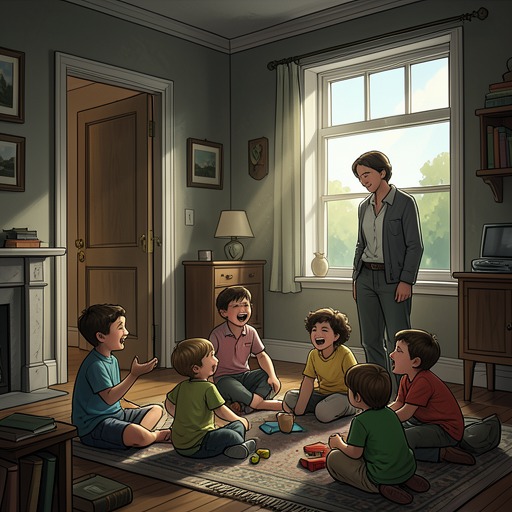
The nun also predicted how quickly classification would arise in practice. By the end of a first class, a teacher might identify one student as the troublemaker in the first row, another as the bright child, and another as a smartypants in the back. Such impressions might initially seem accurate, but the nun warned that children can fool adults. Her point was not that observation is useless; it was that an observation made at one moment must not be converted into a permanent verdict. Because children live amid adult expectations, the teacher insisted that adults can be powerful influences and should choose to be positive ones.
What Labels Do
The narrator applies the lesson to her own family, recognizing that she had mentally assigned fixed descriptions to JoEllen Willis and Kim Willis. She could already see patterns developing, yet the workshop helped her understand that patterns are not destinies. Children grow and change if adults allow them to do so, and adults must repeatedly remind themselves to encourage that continuing movement. The narrator admits that she still sometimes falls unwillingly into the labeling trap, which gives the rule practical force: it is not a once-and-for-all insight but a discipline requiring repeated self-correction.
The rule treats labels as active messages about ability. When an adult calls a child fat, skinny, noisy, boisterous, smart, stupid, funny, or perfect, the child is made to carry an identity that may be inaccurate tomorrow and burdensome even when accurate today. The narrator states that labels can leave children scarred, inhibited, and diminished in self-worth. Mockery does not become harmless because it is presented as humor, and the excuse that someone was only kidding cannot erase the power of a derisive name.
The danger extends beyond openly cruel words. A label can be flattering and still restrictive. Calling a child the bright one or the perfect one may pressure that child to preserve a narrow performance, just as calling another child stupid or troublesome can make lowered expectations seem natural. In each case, the label suggests that behavior is predictable. The rule rejects that assumption because no child is absolutely predictable, and a description that appears accurate at a particular time will not remain accurate indefinitely.
The Rule in Everyday Parenting
The No-Classification Rule belongs to a broader account of how adults create the conditions in which children develop. The narrator argues that mothers and fathers need to notice children as changing people rather than as fixed household roles. That requires time and attention that are not entirely organized around chores or efficiency. Saving time to do nothing, getting down on a child’s level to play, and choosing the What the Hell Club over a completed to-do list all create opportunities to encounter a child outside a preassigned category.
The same principle appears in practical family routines. A parent can calm restless preschoolers by placing them in a warm tub around 4:30 P.M., sitting down to talk with them, and then following the bath with a candlelight family dinner. The meal need not be elaborate; pizza or breakfast is acceptable because the candles, quiet, and whispered conversation matter more than culinary performance. Such a scene does not classify a restless child as difficult. It changes the setting, gives the child a calmer rhythm, and makes communication possible.
The narrator likewise recommends comfortable, individual opportunities for communication: taking one child at a time on an outing, or bringing a toddler to the basement, sitting the child on the dryer, and talking while another load of laundry is started and folded. These arrangements allow adults to see a child in a particular moment rather than through the shorthand of sibling roles or repeated family judgments. Attention becomes a way of resisting the convenience of classification.
Relation to Parental Self-Care
The rule also depends on the adult’s emotional condition. In Mothers Matter seminars, the narrator urges mothers in the first session to recognize their own needs and respond to them. New mothers commonly need rest, confidence, self-esteem, and adult conversation, while exhaustion, tears, inadequacy, resentment, isolation, and guilt recur in their daily lives. A depleted parent is more likely to rely on quick descriptions and inherited judgments; a rested and supported parent has greater capacity to remain attentive to change.
For that reason, the narrator challenges the belief that a good mother must sacrifice every waking moment to the family. She recalls the warning that no child deserves a martyr for a mother and tells parents to ask for help before reaching rock bottom. Time for personal interests, enjoyment, romance, or an outing is not treated as a betrayal of family responsibility. It helps preserve the emotional resources necessary to meet children as developing individuals rather than as problems to be managed.
Her account of raising ten children gives the argument a concrete family history. She says that she genuinely enjoyed being their mother, though not every minute, and that her relative freedom from feeling overwhelmed did not result from exceptional parenting gifts or ignorance of the difficulty. It came from the support of her mother and her husband, Bub Willis, who repeatedly insisted that at least three of the healthy-parenting Rs remain present in her life. Together they cared for her and reminded her that she was important and that no one else could do what she was doing. The lesson complements the No-Classification Rule: adults must resist both fixed judgments of children and the fixed judgment that self-denial is the only proof of parental love.
Significance and Limits
The rule’s compact logic is expressed in three linked propositions: “Labels limit.” “Labels imply that behavior is predictable.” “Labels are limitations that children will live up—or down—to.” These statements make the rule more than a request for polite language. They describe a feedback loop in which an adult’s category guides expectations, expectations guide treatment, and treatment can influence a child’s conduct and self-image.
Against that loop, the rule offers encouragement and inspiration. Children flourish when they are not categorized or stereotyped, and they are more likely to act expansively when they believe that anything is possible and that life contains happy surprises. The rule does not promise that every child will become anything whatsoever, nor does it deny the need to notice difficult behavior. Its narrower and more demanding claim is that present evidence must not be mistaken for permanent identity.
The narrator’s continuing admission that she sometimes labels her own children keeps the principle from becoming a sentimental slogan. The challenge is built into ordinary family life, where comparison, teasing, sibling conflict, school impressions, and hurried parental judgments make categories feel efficient. The No-Classification Rule answers that convenience with a commitment to revision: observe carefully, encourage positively, and leave children enough freedom to become someone their earlier descriptions could not have predicted.