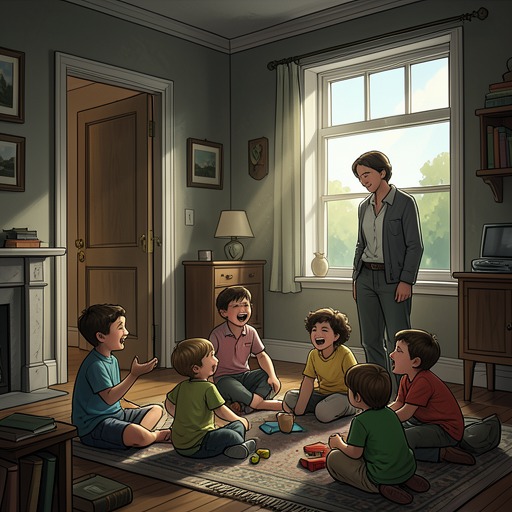
Sibling rivalry
Are We Having Fun YetSibling rivalry is a recurring state of competition, hostility, and attachment among brothers and sisters. The book treats it as both a domestic danger and a form of social training: children may wound one another physically or verbally, yet the same encounters can teach negotiation, bargaining, resilience, and the limits of acceptable behavior. Its central lesson is not that parents can abolish conflict, but that they can prevent conflict from becoming the organizing principle of family life.
Definition and Domestic Form
Sibling rivalry appears in the book through arguments, physical fights, insults, and the constant comparison of one child with another. One mother describes having to repeat that a child’s brother’s arm does not move in a particular direction, a compact image of siblings whose quarrel has crossed from verbal antagonism into bodily struggle. The example also shows how rivalry makes ordinary parental supervision repetitive: the parent must intervene again and again because the conflict is not a single incident but a pattern.
The book gives special attention to the damage caused by labels within that pattern. Children may be described as fat, skinny, noisy, boisterous, smart, stupid, funny, or perfect, and such descriptions can become burdensome identities rather than harmless observations. A label tells a child what others believe about that child’s capacity to change. Even an apparently flattering label can be restrictive: a child praised as someone who can do no wrong may experience ordinary mistakes as catastrophic failures. Rival siblings can become especially dangerous labelers because their attacks are delivered from close knowledge and repeated during conflict.
Parental Boundaries and Family Structure
The author states that the fighting among the ten children of Kay Willis and Bub Willis was never stopped completely. Instead, the parents drew lines that kept the home from becoming a war zone. This distinction is crucial. The family’s rules did not demand permanent harmony or deny anger; they separated permissible anger from deliberate cruelty. A child could express anger, but could not use mean or belittling remarks designed to hurt.
When verbal abuse occurred, Kay Willis pulled the offending child aside and said, "I won’t allow anyone—not even you—to hurt someone I love." The rule combines protection with recognition of emotional reality. Anger is not treated as a moral failure, yet love imposes a boundary on how anger may be used. Kay Willis regards this approach as a personal change because her own parents had taught her that respectable young women should not become angry. In the Willis household, therefore, conflict becomes something to regulate and teach through rather than something to suppress behind an appearance of sweetness.
The family system surrounding rivalry depended on more than one parent’s intervention. The book emphasizes that Kay Willis enjoyed being the mother of ten children largely because her mother and Bub Willis supported and cared for her, repeatedly reminding her that her work mattered and that no one else could perform it in her place. That support made it possible for her to respond to sibling conflict as an ongoing family responsibility rather than as proof of parental inadequacy. The wider household also had stabilizing practices: Bub Willis insisted on returning home for the family dinner hour, where the children heard important family matters, voiced opinions, listened to one another, and took turns describing their days. These routines did not erase rivalry, but they gave competing children a shared forum and a larger identity as members of one family.
Conflict as Preparation
The book introduces a deliberately surprising counterargument: sibling rivalry is not entirely bad. At a panel on the ideal family size, Kay Willis encountered a psychologist who explained that rivalry may be one of the best preparations for the real world. Siblings are not always fair; they can be competitive, selfish, and mean, and they do not necessarily accept one another’s claims without challenge. Within that difficult arena, children learn to negotiate, trade, and drive hard bargains.
The argument does not romanticize cruelty. The same chapter insists that verbal wounds may last longer and prove more harmful than physical injuries, which is why parental limits remain necessary. Rather, the value of rivalry lies in the skills that can emerge when children must manage opposition from people who know them intimately. The book reports that research associates more intense rivalry with higher achievement levels, and Kay Willis repeats this idea to Mothers Matter groups. One mother responds with excited hope that she may be raising future presidents, turning a household problem into a possible source of competence without denying the strain it creates.
This interpretation also complicates the ideal of the perfectly peaceful family. The book advocates happily shared parental responsibility rather than leaving mothers to carry childrearing alone, but it does not suggest that a well-supported family will be conflict-free. Fathers are described as enrichers rather than merely providers, and as genuine parents rather than substitute mothers or babysitters. Such shared responsibility matters to rivalry because repeated sibling conflict requires a family system with enough adult presence, emotional authority, and daily connection to contain it.
The Willis Brothers’ Long Conflict
The clearest extended example concerns Ben and Tim Willis, who were almost two years apart. During adolescence, Kay Willis had to stand physically between them to stop their fights. The conflict lasted for years rather than passing through a short stage, and she feared that the brothers might permanently scar one another. Her fear defines the stakes of sibling rivalry more sharply than any abstract warning: repeated hostility can threaten both bodily safety and the future relationship itself.
The situation eventually improved, although the narrative leaves the precise turning point open. It may have begun when both brothers played varsity football on the same high school team, where a shared institutional identity could redirect competition toward cooperation. It may instead have changed during their college years, when they lived in separate states. The alternatives suggest two different mechanisms for containing rivalry: common purpose can unite competitors, while distance can reduce the opportunities for direct collision.
The brothers’ story reaches its happiest resolution through a family birth. When Ben’s wife, Madeleine, gave birth to Benedict Patrick Willis IV in a New York City hospital, five members of the family who worked in the city arranged to meet at their favorite Irish pub. The gathering centered on a question about the newborn’s godparents, particularly which brother would be chosen as godfather. The old rivalry had not merely ended through a declaration of peace; it had been absorbed into a new family relationship, in which the brothers were connected by the next generation and invited to occupy complementary roles.
Significance and Limits
Sibling rivalry functions in the book as a test of the difference between control and guidance. Parents cannot guarantee that children will stop competing, and Kay Willis and Bub Willis did not succeed in eliminating every fight among their ten children. They could, however, prohibit calculated humiliation, intervene when bodies or dignity were endangered, and create recurring family practices that made listening and belonging possible.
The subject also exposes the danger of interpreting children too quickly. A rival may be called aggressive, selfish, or difficult, just as another child may be elevated as the smart or perfect one. Such labels freeze temporary behavior into supposedly permanent character. The book instead asks adults to distinguish the child from the conflict and to see rivalry as a changing relation with both destructive and developmental consequences.
In the Willis family, the arc runs from repeated intervention, fear, and years of adolescent combat to shared teams, physical distance, and finally a birth that reorders the brothers’ relationship. Rivalry remains part of family history, but it no longer defines the family’s future. The lasting answer is neither sentimental harmony nor surrender to chaos: it is a combination of boundaries, parental cooperation, shared rituals, and enough time for competition to become connection.