The 1920s
Are We Having Fun YetThe 1920s functions as a historical reference point in Kay Willis’s account of changing parenthood. It represents a period when cultural expectations sharply divided domestic care by gender: mothers were understood to be the real parents, while fathers were largely kept outside the practical work of raising infants. The period is therefore less a setting for a single episode than a benchmark against which the book measures the gradual expansion of fatherly participation and the continuing burden placed on mothers.
Gendered Expectations
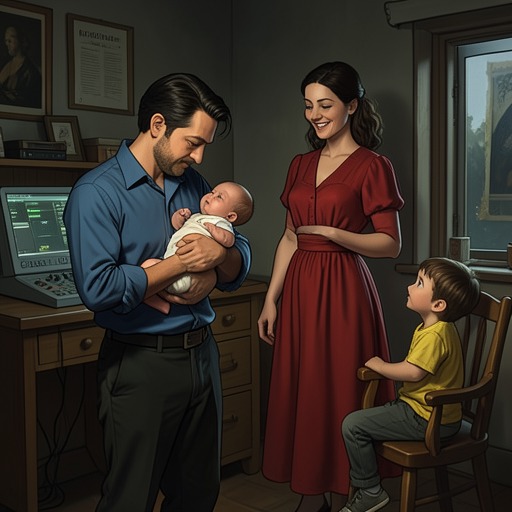
In Willis’s description, a man who became a father in the 1920s was not expected to have hands-on experience with his baby. A father of that generation who did handle an infant risked becoming the target of unlimited ribbing. The norm did not merely assign different tasks to men and women; it made direct infant care appear socially improper for men, turning ordinary parental activity into a possible source of ridicule.
The period also belongs to a broader cultural arrangement in which childrearing was considered women’s work. Mothers, rather than fathers, were regarded as the real parents, while men returned from employment, put on their slippers, and withdrew into their newspapers. Women and children were imagined as existing on another plane, a separation that rendered the mother responsible for the daily emotional and physical maintenance of family life while leaving the father positioned primarily as an outside provider.
A Generational Contrast
Willis contrasts the 1920s with the era in which her husband, Bub, became a father. Even then, too few men felt comfortable handling their own infants, but the man who did so was no longer mocked as consistently and could instead be admired, particularly by other mothers. The comparison shows that social expectations had begun to loosen without disappearing: fatherhood was moving toward participation, but competence with babies was still treated as unusual rather than ordinary.
This change is presented as part of a longer life-course and historical transition. Willis’s own childhood in Passaic, New Jersey, came within a family that valued education and made her feel intellectually capable alongside her three older brothers, yet her remembered ambition was still specifically to become a mother. Her later experience of raising six daughters in seven years, followed by more than twenty years as a full-time mother, demonstrates how thoroughly the maternal role could organize a woman’s adult life even as public ideas about fathers began to change.
Effects on Fathers and Families
The inherited expectations associated with the 1920s help explain why some fathers later felt awkward or inadequate with newborns. Willis observes that men who had never held an infant while growing up, especially men raised by absentee fathers, could be unsure what to do. Instead of receiving practice, they might be sent on errands or reduced to the status of assistant parent. A mother’s efficiency, accumulated through repetition, could unintentionally make the father’s lack of experience more visible and more discouraging.
Willis rejects the idea that fathers should be substitute mothers, babysitters, or pinch hitters. Their role is not to provide a carbon copy of maternal care but to complement and supplement it. Above all, she describes fathers as enrichers rather than simply providers, assigning fatherhood an active relational value that the older model had obscured.
Historical Significance
The 1920s marks the starting edge of Willis’s argument about the social production of parenthood. Its norms show that maternal dominance in childcare was not simply a natural outcome of women’s abilities; it was reinforced by expectations, ridicule, domestic arrangements, and the separation between paid work and family life. At the same time, Willis’s wider account complicates any simple story of progress. Mothers remain the people most often expected to create the home’s emotional atmosphere, while fathers’ increased participation depends partly on changed institutions and economic circumstances.
She identifies two forces that helped alter the older pattern: fathers’ admission to hospital delivery rooms, which allowed them to enter their children’s lives from the beginning, and the return of many mothers to full-time employment outside the home, which brought fathers into closer contact with their children out of necessity. From this perspective, the 1920s is significant not because the book reconstructs the decade in detail, but because it makes the distance between an earlier model of fatherhood and the book’s later ideal of shared responsibility unmistakable.