Willis Family Dinner Time Rules
Are We Having Fun YetThe Willis Family Dinner Hour was the Willis family’s daily rule of gathering everyone at the table, and Kay Willis presents it as one of the most important practices holding a household of ten children together. More than a meal, it created a reliable period in which parents and children could see one another, speak in turn, listen to one another, and share responsibility for the family’s emotional life. Its force came from repetition: the dinner hour returned every day, even when work was stressful, children were noisy, and the practical burdens of feeding a large family were considerable.
Definition and Household Setting
The rule required the family to meet for dinner together rather than treating food as a series of separate meals consumed around competing schedules. Bub Willis regarded this gathering as essential. When Kay Willis occasionally fed the children early and prepared a quiet dinner for the two adults during one of Bub Willis’s especially stressful weeks, he objected that he worked hard precisely so he could come home and be with the children. His objection reveals the rule’s underlying principle: the purpose of returning home was not merely to eat but to participate in the family’s shared life.
The practice was not always tranquil. Kay Willis called Bub Willis “St. Grumpy” because, although he wanted to be with his ten children, spilled milk and general disorder could make him roar like a lion. Even so, with rare exceptions, he came home for dinner every evening. The regularity mattered more than the absence of irritation. The dinner hour gave the family a stable point of contact in which affection, fatigue, conflict, and humor could coexist rather than being separated into different parts of domestic life.
How the Rule Worked
The dinner table organized conversation as deliberately as it organized eating. Because Kay Willis and the children had spent much of the day together, Bub Willis received the first turn to speak and answer the question of how his day had gone. He took the question seriously and actually told the children about his day. Then each family member, in turn, reported something that had happened. The arrangement made listening reciprocal: the children were not simply questioned by adults, but were expected to hear one another and to treat each person’s experience as worth attention.
The children also sat in on important family matters and were encouraged to voice their opinions. In this setting, the dinner hour became an informal training ground for participation, judgment, and family membership. It gave children a place inside conversations that might otherwise have belonged only to adults, while also teaching them that speaking required attention to other people’s turns. The rule therefore joined intimacy with discipline without reducing the meal to a formal lesson.
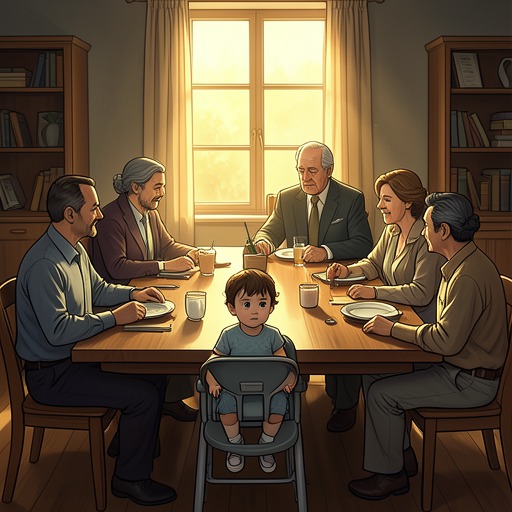
The physical arrangement reinforced that social purpose. Sharing dinner was the one occasion each day when everyone was on the same level and could make eye contact with everyone else. An infant seat might occupy the center of the table, while a toddler sat in a high chair, but even the youngest children remained part of the common visual field. The table adapted to different ages without excluding them, making bodily presence itself a form of participation.
Expansion, Humor, and Conflict
The dinner table also became a durable object of family memory as the children grew older and the household’s circle widened. The extended table could seat eighteen, twenty, or even more diners, and visiting high school friends, college classmates, and later adult acquaintances treated the large gathering as a source of wonder and amusement. The table thus extended beyond the immediate family while preserving the spectacle and ritual of collective eating.
Kay Willis once turned that curiosity into a charitable performance. When the local high school sponsored a talent show as a fund-raiser, she and Bub Willis were having difficulty persuading people to contribute performances. She staged a mock version of the Willis dinner hour: two boys carried oversized platters too large for one person, exaggerated bowls and containers filled a huge table, and the performers deliberately increased the noise. The scene was intended to be funny, and Kay Willis insisted that the charity purpose and the promise of fun justified it.
The children, especially the teenagers, wanted nothing to do with the charade and were mortified by it. Kay Willis heard their objections but did not listen to their feelings at the time. That episode complicates the rule’s otherwise celebratory presentation. A family ritual can produce belonging and embarrassment at once; the same public visibility that makes the household memorable can feel like an unwanted exposure to the children who are made part of the performance. The dinner hour’s value did not make every use of its image emotionally harmless.
Family-System Effects and Limits
Within a family as large as the Willis household, the dinner hour supplied a repeated mechanism for reconnecting members who had spent the day in different roles and spaces. Kay Willis’s enjoyment of being the mother of ten children depended heavily on support from her mother and Bub Willis, who reminded her that she was important and that no one else could do what she was doing. The dinner table was one practical setting in which that shared responsibility could be enacted: Bub Willis returned home, the children took part, and the family’s experiences were circulated rather than held separately.
The rule did not eliminate conflict elsewhere in the family system. Ben Willis and Tim Willis, who were almost two years apart, fought repeatedly throughout adolescence, and Kay Willis sometimes had to stand physically between them. Their rivalry lasted for years before improving, perhaps when they played varsity football on the same high school team and perhaps more decisively when they lived in separate states during college. The dinner hour should therefore be understood as a stabilizing practice, not a magical cure. It created a recurring site of contact and recognition, but sibling conflict still required time, distance, and changing relationships to ease.
The rule also depended on emotional labor. A crowded mind makes attentive listening difficult, and Kay Willis warns that household chores and competing obligations can crowd out the concentration children need from adults. The dinner hour offered a protected occasion for attention, but maintaining its warmth required more than placing food on the table. Parents had to listen, manage irritation, and keep resentment from permeating the atmosphere in which the children were growing. In that sense, the dinner ritual belonged to a larger account of parenting in which atmosphere and attitude shape children’s happiness and success.
Legacy and Significance
Kay Willis ultimately calls the dinner table the core of the Willis family unit and credits Bub Willis’s insistence that everyone meet there every day with making a major contribution to the family’s strong connection. Her emphasis falls on accumulation rather than spectacle: much was learned at the table, much was shared, and more often than not there was a great deal of humor. The rule converted ordinary meals into a daily archive of family life.
Its significance also lies in its resistance to the idea that effective parenting requires completing every chore or controlling every moment. Other guidance in the book urges parents to save time for doing nothing, get down on the children’s level and play, and simplify household work when necessary. The dinner hour follows the same logic. Its value came from presence, eye contact, conversation, and shared time, not from culinary perfection or an immaculate domestic performance. Even the household’s noise and spilled milk could be absorbed into the practice.
The rule’s imagined reach is deliberately expansive. Kay Willis says that if she were ever elected president of the United States, her first official act would be to make the family dinner hour mandatory for the whole country. The exaggeration gives the practice comic force, but it also states the depth of her conviction: in a culture where conversation competes with chores, work, and divided attention, a recurring table can function as a small civic institution. The Willis Family Dinner Hour is therefore remembered not simply as a scheduling preference, but as the family’s daily method for making connection visible and repeatable.