Aden
Around the World in Eighty DaysAden is a crucial resupply point on the Mongolia’s passage from Suez to Bombay: a place where the speed of the journey depends on coal, harbor services, and a brief stop ashore. The port also offers Passepartout a glimpse of a crowded, mixed population, while Phileas Fogg treats the call chiefly as another point on a tightly managed itinerary. In the novel, Aden brings together the material demands of global steam travel and the differing ways its travelers experience the places they cross.
Position and Setting
The Mongolia’s route placed Aden at the far end of the Red Sea, after a passage of 1,310 miles from Suez. From Aden, the steamer still had 1,650 miles to cover before reaching Bombay. The ship passed through the Strait of Bab-el-Mandeb before calling at Steamer Point, northwest of Aden harbor. These distances make the port more than a named waypoint: it occupies a necessary interval between long stretches at sea, where a steamship could not simply continue without replenishing its fuel.
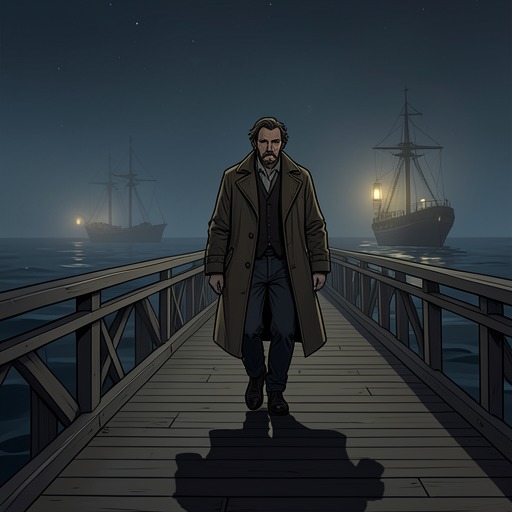
The account introduces Aden through the practical and visual features of its harbor. Passepartout sees fortifications that make the place, in the narrator’s description, the Gibraltar of the Indian Ocean, as well as vast cisterns where English engineers are still at work. The comparison lends the port a strategic cast, while the cisterns direct attention to the work required to sustain a settlement and its traffic in a demanding maritime setting. Aden appears at once as a defended outpost and as infrastructure under continuing construction.
Coaling and the Timetable
The Mongolia’s call was dictated by fuel. The steamer had to remain at Steamer Point for four hours to take on coal; the narrative stresses the expense and difficulty of supplying ships so far from coal mines. It gives the Peninsular Company’s annual coaling costs as about £800,000 and says that coal in these distant seas cost three or four pounds sterling a ton. Such figures make the pause legible as an economic necessity, not an incidental delay. The route’s apparent speed rested on a costly supply system at its ports.
The stop did not, however, put Fogg behind schedule. The Mongolia was due at Aden on the morning of the 15th but arrived on the evening of the 14th, fifteen hours ahead. After the four-hour coaling stop, it left at six in the evening for the Indian Ocean, with 168 hours to reach Bombay. The favorable sea and northwesterly wind assisted the ship, and the passage continued successfully. Aden therefore marks both a dependence on fixed port services and a moment when the journey’s timetable gains rather than loses time.
The Port Ashore
Fogg and Passepartout went ashore to have their passports visaed, and Fix followed them without being noticed. The formal errand connects the port’s practical role to the checks required of travelers moving through the route. Fogg returned to the ship as soon as the visa was obtained, resuming his established habits; for him, the stop remained bounded by what the journey required.
Passepartout used the interval differently. He wandered among the people he encountered in Aden, a population the narrative gives as 25,000 and describes through a list that includes Somalis, Banyans, Parsees, Jews, Arabs, and Europeans. He also looked at the fortifications and cisterns. His response makes the shore leave a brief episode of observation rather than simply a pause in transit: where Fogg’s attention is concentrated on completing formalities and returning aboard, Passepartout registers the port’s built environment and social variety. The contrast is limited but telling; the same stop serves the schedule for one traveler and becomes an occasion to see something new for the other.
Narrative Significance
Aden’s narrative importance lies in how compactly it exposes the conditions behind the journey’s celebrated pace. The Mongolia’s progress depends not only on a ship and a timetable but on coal, money, port facilities, and passport procedures. The four-hour stop is short, yet the account supplies distances, costs, and the ship’s schedule to show how much logistical support that apparent continuity requires.
The port also sharpens the difference between movement and encounter. Fogg’s visit is instrumental, while Passepartout’s brief walk allows the narrative to frame Aden through its people, fortifications, and water infrastructure. Neither experience interrupts the onward route for long: at six in the evening the steamer leaves, carrying its passengers toward Bombay with time in hand. Aden is thus both a functioning link in the travel network and a fleeting vantage point from which the novel makes that network visible.