Allahabad
Around the World in Eighty DaysAllahabad is a city of religious and historical weight that becomes a practical hinge in Phileas Fogg’s journey: the Great Indian Peninsula Railway resumes there after a fifty-mile unfinished stretch, and the travelers must reach its station in time to continue toward Calcutta. Its sacred rivers and diminished urban fortunes give the stop a character distinct from its importance on the timetable.
Setting and urban character
Allahabad is described as the City of God, built at the junction of the Ganges and Jumna, whose waters draw pilgrims from across the peninsula. The account layers sacred geography over a changing civic landscape: a once-noble fort has become a state prison, and the city’s commerce has dwindled. Passepartout looks for a bazaar like those he knew in Regent Street, but finds no such familiar commercial scene. The contrast makes the place legible to him through what it lacks as much as through its celebrated religious associations.
The broader setting is a country whose travel systems and political arrangements are changing. The British Crown exercises authority over much of India, while the narrative describes new steamboat routes and a railway crossing the peninsula. Allahabad belongs to that modern network, but the station’s importance does not erase the older city around it: sacred rivers, pilgrims, a converted fort, and a reduced commercial life coexist within the same account. The city is at once a destination with its own history and a point measured by how quickly travelers can pass through it.
Railway junction and the unfinished route
The Great Indian Peninsula Railway runs from Bombay toward Calcutta, turning north-east before reaching Allahabad and then continuing east toward Benares and the railway’s terminus at Calcutta. The line promises to compress a journey that formerly required travel on foot or horseback, in palanquins, or in cumbersome coaches. Yet the promise of continuous rail travel proves premature. At Kholby, passengers learn that the track has not been completed: fifty miles remain before the line begins again at Allahabad.
This interruption exposes the difference between a published timetable and the material condition of the route. Newspapers had announced the railway’s completion throughout, but the travelers encounter a break in the line. Fogg is not caught without a plan. He says he had expected some obstacle to arise and can spend two of the days he has gained. A steamer is due to leave Calcutta for Hong Kong at noon on October 25, and he believes the party can still arrive in time. Allahabad consequently marks more than a railway terminus: it is the point at which an announced network becomes usable again and the onward schedule can be recovered.
Station, supplies, and onward passage
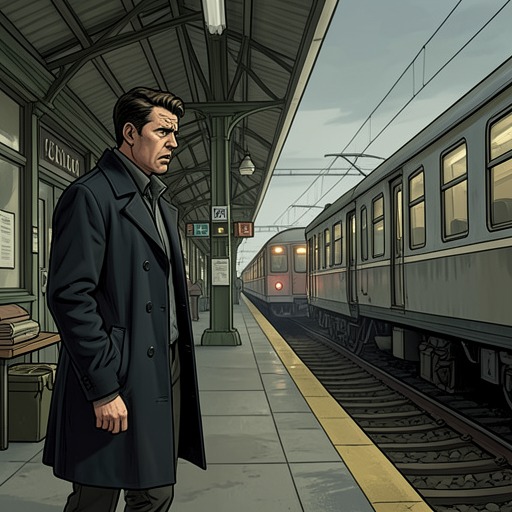
The party reaches the Allahabad station at about ten o’clock. With the interrupted railway resumed, the train can take them to Calcutta in less than twenty-four hours, keeping the October 25 departure within reach. The station’s function is sharply practical: it receives the travelers after the route’s break and returns them to the timetable. The sacred city outside it matters differently to each member of the party, but the railway sets the immediate measure of their stay.
Aouda waits in a station room while Passepartout goes into the city to buy clothing for her. His purchases include a dress made of Scotch material, a large mantle, and an otter-skin pelisse, for which he pays seventy-five pounds. The errand gives the brief stop a personal purpose beyond onward movement: after her rescue, Aouda needs clothes suited to travel, and Phileas Fogg gives Passepartout unlimited credit for the task. Passepartout also takes the opportunity to look around, encountering a city whose religious renown and history do not translate into the familiar bazaar he had expected.
As the train is about to start, Phileas Fogg pays the guide exactly the amount agreed upon, and no more. Passepartout is astonished because the guide had risked his life in the adventure at Pillaji and might still face the Indians’ vengeance. The moment places contractual precision beside personal gratitude: Fogg observes the agreed terms, while Passepartout registers the human danger and devotion behind the service. Allahabad is thus also where the party’s passage through India is settled in practical details—clothing, payment, and the return to rail.
Narrative significance
Allahabad concentrates the book’s tension between speed and interruption. The railway makes rapid passage possible, and its resumption allows Fogg to preserve his onward connection; the missing fifty miles show that modern transport remains dependent on incomplete infrastructure and improvised transitions. The city’s sacred confluence, historic fort, and altered commerce briefly widen the narrative beyond the travelers’ calculations, while their station stop narrows attention again to the next departure. Allahabad matters in both registers: as a place shaped by layered religious and urban histories, and as the junction where a broken route becomes a continuous journey once more.