American bison
Around the World in Eighty DaysIn the American railway episode, American bison are more than scenery: their mass and unalterable movement bring the train to a halt. The encounter makes the journey’s dependence on forces outside human control concrete, as passengers and railway machinery must yield to the herd’s passage.
Herd and Movement
The narrative presents the animals collectively, as a great herd that can gather in numbers large enough to obstruct the track. Herds of thousands may cross for hours, making passage impossible until the line is clear. In this encounter, an estimated ten or twelve thousand American bison crowd onto the route around noon. They move with a tranquil gait and bellow deafeningly; once they have taken a particular direction, nothing can moderate or change their course. Their movement is compared to a torrent of living flesh, an image that stresses not aggression but sheer scale and momentum.
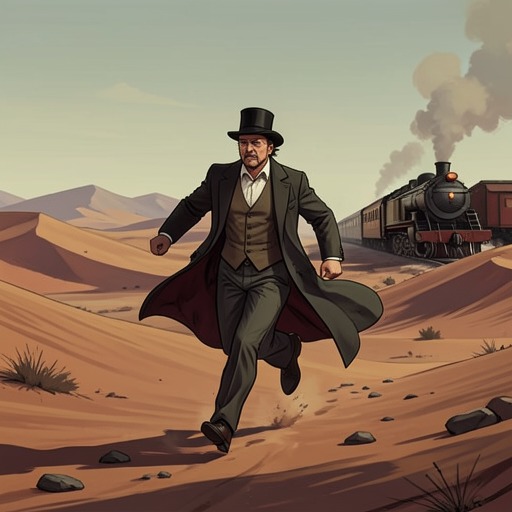
The train’s cow-catcher cannot clear the way. The locomotive slows and tries to push through, but the mass is too great. The account makes the danger practical rather than abstract: although the engine might crush the first animals, the herd would soon stop it, and the train would inevitably be thrown from the track. Against that risk, the animals’ passage is not a spectacle the railway can simply overpower.
The Halt on the Railway
The passengers watch from the platforms, but Phileas Fogg stays in his seat, waiting philosophically despite having the greatest reason to hurry. His restraint contrasts with Passepartout’s fury: he resents the delay and longs to use his revolvers against the herd. The difference in their responses marks two ways of meeting the interruption, but neither changes the train’s predicament. The engineer does not attempt to force a passage; the prudent choice is to wait and make up time with greater speed once the track is clear.
The herd’s passage lasts three full hours, and night falls before the railway is clear. As the last ranks cross the rails, the first have already disappeared below the southern horizon. The delay is therefore measured not just by the train’s standstill, but by the immense length of the moving herd, stretching across the landscape beyond the passengers’ immediate view.
Narrative Significance
The encounter reverses the expected hierarchy between modern transport and the natural world. The locomotive is powerful, and the railway promises rapid movement, yet neither can command the herd or safely force it aside. For the duration of the crossing, the timetable must accommodate animal movement. The practical answer is waiting, followed by an attempt to recover lost time—a reminder that speed depends on conditions a machine cannot control.
The episode also gives the animals a forceful, if collective, presence. Their course is described as beyond moderation, while human responses range from Fogg’s patient stillness to Passepartout’s anger. The scene does not turn the herd into an antagonist with a personal motive; its importance lies in the independent movement that interrupts the travellers’ plans. Once the track clears, the train continues, passing through the Humboldt Range at eight o’clock and reaching Utah, the region of the Great Salt Lake, at half-past nine.