Bundelcund
Around the World in Eighty DaysBundelcund is a sparsely travelled, politically contested territory between the railway route from Bombay toward Allahabad and the Vindhias. In the novel, it is both a break in the promised speed of modern transport and the setting for the episode that redirects Phileas Fogg’s party from simple passage to the rescue of Aouda. Its distance from firm British control shapes the dangers of travel there, while the contrast between railway timetables and local conditions gives the landscape a decisive role in the plot.
Geography and Political Position
The account places Bundelcund within a much larger India described as subject to uneven rule. British authority, exercised directly by the Crown after the East India Company’s power ended, governs much of the country, but the narrative distinguishes British India from territories beyond its full reach. Bundelcund is among the regions whose rajahs retain substantial independence. Its mountain fastnesses make them difficult to reach, and the Great Indian Peninsula Railway skirts the territory rather than making it a simple passage on a direct line.
That political geography matters to the travellers. Sir Francis Cromarty explains that the authorities cannot prevent the violence and pillage attributed to the district north of the Vindhias. The novel thus presents Bundelcund not as an empty interval on a map, but as a place where the limits of administrative power have immediate consequences for people moving through it.
Railway Promise and the Overland Gap
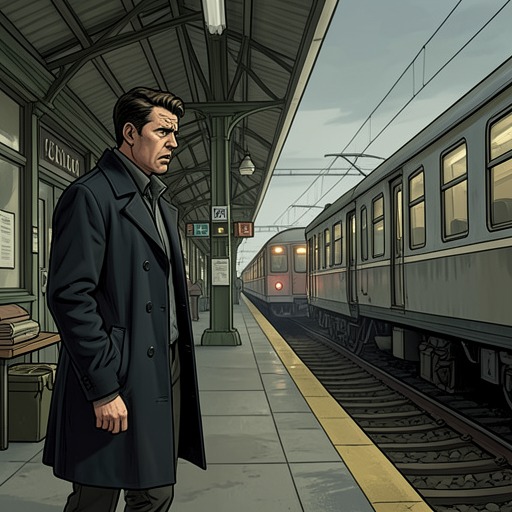
The Great Indian Peninsula Railway is presented as a modern network that can carry passengers between Bombay and Calcutta in three days, although its winding route is substantially longer than the direct distance. The apparent promise of continuous rail travel fails at Kholby: the train stops because the track is unfinished, with about fifty miles still to be laid before the line resumes at Allahabad. The railway had been announced as open throughout, but the travellers discover that the announcement does not match the conditions on the ground.
The break changes the form of the journey. Rather than wait for a railway connection that does not exist, Fogg’s party continues across country on an elephant with a guide. The route is not a brief, abstract interruption: after crossing the Vindhias, the travellers have covered nearly twenty-five miles, and another equal distance remains to Allahabad. Bundelcund makes visible the material limits behind the timetable. A railway can reorganize distance, but an unfinished stretch leaves passengers to negotiate terrain, fatigue, and local conditions themselves.
Landscape and Passage
The journey through Bundelcund moves from copses of date palms and dwarf palms to dense forest, then to dry plains dotted with sparse shrubs and large blocks of syenite. The region is described as little frequented by travellers. Bands of armed local people make threatening gestures when they see the elephant, and the guide tries to avoid them; monkeys flee the party’s path. These details establish a route that is neither a smooth extension of the railway nor a neutral wilderness. It is encountered through the travellers’ movement and the guide’s efforts to find a way through it.
The passage also measures travel by bodily pauses rather than by railway schedules. After two hours, the guide stops to rest the elephant, which drinks at a spring and feeds on nearby branches and shrubs. Later, the party halts on the northern slope of the Vindhias at a ruined bungalow. Provisions bought at Kholby make supper possible, a fire provides warmth on the cold night, and the travellers sleep while the guide watches the elephant. Their progress depends on the animal, the guide’s knowledge, supplies, and improvised shelter: a different infrastructure from the one Fogg expected to follow.
The Pagoda and Aouda’s Peril
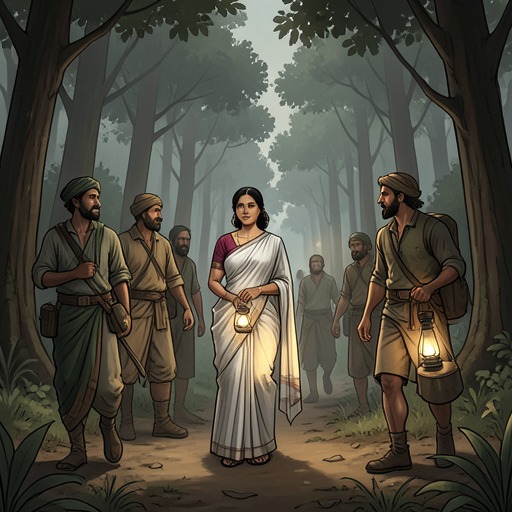
Bundelcund’s political isolation also frames the discovery of Aouda’s danger. The party learns that she is the daughter of a wealthy Bombay merchant, a member of the Parsee community, and educated in an English manner. Orphaned, she was married against her will to the old rajah of Bundelcund. After escaping, she was recaptured and, according to the guide, devoted to a funeral sacrifice by the rajah’s relatives, who had an interest in her death. The body of her husband is identified as that of the prince, an independent rajah of Bundelcund.
Fogg asks whether such practices can still occur in India and whether the English have been unable to stop them. Sir Francis answers that the authorities lack power in territories such as Bundelcund. His explanation links the threatened sacrifice to the same political conditions that make the railway gap and dangerous overland passage consequential: the party has entered a region beyond effective control by the authorities it associates with protection. Once the guide tells Aouda’s story, Fogg and his companions confirm their intention to act. They direct the elephant toward the Pagoda of Pillaji and conceal themselves in a copse about five hundred feet away, close enough to hear the cries from the ceremony.
Narrative Significance
Bundelcund brings two kinds of interruption into the same stretch of the journey. The unfinished railway breaks Fogg’s carefully timed route; the threatened sacrifice interrupts the party’s role as mere travellers. The first difficulty is answered with an overland crossing, but the second calls for a moral choice. The territory’s geography and limited reach of authority make both changes plausible within the story, while the contrast between a published railway opening and a line that still lacks fifty miles of track gives the episode a broader tension between claims of orderly progress and the uneven conditions beneath them.