Calcutta
Around the World in Eighty DaysCalcutta serves two roles in the journey: it is identified as the seat of British India’s governor-general, and it is the transfer point where Phileas Fogg’s overland passage across India gives way to the sea route toward Hong Kong. The city’s importance is measured less through a sustained portrait of its streets than through administration, transport, and a sudden legal interruption; Fogg reaches it on the precise date in his journal and departs with time still in hand.
Imperial and Administrative Setting
The account places Calcutta within a broad description of India under British rule. It gives India’s area as 1.4 million square miles and its population as 180 million, while distinguishing British India proper as roughly 700,000 square miles with between 100 and 110 million inhabitants. The British Crown, the narrator says, exercises dominion over the larger portion of the country, with the governor-general stationed at Calcutta. Governors are also identified at Madras, Bombay, and in Bengal, and a lieutenant-governor at Agra. Calcutta’s standing is therefore administrative: it is named as the centre from which imperial government is organized across a vast and unevenly controlled territory.
That political arrangement is presented as the outcome of historical change. The East India Company, described as having grown powerful after the English foothold at Madras in 1756, had annexed provinces and appointed civil and military officials; after the Sepoy insurrection, it gave way to direct Crown control. The account also notes that parts of India remain beyond British authority, including territories ruled by independent rajahs, and that the country’s appearance and social distinctions are changing. Calcutta sits inside this account as a governing centre in a political landscape the narration describes as both extensive and unsettled, not as a city isolated from the structures around it.
Arrival and the Journey’s Timetable
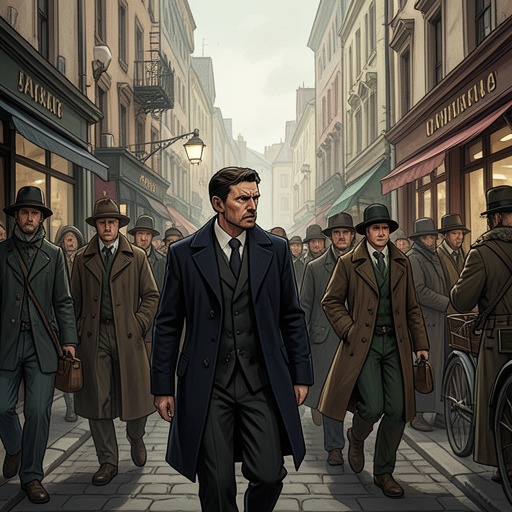
Fogg reaches Calcutta by train at seven in the morning, after the party’s passage across India. The packet for Hong Kong is due to leave at noon, giving him five hours in the city. His journal records that he should arrive on October 25, and that is the date on which he actually arrives: neither late nor early. The two days gained between London and Bombay have been lost during the Indian crossing, but the narration emphasizes that Fogg does not regret the change. Calcutta thus marks a precise accounting point in the wager, where the schedule can be checked against the journey rather than merely anticipated.
The route’s delays have a material context. At Kholby, the travellers learn that the railway is unfinished: about fifty miles remain before the line resumes at Allahabad, despite newspapers having announced its opening throughout. The interruption makes clear that the advertised network and the usable one are not identical. Later, the travellers pass through the country by train, with places and industrial sites appearing rapidly along the route; the journey is not simply a seamless dash across a map. By the time the train reaches Calcutta, the lost days are part of the timetable Fogg must manage, and the city becomes the hinge between an incomplete overland connection and a scheduled sea departure.
The Court and the Departure
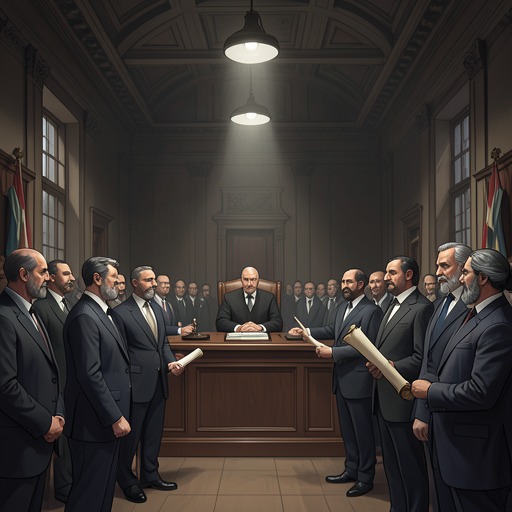
The transition from station to ship is interrupted by a policeman who addresses Fogg and identifies Jean Passepartout as his servant. At half past eight, the officer leads Fogg and his companions into a crowded courtroom, where Judge Obadiah enters and begins proceedings. The supplied episode gives the trial a brisk, almost comic surface—the judge hastily puts on a wig and discovers it is not his—but its practical consequence is serious enough to threaten the party’s onward movement. The courtroom places the travellers within Calcutta’s legal machinery just when their itinerary calls for rapid passage through the city.
After the proceedings, Passepartout angrily asks for his shoes back and remarks on their extravagant cost and poor fit. Fogg offers his arm to Aouda, and the group leaves, with Passepartout crestfallen behind them. Fix follows, still hoping that the suspected robber will remain in jail rather than leave the money behind. The episode therefore brings the pursuit into the same public space as the travellers’ efforts to keep moving: Fogg’s private timetable is tested by a legal process, while Fix continues to interpret his actions through the bank-robbery suspicion.
The party takes a carriage to a quay, where the Rangoon is moored half a mile offshore with its departure signal raised. At eleven, Fogg is an hour ahead of the vessel’s departure time. The sequence compresses Calcutta into a station, a courtroom, and a waterfront transfer, yet each setting changes the immediate stakes: arrival confirms the journal, the court briefly obstructs the route, and the quay restores the possibility of onward travel. The city’s narrative significance lies in this combination of imperial scale and exact local timing.
A Point of Comparison on the Route
Calcutta is not given an extended street-level portrait in these episodes, but it recurs as a reference point in the novel’s account of travel and encounter. When Jean Passepartout later wanders through Yokohama among merchants and people of many nationalities, the narration compares that mixed crowd to those in Hong Kong and Calcutta. The comparison makes Calcutta legible as one of the route’s international commercial settings, even though the scene itself takes place elsewhere. It also shows how the itinerary gathers cities through repeated points of contact—ports, crowds, trade, and transport—rather than pausing to describe each place equally.
That selective treatment complements Calcutta’s role as a junction. It is at once the named centre of colonial administration, a destination reached after the railway gap and the long Indian crossing, the setting for a court appearance, and the point from which the party sails toward Hong Kong. Its importance in the narrative comes from how these functions converge: a vast political geography is reduced to a scheduled arrival, a contested morning, and a ship waiting offshore.