Calcutta Trial for Temple Desecration
Around the World in Eighty DaysThe Calcutta Trial for Temple Desecration transforms a tourist’s heedless entry into a pagoda into a legal crisis for Phileas Fogg and Passepartout. Its immediate stakes are imprisonment, a heavy fine, and the interruption of Fogg’s journey; its decisive reversal comes when Fogg pays the required bail and leaves the court with his party rather than remaining in custody.
The visit to Malabar Hill
While in Bombay, Passepartout’s curiosity carries him beyond his intended route. After watching a Parsee religious carnival recede into the distance, he sees the pagoda on Malabar Hill and decides to enter, unaware that Christians are forbidden from entering certain Indian temples and that visitors must remove their shoes. The British Government, the narrative notes, severely punishes disregard for the practices of native religions.
Inside, Passepartout admires the Brahmin ornamentation until he finds himself sprawled on the sacred floor. Three priests attack him, tear off his shoes, and beat him. He gets to his feet, knocks down two of them with his fists and kicks, then escapes the third by mixing with the crowd. The encounter leaves him hatless and shoeless, and he loses the package of shirts and shoes he had bought. Five minutes before eight, he rushes breathlessly into the station. The sequence makes the charge arise from a specific, unintended breach, but his effort to escape the beating adds a physical confrontation to the original intrusion.
Arrest and accusation
The legal consequences reach Fogg just as he is leaving the station with Aouda. He intends to go directly to the Hong Kong steamer so that she can be settled comfortably for the voyage, and he does not want to leave her while they are still in dangerous surroundings. A policeman approaches and confirms Fogg’s identity, then asks whether Passepartout is his servant. The interruption places the planned departure and the criminal proceeding in immediate competition.
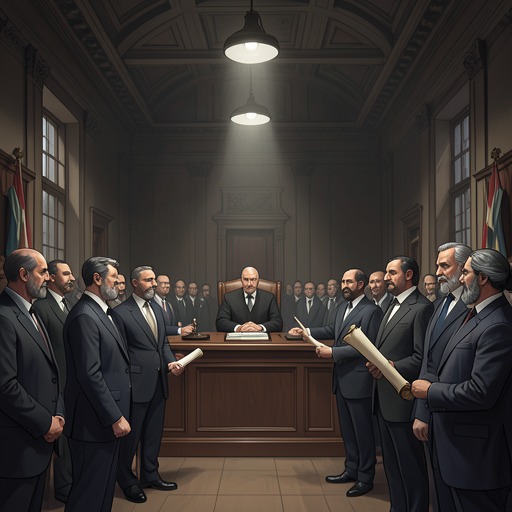
At the hearing, the judge orders the door opened and three Indian priests enter as complainants. Passepartout recognizes them as the men who had attacked him. The clerk reads the accusation: Fogg and his servant are charged with violating a place consecrated by the Brahmin religion. The charge thus reaches beyond Passepartout’s own entry and names his master as well. Asked whether he hears it, Fogg consults his watch and admits it; when the judge later asks whether the facts are admitted, Fogg again answers affirmatively and coldly. His response is not an attempt to dispute the violation or delay the proceeding. Even in court, the watch remains part of how the scene registers his attention to time.
Sentence and bail
The judge grounds the ruling in English law, which, he says, protects the religions of the Indian people equally and sternly. He specifies that Passepartout violated the sacred pagoda of Malabar Hill in Bombay on October 20, then sentences him to fifteen days’ imprisonment and a fine of three hundred pounds. Passepartout is startled by the size of the fine. The judgment makes the legal protection of religious practice concrete through both a prison term and a substantial financial penalty.
The court also sets bail at one thousand pounds for each prisoner. Fogg immediately takes banknotes from the carpet-bag, which Passepartout has with him, and places them on the clerk’s desk. The judge explains that the sum will be returned upon release from prison and declares the prisoners liberated on bail. Fogg’s payment resolves the immediate danger of detention without erasing the conviction or its consequences: the party can leave, while the money remains held as security. His readiness to pay is especially consequential because the accusation threatens to keep him from the next stage of the journey.
Departure and dramatic consequence
Fogg offers his arm to Aouda and leaves, followed by a crestfallen Passepartout. Fix, who has been following Fogg, first fears the consequences of the ruling, then hopes the required bail might persuade him to remain in jail. Instead, Fogg takes a carriage with the others to a quay. The Rangoon lies half a mile offshore with its departure signal raised; it is eleven o’clock, and Fogg is an hour ahead of schedule. They leave the carriage and push off in a boat for the steamer.
Fix stamps his feet in disappointment and treats the two thousand pounds as money sacrificed by the suspected robber, whose supposed theft he believes will soon be exhausted at this rate. That interpretation belongs to Fix’s mistaken pursuit, not to the court’s finding. For Fogg and his party, the trial’s practical outcome is an escape from immediate imprisonment and a prompt return to the route: the legal crisis has cost money and left Passepartout crestfallen, but it has not prevented them from boarding the Rangoon.