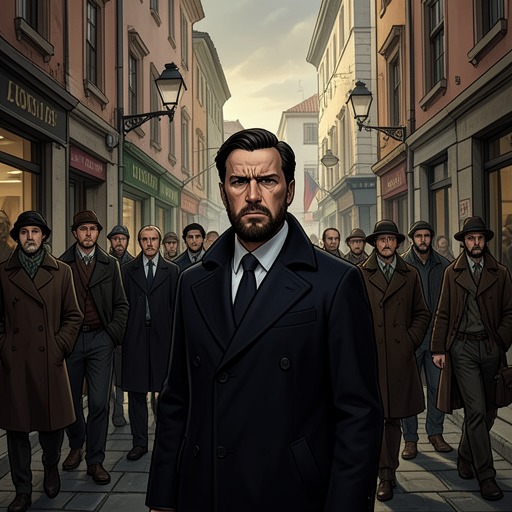
Colonel Stamp Proctor
Around the World in Eighty DaysColonel Stamp Proctor enters the story as an adversary of Phileas Fogg, and his repeated appearances turn a personal grievance into a test of how conflict changes under pressure. He first becomes identifiable to Fogg in San Francisco; later, their planned duel aboard a train is interrupted by an attack from Sioux raiders. Proctor then joins Fogg in rushing toward the danger, before being wounded in the fighting. The sequence makes him more than the occasion for a quarrel: when the immediate stakes change, he acts alongside the man he had challenged.
Identity and Introduction
Proctor is identified as a colonel and encountered during the San Francisco episode. When the two men meet again, Fogg asks his name, and Proctor supplies it. The exchange establishes his identity directly, but the evidence gives little biographical background beyond his military title and his presence among travelers in the United States.
His first established connection to the central party is antagonistic. Aouda recognizes him at Green River as the man who had grossly insulted Fogg at a meeting in San Francisco. Proctor is not simply a stranger who happens to share their route: his earlier conduct has left Fogg with a grievance and made his reappearance consequential to the travelers. Aouda, aware that Fogg wants to call him to account, fears that Fogg will notice him. Her response shows that the conflict has become a concern for the party before Proctor and Fogg confront each other again.
A Conflict That Returns
At Green River, Proctor’s presence is described as chance, not as a deliberate pursuit of Fogg. Aouda draws back from the window to avoid being recognized, while the encounter’s significance lies in what might follow: Fogg has not yet seen the man he wants to confront. The episode renews the San Francisco dispute without immediately resolving it, carrying the threat of a personal reckoning onto the train.
The confrontation takes place later aboard the same train. Proctor and Fogg recognize each other at once. Proctor challenges Fogg over a card-game decision, and Fogg rises to answer him. The quarrel thus resumes through a small, specific provocation rather than through a new account of their earlier disagreement. For Fogg, however, it is not merely a dispute about the game: he says Proctor has insulted him again and insists the affair is his to settle. He refuses Fix’s attempt to take responsibility for the confrontation, making clear that he regards the grievance as personal.
The Duel Interrupted
Proctor accepts Fogg’s challenge, and the men prepare to duel in a separate train car. The arrangement is starkly practical: the long aisle provides room for the two opponents, each is given two six-chambered revolvers, and the seconds agree that they will begin at the locomotive’s whistle. Fix and Passepartout wait outside. The impending duel appears to have reduced the journey to a formal contest between two men, with a precise signal marking its beginning.
That signal never becomes the decisive sound. Before the duel can start, cries and gunfire break out along the train. Proctor and Fogg leave the car with their revolvers and hurry toward the disturbance. They discover that Sioux raiders have attacked the train, with a hundred raiders having climbed aboard without stopping it. The change is immediate: the men who had been prepared to shoot each other now face a threat to the passengers and train around them.
Action During the Attack
Proctor’s role shifts from challenger to participant in the response to the raid. He rushes forward with Fogg, rather than remaining inside the car to pursue their private dispute. The account describes him as fighting bravely. This action does not erase his hostility toward Fogg, but it places that hostility beside a more urgent shared danger and shows both men acting within the same crisis.
The attack leaves several passengers missing, and the wounded are taken to a station for care. Proctor is among the most seriously hurt, though none of the wounded passengers is reported mortally injured. Fogg escapes without a scratch; Fix has a minor wound to the arm; Aouda is safe. Passepartout, however, is missing, and Aouda weeps. Proctor’s injury therefore belongs to a wider aftermath in which the travelers’ concern shifts from the duel to the uncertain fate of the missing passengers. The evidence establishes that he survives the immediate attack, but does not detail his later course.
Narrative Role
Proctor’s appearances bind together two kinds of conflict: the private challenge between him and Fogg, and the sudden collective danger of the train attack. His return at Green River renews the unresolved dispute; the preparation for a duel gives it a concrete form; the raid then interrupts that form before the planned contest begins. The reversal is central to his function in the episode: the confrontation is not settled by the agreed weapons or signal, but displaced by an emergency that demands action from both opponents.
The episode also distinguishes Proctor from a purely static obstacle. He remains Fogg’s adversary in the personal dispute, yet the attack elicits a different alignment. His decision to hurry toward the gunfire with Fogg, and his brave fighting before he is wounded, place him temporarily on the same side of the immediate crisis. The story does not supply a reconciliation or a final resolution between the two men. Instead, it leaves their quarrel unfinished while giving Proctor a consequential role in the train’s defense.