Eighty days
Around the World in Eighty DaysEighty days is the novel’s governing measure of distance, risk, and suspense. Phileas Fogg makes the period precise enough to stake half his fortune on it: he must travel around the world and return to the Reform Club by a quarter before nine in the evening on 21 December 1872. The deadline first appears to be a test of transport and calculation; by the end, the difference between the date Fogg believes it is and the date it actually is determines whether the wager has been won.
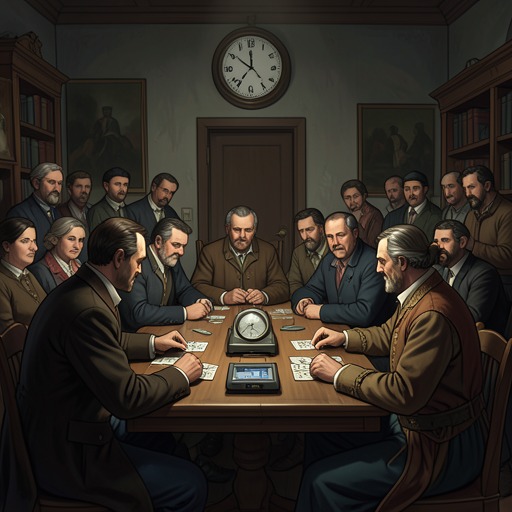
The wager and its exact terms
The time limit emerges from a discussion of how the world has grown smaller through improved travel. John Sullivan points to the opening of the Rothal-to-Allahabad section of the Great Indian Peninsula Railway as a change that makes a shorter circumnavigation possible. Phileas Fogg corrects the estimate of three months to eighty days, then answers the challenge to prove it with a wager rather than an argument.
Fogg defines the limit in three equivalent forms: eighty days, nineteen hundred and twenty hours, or one hundred and fifteen thousand two hundred minutes. The conversions make the challenge sound less like a boast than a schedule that can be measured and audited. He states the required return time as well as the date: he is due back in the same Reform Club room at a quarter before nine on Saturday, 21 December. If he misses that appointment, twenty thousand pounds deposited in his name at Barings Bank will belong to his opponents.
The wager is accepted by Stuart, Fallentin, Sullivan, Flanagan, and Ralph, and the parties sign a memorandum. Fogg remains composed, but the stake has practical importance beyond the contest: it is half his fortune, and he expects that carrying out the difficult journey may consume the other half. The fixed deadline thus governs both the journey’s duration and the scale of the financial risk.
A deadline turned into a timetable
The novel repeatedly measures progress against the remaining days. On 23 November, after the General Grant passes the 180th meridian, Fogg has spent fifty-two of the eighty days and has twenty-eight left. The ship has reached the point opposite London, so the journey is halfway round the globe by longitude. Yet that measurement understates the distance already covered: the route’s circuits between London, Aden, Bombay, Calcutta, Singapore, and Yokohama have forced the party to travel much farther than a direct line would require.
The figures make the distinction concrete. A route following London’s fiftieth parallel would be about twelve thousand miles, but irregular transport routes require a journey of about twenty-six thousand. By 23 November, Fogg has covered seventeen thousand five hundred miles—two-thirds of the actual journey, despite being only halfway around by the meridians. The shrinking number of days and the uneven geography therefore tell different stories about how far he has come.
The General Grant offers a fresh calculation of the remaining time. Its speed of twelve miles an hour is expected to carry it across the ocean in twenty-one days. On that basis, Fogg hopes to reach San Francisco by 2 December, New York by 11 December, and London by 20 December, leaving several hours before the fatal deadline. The projected arrival is not simply a destination on a map: it is a margin of safety measured against the exact evening appointment.
Delays and diminishing margin
The timetable remains vulnerable to events on the route. After the party reaches New York, Passepartout’s failure to board a boat costs them a departure by three-quarters of an hour. He blames himself for the lost time and fears that the expenses of the journey, added to Fogg’s stake, will ruin his master. Fogg does not reproach him, but the missed boat makes the deadline newly precarious.
On the morning of 12 December, the remaining interval is calculated down to the minute: from seven o’clock that morning to a quarter before nine on 21 December, Fogg has nine days, thirteen hours, and forty-five minutes. The calculation preserves a possible route to success. Had he taken the China steamship, he could have reached Liverpool and then London within the agreed period. The conditional phrasing matters: the schedule still permits success, but the means of reaching it cannot be treated as assured.
The deadline consequently functions as more than a final date. Each delay changes the available choices, and each proposed connection has to be judged by whether it can deliver Fogg to London in time. The narrative gives the clock an accumulating pressure: at first eighty days seems a generous span to the skeptics, but as the margin narrows, hours and minutes become decisive.
The final date and the wager’s meaning
When Phileas Fogg appears in the Reform Club saloon, the clock indicates a quarter before nine. He has completed the journey around the world in eighty days and won the twenty-thousand-pound wager. The result initially seems to depend on an error of one day: Fogg had thought he arrived on Saturday, 21 December, when it was actually Friday, 20 December, the seventy-ninth day after his departure. The discrepancy transforms what looked like a narrow failure into a timely return.
The ending gives the numerical test a human consequence. Fogg later observes that if he had not crossed India, he would not have saved Aouda; without that rescue, she would not have become his wife. His successful journey therefore cannot be measured only by whether the clock and the wager were satisfied. The same route that created the challenge also led him to an outcome he values beyond the money.
Eighty days binds the novel’s forward motion to a precise, public condition: a place, a date, and an hour agreed upon before the journey begins. Its arithmetic repeatedly promises control, while missed connections and indirect routes expose how little the schedule can command. The final success resolves the wager through the discrepancy in the date, but the closing reflection widens the measure of what the journey has achieved. The deadline determines the contest; it does not exhaust the journey’s significance.