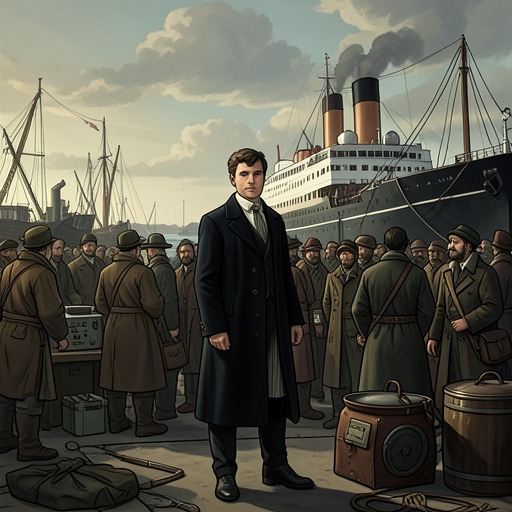
Emergency Tankadere Voyage
Around the World in Eighty DaysThe Emergency Tankadere Voyage begins when Phileas Fogg, stranded in Hong Kong by the Carnatic’s unexpectedly early departure, hires John Bunsby’s vessel rather than wait a week for another steamer. The decision turns a missed connection into a new, urgent sea passage: Fogg insists that he must reach Yokohama in time for the San Francisco boat, while Fix follows close behind and Passepartout remains absent.
The missed connection
Fogg and Aouda had intended to sail on the Carnatic, but its repairs were completed sooner than expected and it left Hong Kong twelve hours before the stated time, without notice. The practical consequence is severe: the next steamer would require a week’s wait, a delay incompatible with Fogg’s tightly timed journey. The missed ship is not a minor inconvenience but the obstacle that forces him to find another vessel and negotiate a route under pressure.
The news produces sharply different expectations. Fix, who is waiting for the arrest warrant, is overjoyed by the prospect of Fogg being held in Hong Kong for a week. Fogg, by contrast, calmly points out that other vessels are in the harbor. Offering his arm to Aouda, he heads for the docks to look for a craft that can leave. Fix follows him, still hoping the delay will serve the law, but Fogg’s response immediately deprives that hope of its apparent certainty.
For three hours Fogg searches the docks. The vessels he finds are loading or unloading and cannot set sail, so the first alternative is no solution. His search nevertheless has a defined purpose: if necessary, he is prepared to charter a vessel to carry him to Yokohama. The episode makes the difference between waiting for a scheduled service and taking responsibility for the itinerary explicit. When the regular connection fails, Fogg treats the timetable as a problem to be acted upon, not a reason to abandon it.
The destination and the route
Fogg’s urgency is tied to a specific connection. He tells the sailor he approaches that he has missed the Carnatic and must reach Yokohama by the fourteenth at the latest to take the boat for San Francisco. The date and onward destination give the request its stakes: a vessel is useful only if it can keep the journey moving toward the next link in the planned passage.
A route discussion tests that requirement against alternatives. The pilot proposes Nagasaki, at the southern end of Japan, or Shanghai, described as eight hundred miles away. Shanghai has a stated navigational advantage: the boat would not have to sail wide of the Chinese coast, and northward currents would help it along. Fogg nevertheless insists that he must take the American steamer at Yokohama, not at Shanghai or Nagasaki. When the pilot counters that the San Francisco steamer starts from Shanghai and only calls at Yokohama and Nagasaki, the disagreement reveals the pressure between a potentially more advantageous route and Fogg’s determination to meet the connection as he understands it. The evidence establishes the competing proposals and Fogg’s insistence; it does not make the proposed alternatives interchangeable with his intended plan.
Chartering the Tankadere
The available vessel is the Tankadere, whose master is John Bunsby. Fogg asks whether Bunsby will take him to Yokohama and, when the terms are accepted, asks whether he is the boat’s master and whether he wants earnest-money. The exchange reduces the crisis to a concrete arrangement: an identified boat, an identified captain, and a bargain that can replace the missed scheduled steamer. Bunsby says the vessel can be ready in an hour, once provisions are aboard and the sails are raised.
The agreement changes Fix’s prospects once more. His initial delight depended on Fogg being detained; now Fogg has found a way to depart rather than wait for the warrant to arrive. Fix’s hopes rise and fall with each practical development at the docks, while his continued proximity makes him a witness to the very initiative that frustrates his plan. The search has not removed him from the pursuit; it has instead forced him to follow Fogg into a fresh passage.
Departure and immediate consequence
At ten minutes past three, the sails and English flag are hoisted. Fogg and Aouda sit on deck and give the quay a last look, hoping to see Passepartout. Fix also fears that the servant might appear, since he has treated him badly and an encounter would require an explanation. Passepartout does not arrive; the account indicates that he is still under the stupefying influence of opium. His absence is therefore part of the departure’s cost: Fogg leaves with Aouda, while the servant who might have rejoined them remains behind.
Bunsby gives the order to start, and the Tankadere catches the wind in its brigantine, foresail, and standing-jib before moving briskly over the waves. The detailed naming of the sails gives the change from negotiation to action a physical form: provisions and rigging have been made ready, and the vessel is moving. The episode establishes an urgent departure intended to get Fogg to Yokohama, not the voyage’s eventual arrival or success. Its decisive turn is that the early loss of the Carnatic does not leave him waiting in Hong Kong; he substitutes a chartered boat for the missed connection and resumes his attempt to keep the larger journey on schedule.