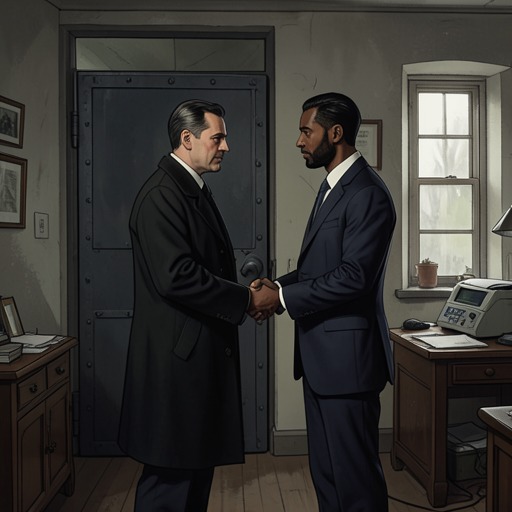
Fix Drugs Passepartout in Hong Kong
Around the World in Eighty DaysFix drugs Passepartout in Hong Kong to prevent him from warning Phileas Fogg that the Carnatic is leaving earlier than expected. The episode converts Fix’s pursuit from surveillance and persuasion into deliberate incapacitation: with the arrest warrant still absent, he tries to hold Fogg in Hong Kong by removing the one companion ready to tell him the news.
The departure that changes the stakes
The immediate pressure comes from a change in the ship’s schedule. Fix and Passepartout enter the steamer office and secure cabins for four people. As the clerk hands over their tickets, he reports that repairs to the Carnatic are complete and that it will sail that very evening, not the next morning as previously announced. Passepartout sees the news as good for his master and goes to tell him. The earlier departure makes an ordinary errand urgent: if Passepartout reaches Phileas Fogg in time, Fogg can respond to the changed timetable; if he does not, the opportunity to travel on the ship may be lost.
That practical urgency sharpens the contrast between the two men. Passepartout treats the revised sailing time as useful information to relay, while Fix recognizes that it threatens his plan to keep Fogg in Hong Kong. The four tickets also mark Fix’s apparent place among the travelers: shortly before the encounter, he has agreed to join them. His outward participation now gives way to an effort to separate Passepartout from the party.
Fix’s bargain and disclosure
Fix chooses what he calls a bold move and decides to tell Passepartout the truth about his pursuit. He explains that he has tracked Phileas Fogg to Hong Kong but has not yet received the arrest warrant he requested from London. He wants Passepartout to help keep Fogg there. The confession makes the legal uncertainty explicit: Fix is acting against Fogg before the document that would authorize his arrest has arrived.
Fix frames his proposal as a bargain. He tells Passepartout that the suspected bank theft involves fifty-five thousand pounds and that he stands to receive two thousand pounds if successful; in return for help delaying Fogg for two or three days, he offers Passepartout five hundred. The amount and the proposed delay give the plan a precise, transactional shape. Yet Passepartout’s response is not immediate cooperation. He asks what Fix wants of him only after struggling with the allegation against his master. He knows Fogg as Aouda’s saviour, a brave and generous man, and finds the charge difficult to accept even while acknowledging that the suspicions appear weighty. His divided reaction makes Fix’s attempt to recruit him a test of trust as well as a practical negotiation.
The smoking-house and the drugging
Fix takes Passepartout to a tavern on the quay. Inside, the room’s arrangement reveals the nature of the place: customers drink beer, porter, gin, and brandy at small tables, while others lie on a large cushioned camp-bed. Smokers use long red clay pipes loaded with opium mixed with rose essence. When the drug overcomes a customer, waiters carry the unconscious person by the head and feet to the bed. The narration notes that twenty people already occupy it, presenting the house as a routine setting for incapacitation rather than a private space arranged for Passepartout alone.
The episode also situates Fix’s act within the book’s portrayal of the opium trade. The narrator describes the smokers as wretched, cadaverous, and stupefied, and states that English merchants sell the drug in large quantities. Fix exploits the room’s ordinary practice for his own purpose. After Passepartout has been drinking, Fix sees that he must be separated from his master and offers him one of the pipes lying on the table. Passepartout takes it, lights it, and draws several puffs; the narcotic makes his head heavy, and he falls unconscious onto the table.
The progression matters: Fix first appeals to money and suspicion, then invites Passepartout to drink, and finally uses opium when persuasion has not secured the assistance he wants. The unconsciousness is not an accidental consequence in Fix’s eyes but the means by which he can prevent a message from reaching Fogg. His method turns a conversation that might have remained an argument into a physical intervention against Passepartout’s ability to act.
Immediate consequence and narrative significance
Seeing Passepartout unconscious, Fix concludes that Fogg will not be told of the Carnatic’s departure. He also recognizes the contingency in his plan: even if Fogg learns of the sailing, he will have to go without Passepartout. Fix pays his bill and leaves the tavern. The intended consequence is therefore twofold—delay Fogg’s access to timely information and separate him from his servant—but the evidence establishes Fix’s expectation, not the eventual success of every part of the scheme.
The episode’s central reversal lies in Fix’s role among the travelers. He has secured a place in their company, but privately seeks to obstruct their progress; he speaks openly to Passepartout about the warrant, then resorts to deception and a narcotic when disclosure does not produce cooperation. The ship’s unexpected schedule change supplies the narrow window for this choice. By making Passepartout unconscious at the moment he means to carry news to his master, Fix turns the timetable into a contest over who can communicate with Fogg, and shows how far he is willing to go before his legal authority has arrived.