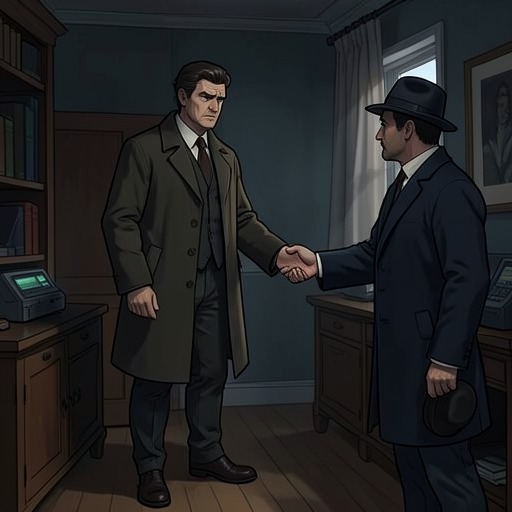
Fix Turns to Helping Fogg
Around the World in Eighty DaysFix’s turn toward helping Phileas Fogg is a tactical reversal, not a declaration of Fogg’s innocence. After Passepartout gives him a beating, Fix calmly recounts the measures he took to obstruct Fogg and offers a new arrangement: he will now remove obstacles from Fogg’s path on the journey back to England. Passepartout accepts cooperation, but not friendship, making the alliance explicitly conditional on Fix’s honesty.
The reversal aboard the General Grant
The conversation follows a physical confrontation. Fix acknowledges that Passepartout has thrashed him and says he expected it; rather than answering with another threat, he asks Passepartout to listen. The two sit apart from the other passengers, and Fix announces that he was Phileas Fogg’s adversary but is now in his game. His composure makes the change sound calculated rather than repentant: the immediate subject is not whether he has wronged Fogg, but why helping him has become Fix’s best course.
Passepartout tests the apparent change of sides by asking whether Fix is now convinced that Phileas Fogg is honest. Fix answers no. He still considers Fogg a rascal, so his offer does not rest on new evidence of Fogg’s character or a revised judgment of the suspected crime. The distinction matters: Fix changes his conduct while retaining his suspicion. The reversal is therefore a change in strategy, not a resolution of the case.
Fix’s account of the obstruction
Fix explains that, while Phileas Fogg was on English ground, his own interest was to detain him until the arrest warrant arrived. He then names the actions he took to delay the party: he sent the Bombay priests after Fogg, got Passepartout intoxicated in Hong Kong, separated him from his master, and caused Fogg to miss the Yokohama steamer. These are not vague claims of past opposition; together they show how Fix’s pursuit repeatedly worked through interruption and separation, including against Passepartout himself.
The confession also recasts the earlier setbacks as deliberate interventions by the detective. Fix does not present those actions as misunderstandings or deny responsibility for them. He says plainly that he did everything he could to keep Fogg back, because that served his interest while Fogg remained in England and the warrant had not arrived. Passepartout listens with clenched fists, a physical sign that the admission has not erased the harm or anger. Yet he stays to hear Fix out, and, after listening attentively, believes that Fix is speaking in good faith.
A conditional alliance
Fix’s new calculation begins with the prospect of Fogg returning to England. He intends to follow him there, but says he will now do as much to keep obstacles out of Fogg’s way as he previously did to put them in it. He explains the reversal in terms of self-interest: the circumstances have changed, so his game has changed with them. The help is real in its intended effect, but it is not offered as a favor or as proof of loyalty to Fogg.
Fix also appeals to Passepartout’s interest. Only in England, he argues, can Passepartout find out whether he has been serving a criminal or an honest man. The proposal thus leaves the central uncertainty open while giving the two men a shared immediate purpose: getting back to England, where the question can be settled. Passepartout does not call Fix a friend. He allows that they may be allies, while warning that the smallest sign of treachery will make him twist Fix’s neck. Fix quietly agrees. Their compact is practical and guarded, formed after violence but held together by a common destination and a still-unresolved suspicion.
The alliance put to use
The later encounter with Colonel Stamp Proctor shows Fix acting in keeping with the new alignment. When Aouda reports that she has seen Proctor on the train, Fix says Proctor will have to deal with him before he settles matters with Phileas Fogg, adding that he feels he was the more insulted of the two. Passepartout likewise offers to take charge of Proctor. The exchange shows Fix ready to interpose himself between Fogg and a confrontation, although it does not establish that a fight takes place.
Aouda warns that Phileas Fogg will not allow anyone to avenge him and intends to return to America to find Proctor. She fears that Fogg may recognize him and that a collision could have terrible results. Fix accepts her reasoning: whether Fogg won or lost, a meeting would delay him. His response connects the earlier promise to a concrete travel risk. Protecting Fogg’s progress now means helping prevent a personal encounter that might cost the party time, not simply confronting the man who had insulted him.
The episode’s significance lies in this uneasy alignment. Fix remains convinced that Fogg is guilty, yet works against the delays he once engineered because the changed route makes that the useful course. Passepartout, for his part, trusts Fix’s immediate sincerity without granting him friendship or unconditional confidence. Their alliance advances the journey while preserving the question that divided them: whether Phileas Fogg is an honest traveler or the criminal Fix still believes him to be.