Fogg and Aouda’s marriage
Around the World in Eighty DaysFogg and Aouda’s marriage is the personal resolution of a journey that has carried them from her rescue to his apparent ruin. Aouda proposes when she sees Fogg bereft and alone; he responds with an emotion that breaks through his customary composure. Their marriage is then reaffirmed after Fogg’s fortune is restored, and Passepartout, who had saved Aouda, gives her away at the wedding.
Circumstances of the Proposal
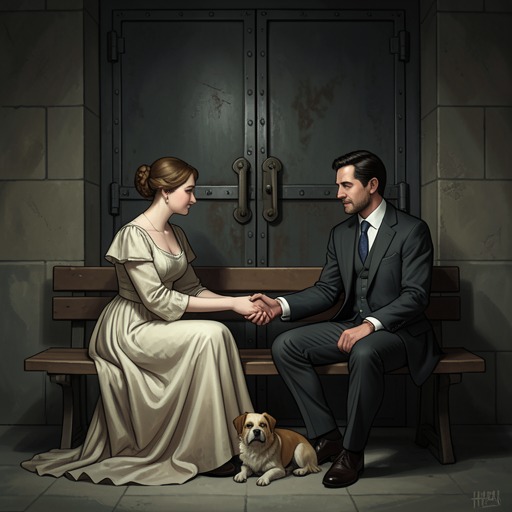
After the journey’s final reversals, Fogg is distressed enough not to remain alone. He goes to Aouda’s room, sits silently in a corner, and looks at her ruefully; she, too, is pensive. Later, at about half-past seven in the evening, he sends to ask whether she will receive him. When they meet, Fogg sits opposite her by the fireplace, outwardly unchanged: the calm, impassive man who had departed has returned. His silence makes the scene’s change of direction all the more striking. Rather than beginning with a declaration, he approaches Aouda as someone without a heart to whom he can confide his grief.
Aouda answers with sympathy, reflecting that sorrow may be borne more patiently when shared by two sympathetic people. Fogg replies only, “They say so, madam.” The restrained exchange gives way to an unmistakable offer. Aouda rises, takes his hand, and asks, “do you wish at once a kinswoman and friend? Will you have me for your wife?” The proposal comes from her: she offers not merely affection, but kinship and friendship to a man she sees facing solitude.
Fogg’s Response and Their Decision
Fogg rises in turn. For once, his face registers what his habitual impassibility conceals: there is an unusual light in his eyes and a slight tremble in his lips. Aouda’s glance, described as sincere, resolute, firm, and sweet, affects him; the narrator links its force to her willingness to dare anything to save the man to whom she owes everything. Fogg first shuts his eyes briefly, as if to avoid her look. When he opens them, he answers simply, “I love you!” He then declares, “I am entirely yours!” Aouda presses his hand to her heart.
The scene turns on a contrast between Fogg’s controlled exterior and the involuntary signs of feeling that appear in his eyes and lips. His response is not an elaborate courtship or a practical arrangement: it is a direct confession, made in answer to Aouda’s offer of shared life. The marriage therefore marks a change in their relationship, from a bond shaped by her rescue and gratitude to a commitment both explicitly accept. The next exchange fixes their intention in ordinary time: when asked whether it will be the following day, Monday, Fogg turns to Aouda, and she confirms that it will.
Reaffirmation After the Reversal
The marriage question returns after Fogg wins the wager and recovers his fortune. That evening, still tranquil and phlegmatic, he asks Aouda, “Is our marriage still agreeable to you?” Her answer recalls the abrupt change in his circumstances: she says that he had been ruined, but was rich again. The exchange makes clear that the proposal is being considered anew after that reversal, rather than treated as a decision insulated from it.
Fogg answers that his fortune belongs to Aouda and begins to explain that she had suggested the marriage when he had been ruined. The sentence is left unfinished, but its opening makes his position plain: her commitment was not founded on his restored wealth, and he places what he possesses at her disposal. Their brief exchange ends with mutual endearments. The restoration of money changes the practical circumstances, but the text presents the marriage as continuing by their consent, not as a bargain secured by Fogg’s winnings.
Wedding and Narrative Resolution
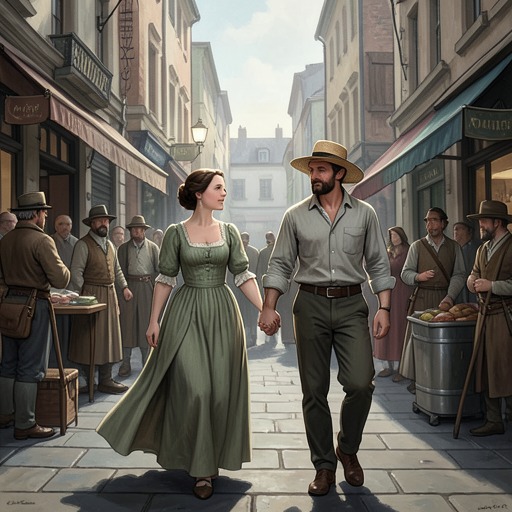
The narrator states that the marriage takes place forty-eight hours later. Passepartout gives the bride away, glowing and dazzling; the account connects his place in the ceremony to his having saved Aouda. His role brings the earlier rescue into the wedding itself: the journey’s danger is not forgotten, but becomes part of the history that precedes the couple’s union.
The marriage also closes the emotional arc of Fogg’s return. The man who first visits Aouda in grief and silence has, by the end, spoken openly of love and placed his fortune in her hands. Aouda, who initiated the proposal by offering to be both kinswoman and friend, becomes his wife. Their union resolves the personal story alongside the wager’s outcome, while Passepartout’s presence at the ceremony binds the household’s shared adventures to its new beginning.