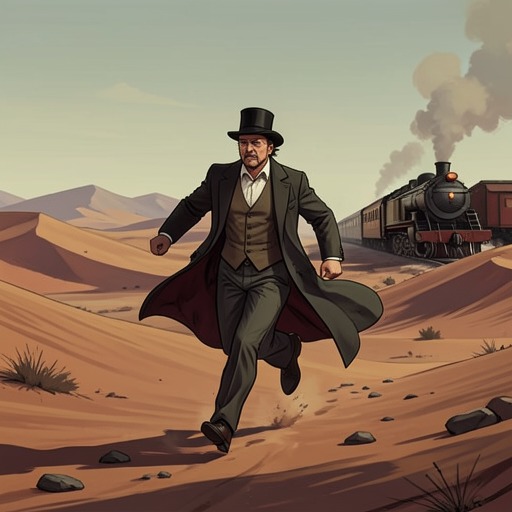
Fogg’s Party Travels to Omaha by Sail Sledge
Around the World in Eighty DaysThe sail-sledge journey from Fort Kearney to Omaha turns a railway delay into a test of improvisation: Phileas Fogg replaces a fixed timetable with a wind-driven vehicle and carries his party across the frozen prairie in pursuit of the hours needed to keep his wager alive. The episode makes the journey’s governing paradox concrete: modern transport can compress distance, but progress still depends on exposed bodies, changing conditions, and successful connections between routes.
The Lost Time and the Alternative
The immediate problem was the delay caused by the Sioux raiders’ interruption of the train journey. Fogg had expected to reach New York on the morning of the 11th, with eleven hours to spare before the steamer departed. Instead, the party was twenty hours behind. Fix calculated that, after accounting for the time already lost in the interruption, they needed to regain eight hours. The arithmetic turned the trip to Omaha into more than a passage across the plains: it was a bid to recover a narrowly specified margin before the Atlantic crossing.
Fix proposed a sledge with sails, an idea he had heard from a man who had offered it during the night. Fix had refused that offer then; now, with the timetable endangered, he pointed the man out to Fogg. The vehicle belonged to Mudge, who could take them toward Omaha, where trains ran east to Chicago and New York. The suggestion mattered because it offered a different kind of connection, not a faster train: the party would leave the railway line and rely on a land-craft powered by the wind.
A Sledge Made for the Prairie
At a hut below Fort Kearney, Fogg examined Mudge’s unusual vehicle before making a bargain. Built on two long runners, it had room for five or six passengers, a mast secured by metal lashings, a large brigantine sail, a jib, and a rudder. It resembled a sloop translated onto runners. In winter, when snow blocked trains, such vehicles could travel between stations across the frozen plains at speeds equal to, or greater than, express trains.
The conditions seemed favorable. The wind was fresh from the west, and the snow had hardened. Mudge was confident that he could get Fogg to Omaha in a few hours; Fogg made the journey financially worthwhile to him by offering a handsome reward for reaching the destination within the agreed time. Their arrangement joined Mudge’s knowledge and vehicle to Fogg’s urgency and money: the schedule could be challenged, but only if the wind held and the sledge remained intact.
Fogg initially proposed leaving Aouda at Fort Kearney with Passepartout, so she could continue to Europe by a more comfortable route. Aouda refused to be separated from him. Passepartout welcomed her decision, and the whole party went together. At eight o’clock they boarded, wrapped themselves closely in travelling-cloaks, and raised the two great sails. The sledge began to slide over the packed snow at forty miles an hour.
Across the Frozen Prairie
The direct distance from Fort Kearney to Omaha was at most two hundred miles; in favorable conditions Mudge expected the crossing to take five hours. The sledge also shortened the railway route. The railroad swung through towns including Great Island, Columbus, Schuyler, and Fremont while following the Platte River. Mudge’s vehicle could cut across the arc of that line, and the frozen river itself posed no obstacle. The dangers were instead a mechanical accident or a lull or change in the wind.
The prairie offered little shelter or human presence. Between the Union Pacific Railroad and the branch joining Kearney to Saint Joseph lay a broad, uninhabited stretch without villages, stations, or forts. The travelers passed skeletal trees in the wind, and packs of hungry prairie-wolves ran after the sledge. Passepartout held a revolver ready in case the animals came too close; a breakdown there could have left the party exposed to them. The sledge kept moving, however, and left the wolves behind.
The velocity that saved time also made the crossing physically harsh. Huddled together against the cold, the travelers could scarcely speak. The whiteness of the plain blurred fields and streams into one surface, while the wind pressed against the sails and the metal lashings held the mast firm. Their progress depended on the same force that made the journey dangerous: a wind strong enough to drive them rapidly onward, but not so changeable that it halted or overturned their craft.
Arrival and the Return to Rail
Around noon, Mudge recognized landmarks indicating that the sledge was crossing the Platte River and that Omaha was less than twenty miles away. Within the hour he left the rudder and furled the sails. The vehicle continued for another half-mile on its accumulated momentum before stopping beside snow-covered roofs. The crossing had brought the party to the town’s railway connection, though the effort had left Passepartout and Fix stiff-limbed as they helped Fogg and Aouda down.
Fogg generously rewarded Mudge, and Passepartout warmly grasped the driver’s hand. The party then made for the station, where a train was ready to leave; they had time only to board. The Pacific Railroad ended at Omaha, and the Chicago and Rock Island Railroad connected the town eastward with Chicago, passing fifty stations. The party saw nothing of Omaha, a deliberate contrast with travel undertaken for sightseeing: here the place mattered as a junction, and arrival counted because another departure was immediately available.
The train carried them across Iowa, through Council Bluffs, Des Moines, and Iowa City, then over the Mississippi at Davenport and into Illinois by Rock Island. It reached Chicago at four o’clock in the afternoon on the 10th. Fogg transferred at once to the train for New York, and the journey continued through Indiana, Ohio, Pennsylvania, and New Jersey. By a quarter past eleven on the evening of the 11th, the party had reached the station beside the Cunard pier on the Hudson River. The sledge had not ended the race; it had restored access to the next stage of it.
Significance
The episode shows how the route around the world is assembled from unlike systems rather than delivered by one seamless network. The railway’s interruption creates the need for the sledge; wind, hardened snow, Mudge’s vehicle, a paid incentive, and the Omaha connection make the detour possible; then a waiting train carries the party onward. Each link has its own conditions, and the success of the larger journey depends on moving between them without losing more time than can be recovered.
That practical chain also sharpens the story’s idea of a shrinking world. Fogg’s party crosses a vast, nearly empty plain at forty miles an hour, but the speed does not erase distance or vulnerability. It exposes them to cold, animals, and the possibility of mechanical failure. The achievement lies not in mastering the landscape once and for all, but in making a timely passage through it and reaching the next connection while the wager remains in play.