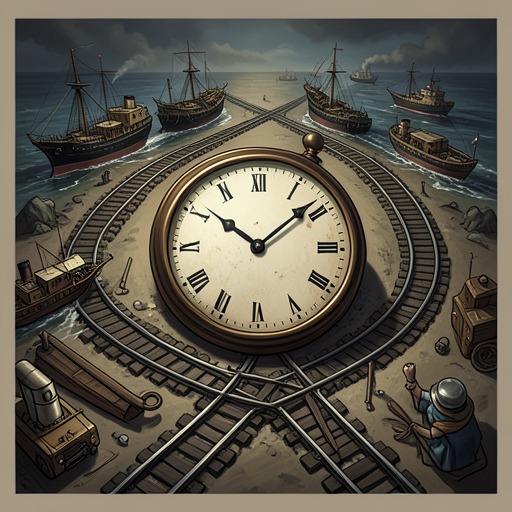
Fogg’s Travel Itinerary Book
Around the World in Eighty DaysFogg’s Travel Itinerary Book is the working record by which Phileas Fogg measures his attempt to travel around the world within eighty days. Its columns set prescribed arrivals beside actual ones and leave room to register time gained or lost, making the wager a sequence of checkpoints rather than a distant deadline. The book embodies Fogg’s faith in calculation, but the journey’s changing routes and its final gained day show that precise accounting depends on more than punctuality alone.
Format and purpose
After leaving the consulate at Suez, Fogg went to the Mongolia, descended to his cabin, and took up his notebook. It contained memoranda of the journey already completed, including his departure from London on Wednesday, October 2, at 8:45 p.m., and his arrival in Paris the following morning at 7:20. The first entries make the book a record of actual movement, not merely a prospective plan: it captures where Fogg has been and when he reached each point.
The running record also gives elapsed time a numerical form. At Suez, Fogg calculated that 158 or more hours had passed since departure, equivalent to six and a half days. That total sits within a larger itinerary arranged in columns for the month, day of the month, and weekday, with stipulated and actual arrivals at principal points. The listed route extends through Paris, Brindisi, Suez, Bombay, Calcutta, Singapore, Hong Kong, Yokohama, San Francisco, New York, and London, with the period running from October 2 to December 21.
A separate space for gains and losses makes comparison the book’s central operation. Fogg can see whether the trip is running ahead of or behind its appointed times, rather than relying on a general impression of speed. On Friday, October 9, he entered his arrival at Suez and noted that he had neither gained nor lost time. He then sat down to breakfast in his cabin instead of inspecting the town: the record gives the journey’s progress priority over sightseeing.
A method matched to Fogg
The itinerary extends a discipline already visible in Fogg’s household. On October 2 he dismissed his servant James Forster because the shaving water was delivered at eighty-four rather than eighty-six degrees Fahrenheit. His own departure from Saville Row followed a fixed daily routine, and he watched a clock displaying not only hours and minutes but seconds, days, months, and years. The itinerary carries that insistence on exactness beyond the home: time is divided, checked, and entered against a standard.
It also suits the terms of the wager. When challenged that eighty days represented only the shortest possible estimate, Fogg maintained that a well-used minimum was enough. He accepted the need to move mathematically from trains to steamers and back again. The timetable in his notebook gives that confidence a practical shape: each connection and arrival becomes part of a chain whose success depends on keeping within the allotted interval.
The book is not the only measure of time in the story. Passepartout’s inherited family watch indicated eight minutes before ten when he believed it was twelve, and Fogg dismissed it as slow. The contrast is telling: personal attachment to a timepiece does not make it a reliable guide, while Fogg’s notebook is built around comparison with stipulated arrivals. Even so, the record’s authority rests on a world of clocks, schedules, and transport that can disagree or fail.
Progress, interruption, and revision
At Bombay, the comparison produced a clear gain. The Mongolia arrived on October 20, although it was due on the 22nd. Fogg calmly entered the two days gained in the itinerary’s gain column. This is the book in its most straightforward role: an early arrival becomes a usable margin in the larger race, and a change in the running balance is recorded rather than celebrated at length.
The railway journey through India exposed a different condition. At Kholby, passengers learned that the railway was unfinished, with roughly fifty miles still to be laid to Allahabad. The interruption shows the distance between a planned timetable and the infrastructure that must make it possible. Elsewhere, when Fogg found no vessel ready to sail from Hong Kong, he searched the docks for a craft he could charter, persisting in the effort rather than abandoning the onward journey. Such episodes make the itinerary’s gains and losses consequential: the figures reflect a route that can be interrupted and must sometimes be pursued by another means.
After the attack on the Pacific Railroad train delayed the party, Fogg calculated that he was twenty hours behind, although his companions’ intervention left eight hours to regain. The onward movement depended on a sail sledge and a connection at Omaha, where the Pacific Railroad proper ended and a train was ready to take the party east. These passages clarify what a tabulated itinerary can and cannot do. It can state the deficit and the remaining margin; it cannot itself restore lost time or guarantee the next connection.
The final time calculation
The itinerary’s endpoint is December 21, the wager’s deadline, but Fogg initially believed he had reached London on Saturday the 21st when it was actually Friday the 20th, the seventy-ninth day since his departure. The discrepancy did not arise from a missing day in his punctual habits. It arose from the direction of travel: moving eastward, he had gained a day without realizing it. Over the earth’s 360 degrees, the four minutes by which the day diminishes for each degree amount to twenty-four hours; Fogg had seen the sun pass the meridian eighty times while those in London had seen it pass only seventy-nine.
The book therefore belongs to a story in which exact records both govern action and meet their limit. It provides Fogg with a running account of scheduled and actual arrivals, and turns an early two-day gain or a later twenty-hour deficit into intelligible quantities. But the decisive extra day is not simply another margin entered along the route: it is the consequence of measuring a global journey against local days. The itinerary makes the deadline precise; the eastward circuit reveals that precision itself must account for how time changes across the world.