Henrietta
Around the World in Eighty DaysHenrietta is the trading vessel that carries Phileas Fogg across the Atlantic in the final, precarious stage of his attempt to reach London before his wager expires. First unavailable to a passenger who needs speed, it becomes a ship under Fogg’s command; when its coal is exhausted, its own wooden structure is dismantled for fuel. Its progress toward Europe is therefore measured both in miles and in the material consumed to keep it moving.
Identity and Construction
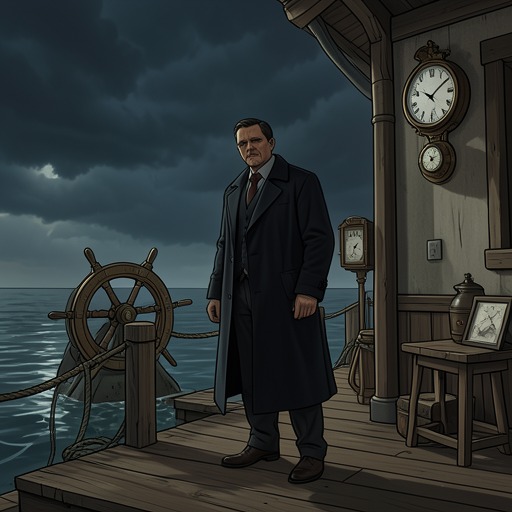
Henrietta is an iron-hulled vessel with a wooden superstructure, fitted with a screw and described as well-shaped. When Phileas Fogg finds it anchored near the Battery in New York, its funnel is already sending up smoke, a visible sign that it is preparing to depart. Its presence offers a narrow alternative to the sailing vessels setting out from the port, which cannot serve Fogg’s urgent need to cross the Atlantic quickly.
The captain, Andrew Speedy, describes Henrietta as a swift vessel, capable of between eleven and twelve knots. He also insists that he carries no passengers because they get in the way. The ship is a trading vessel rather than a passenger liner: its speed makes it valuable to Fogg, while its working arrangement and the captain’s refusal make clear that no ordinary booking will secure the passage he needs.
From Refused Passage to Fogg’s Command
Fogg asks Andrew Speedy to carry him and three other people to Liverpool. The captain questions the destination and refuses the request; Fogg’s offer to buy the vessel is rejected as well. For the first time in the journey, money does not immediately remove the obstacle. Henrietta is close at hand and suitable for the crossing, but access to it depends on more than purchasing a ticket or making an offer.
Fogg initially takes passage for Bordeaux. During the thirty hours he spends aboard, he uses banknotes to win over the sailors and stokers, an occasional crew who are already on poor terms with their captain. They transfer their allegiance to him as a group. Fogg takes command, confines Andrew Speedy to his cabin, and redirects Henrietta toward Liverpool. The ship’s change of course follows a change in authority: the captain’s refusal has not been overcome by a negotiated passenger berth, but by Fogg’s practical control of the people and vessel needed to sail.
Once in command, Fogg shows that he can manage the craft like a sailor. Henrietta passes the lighthouse at the entrance to the Hudson, rounds Sandy Hook, skirts Long Island and Fire Island, and heads east. The passage demonstrates that the vessel is not simply a means of transport placed at Fogg’s disposal. Its crew, propulsion, and handling become the instruments through which he converts a blocked plan into a possible one.
The Atlantic Crossing
The schedule leaves almost no margin. Fogg has nine days and thirteen hours and forty-five minutes between the morning of December 12 and the evening deadline on December 21. If Henrietta can cross the three thousand miles from New York to Liverpool in that interval, he may still reach London in time. But the prospect depends on conditions that neither speed nor command can settle: the sea must not become too rough, the wind must not turn against the ship, and its machinery must hold.
On December 13, Henrietta reaches the edge of the Banks of Newfoundland, a dangerous area where winter fogs and gales are frequent. The falling barometer signals a change, the temperature drops, and the wind veers to the southeast. Fogg furls the sails and increases the steam to keep the vessel on course, but the heavy waves slow its progress. Henrietta pitches violently, and the growing tempest threatens its stability. The ship’s advertised speed cannot guarantee its passage when the sea itself is opposing forward motion.
For two days, Passepartout is frightened by the worsening weather. Fogg, by contrast, maintains the course without reducing steam. When Henrietta cannot rise over the waves, it drives through them, shipping water across the deck; at times its screw lifts clear of the surface as a great wave raises the stern. Yet the vessel continues straight ahead. The wind remains fresh and stubbornly southeast, making the sails useless. The crossing thus turns on the interaction of weather, steam, and the ship’s ability to endure, rather than on speed alone.
Burning the Ship to Keep It Moving
As coal dwindles, Fogg orders the engineer to feed every fire until the supply is exhausted. The funnel pours out smoke, and the ship continues at full steam. On December 18, the engineer warns that the coal will give out during the day. Fogg orders him to keep the fires up to the last and fill the valves: the remaining fuel is to be used, not conserved for a safer but slower passage.
Fogg then asks Andrew Speedy to sell him Henrietta and states that he will have to burn it. He clarifies that the upper wooden parts—not the iron hull—can be sacrificed. The ship’s ordinary interior and fittings become the next source of power. The poop, cabins, bunks, and spare deck are burned; on December 19, the masts, rafts, and spars follow. The crew keeps the fires supplied, while Passepartout hews, cuts, and saws with all his might. The vessel that had carried them now supplies the fuel that carries it onward.
On December 20, railings, fittings, much of the deck, and the topsides disappear. Henrietta is reduced to a flat hulk. The demolition is neither incidental damage nor a storm’s destruction: it is a deliberate exchange of the ship’s wooden fabric for the steam needed to continue the voyage. Its iron hull remains afloat, but the recognizable working vessel has been consumed piece by piece in pursuit of the deadline.
Queenstown and Narrative Significance
Henrietta sights the Irish coast and Fastnet Light, then passes Queenstown late in the evening. Because transatlantic mail steamers put off their mail there, the mail can be carried by express train to Dublin and then by fast boat to Liverpool, gaining twelve hours over the Atlantic route. Fogg has counted on using that connection to recover time. Henrietta enters Queenstown Harbour at one in the morning on the high tide, after the vessel has been stripped to its hulk.
Andrew Speedy shakes Fogg’s hand warmly before leaving him aboard the levelled remains of his craft, which is still worth half what he sold it for. Henrietta has therefore brought both its captain and its new commander to an unexpected outcome: Speedy’s refusal is overturned, yet Fogg does not simply take the ship and leave its owner with nothing. The party goes ashore and boards the waiting train; Fix, though tempted to arrest Fogg there, does not do so. Henrietta’s role ends at the port, but its arrival makes the onward mail connection possible.
The ship’s arc concentrates the practical reversals of this part of the journey. Its speed makes it promising but cannot defeat contrary seas; its captain’s refusal appears decisive but does not remain so; and its structure, initially the condition of passage, becomes fuel for passage. By reaching Queenstown as a hulk rather than an intact ship, Henrietta embodies the cost of Fogg’s last attempt to keep moving: progress is purchased not only with money and command, but with the vessel itself.