Hong Kong
Around the World in Eighty DaysHong Kong is both a major port under British rule and a decisive junction in Phileas Fogg’s journey: the place where he tries to leave Aouda safely with family, while Fix sees his final opportunity to secure an arrest. Its busy harbor makes movement seem abundant, but the timing of a single steamer’s departure turns the island into a trap from which Fogg must improvise.
Island, Port, and Colonial Setting
Hong Kong is described as an island at the mouth of the Canton River, about sixty miles from the Portuguese town of Macao. It came into English possession through the Treaty of Nankin after the war of 1842. British colonization had made it an important city and an excellent port, and its commercial growth had overtaken Macao in the Chinese trade: much of the transportation of Chinese goods now passed through Hong Kong.
The city’s built environment gives this colonial authority a visible form. Docks, hospitals, wharves, a Gothic cathedral, a government house, and macadamized streets make the settlement appear, in the narrator’s comparison, like a town in Kent or Surrey transferred to the other side of the world. That resemblance sits beside its geography and commerce rather than replacing them: Hong Kong is at once a British-administered urban center and a harbor facing the China seas.
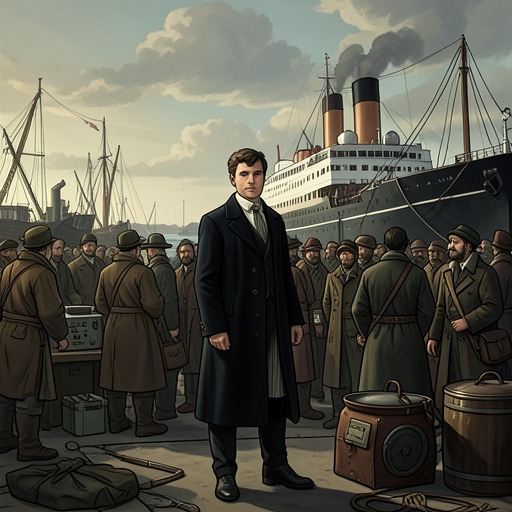
Passepartout’s walk through the city registers that mixture from the viewpoint of a traveler. He sees palanquins and a moving crowd of Chinese, Japanese, and Europeans; at Victoria port, ships of many nationalities crowd together, including warships and trading vessels, Chinese and Japanese craft, and European ships. He thinks Hong Kong resembles Bombay, Calcutta, and Singapore because each displays evidence of English supremacy. The comparison makes colonial power legible to him through recurring urban signs, while the harbor’s many ships and populations reveal a more complicated commercial and cultural contact zone.
A brief encounter also shows how the city’s unfamiliar customs become material for the traveler’s observation. In a barber’s shop, Passepartout learns that the very old men he has noticed wearing yellow are at least eighty, and that they are permitted to wear the Imperial color at that age. He finds the custom amusing, though he does not know exactly why. The scene presents local practice through his limited, comic response: Hong Kong is not only a transit point but a place where passing observation turns unfamiliar details into travel narrative.
The Pursuit Converges on Hong Kong
For Fix, Hong Kong is not simply another stop. After failing to make an arrest at Bombay and Calcutta, he hopes the warrant will reach him there. It is the last English ground on Fogg’s route; beyond it lie China, Japan, and America, where Fix believes his suspect could find an almost certain refuge. In Hong Kong, he could arrest Fogg and hand him to the local police. Beyond the island, a simple warrant would no longer suffice: an extradition warrant would be needed, bringing delays and obstacles that might let the fugitive escape.
Fix therefore treats the warrant’s arrival as a deadline. He has arranged for it to be forwarded to Hong Kong if it comes, and considers how to prevent Fogg’s departure if it does not. One possibility is to confide in Passepartout and persuade the servant that his master is a criminal; but Fix fears that Passepartout might warn Fogg and spoil the plan. The island concentrates the detective’s hopes because it offers a narrow legal and geographical window, not because his pursuit has become more certain.
Fogg’s Plan for Aouda
The Carnatic is scheduled to leave Hong Kong at five the next morning, leaving Fogg sixteen hours to attend to his business. His first priority is to place Aouda safely with her wealthy relative. On landing, he takes her by palanquin to the Club Hotel, secures a room, and makes sure she wants for nothing before setting out to find her cousin, Jeejeeh. He instructs Passepartout to stay at the hotel so that Aouda will not be left entirely alone.
Fogg searches for Jeejeeh at the Exchange, expecting that such a wealthy and prominent Parsee merchant will be known there. A broker tells him that Jeejeeh left China two years earlier, retired with an immense fortune, and settled in Europe, probably Holland, where he had done much of his trading. Fogg returns to the hotel and tells Aouda what he has learned. After a moment of reflection, she asks what she ought to do; Fogg’s answer is that she should go on to Europe. The failed search changes his immediate plan from placing her with a relative in Hong Kong to continuing her journey with him, without resolving the question of her eventual destination.
A Missed Steamer and an Improvised Departure
Hong Kong’s importance as a junction sharpens when the expected departure changes. Fix hears that repairs to the Carnatic are complete and that it has left twelve hours ahead of schedule, without notice; he assumes that Fogg and Aouda will have to wait a week for another steamer. The prospect briefly seems to give him the delay he needs for the warrant to arrive. But Fogg does not accept the week-long wait. He points out that other vessels are in the harbor, offers Aouda his arm, and goes to the docks to find a craft bound onward.
For three hours Fogg searches with the determination to charter a vessel if necessary, but the ships he finds are loading or unloading and cannot sail. Fix follows him, alternately hoping that the delay will hold Fogg and fearing that it will not. The crowded harbor thus becomes an ironic setting: it contains ships from across the world, yet few are immediately available, and a timetable rather than distance governs the party’s choices.
The departure of the Carnatic also separates Passepartout from Fogg and Aouda. Fix has lured the servant into an opium den; after waking, Passepartout struggles against the narcotic’s effects and rushes toward the steamer, crying out its name. He reaches the plank as the ship is leaving and collapses aboard. On waking the next morning, he realizes that he is on the Carnatic without his master, and that his failure to report the changed sailing time has caused Fogg and Aouda to miss it. He also recognizes Fix’s deception and fears that Fogg’s wager is lost and that he himself may be arrested.
Narrative Significance
Hong Kong brings the story’s competing forms of urgency into one place. Fogg’s measured effort to secure Aouda’s welfare meets a changing timetable; Fix’s pursuit depends on the limits of a warrant and the island’s status as the last English jurisdiction; Passepartout’s loyalty is exploited to make the missed departure possible. The resulting delay is not simply a travel inconvenience. It forces Fogg to seek another way forward, while leaving Passepartout aboard the Carnatic and Fix still entangled in the pursuit.
The city’s descriptions also connect the adventure’s route to the unequal structures that shape it. British authority appears in Hong Kong’s institutions, streets, and commercial prominence, and Passepartout recognizes related signs in other ports he has visited. At the same time, the harbor is crowded with vessels and travelers from different places, and the city’s details resist reduction to a single European likeness. Hong Kong functions both as an instrument of colonial movement and as a densely mixed contact point where the travelers’ plans, legal assumptions, and observations meet their limits.