Liverpool
Around the World in Eighty DaysLiverpool is the point at which Phileas Fogg’s return to Britain becomes a last test of time rather than distance. He reaches its quay on 21 December with London only six hours away, but Fix arrests him before he can continue. The resulting passage through the city—from landing place to Custom House to railway station—compresses the remaining journey into a sequence of delays and narrow chances.
Port of Arrival and Narrowing Deadline
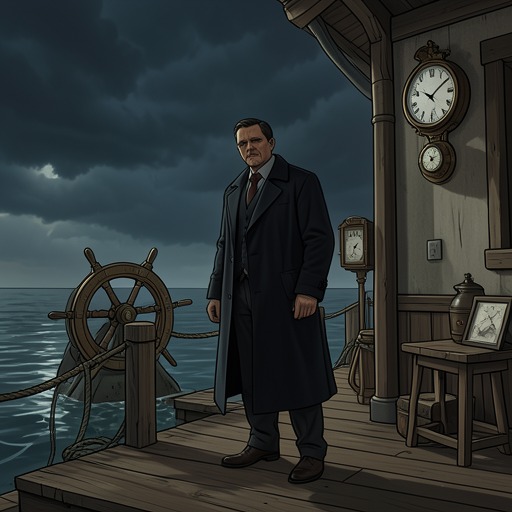
The approach to Liverpool comes after the Henrietta has been stripped to sustain its engines. By 20 December its railings, fittings, much of its deck, and its topsides have been consumed as fuel, leaving it a flat hulk. That day the Irish coast and Fastnet Light come into view, and the vessel passes Queenstown at ten in the evening. Liverpool is therefore not simply another stop on the itinerary: it is the first point from which Fogg can make the final overland run to London.
The crossing has left little margin. When the party is opposite Queenstown, Andrew Speedy tells Fogg that they are there and that everything is against him. Fogg asks whether the lights they see belong to Queenstown; the exchange marks how narrowly the ship has reached the coast, while the remaining distance to Liverpool is still ahead. Once ashore, Fogg has only twenty-four hours in the broader calculation of the voyage, but the decisive local deadline is much closer: he must reach the Reform Club by a quarter before nine that evening.
Arrival and Arrest
Fogg disembarks on the Liverpool quay at twenty minutes before twelve on 21 December. The arrival appears to leave a workable interval: London is six hours away, while nine hours and fifteen minutes remain before the Reform Club deadline. The difference between those figures is the slender reserve on which the journey now depends.
Fix closes that interval at the moment of arrival. He comes up to Fogg, places a hand on his shoulder, shows his warrant, and arrests him in the Queen’s name. The arrest turns Liverpool from a transit point into an enforced pause. At the Custom House, Fogg sits motionless on a wooden bench, calm in outward appearance and without visible anger. The narrative makes the contrast stark: he has nearly completed the journey, yet detention threatens to make his arrival in Britain equivalent to failure.
The time calculation gives the arrest its force. From 11:40 in the morning until 8:45 in the evening, Fogg has nine hours and fifteen minutes; the Liverpool-to-London journey requires six. The remaining three hours and fifteen minutes are not leisure but the whole allowance for reaching the railway, securing passage, and absorbing any further delay. Liverpool’s significance lies in this arithmetic as much as in its place on the route: a schedule that has carried Fogg around the world can still be undone at its final port.
From the Custom House to the Station
Fogg does not remain in custody for the rest of the day. After Fix is knocked to the floor by Passepartout, Fogg, Aouda, and Passepartout leave the Custom House without delay and take a cab to the station. The narrative does not dwell on the transition; its speed reflects the urgency of getting back onto the route. The party’s movement from the Custom House to the railway station is the immediate reversal of the arrest’s apparent finality.
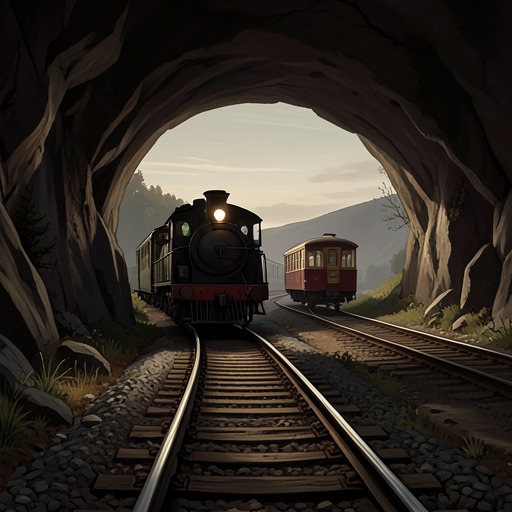
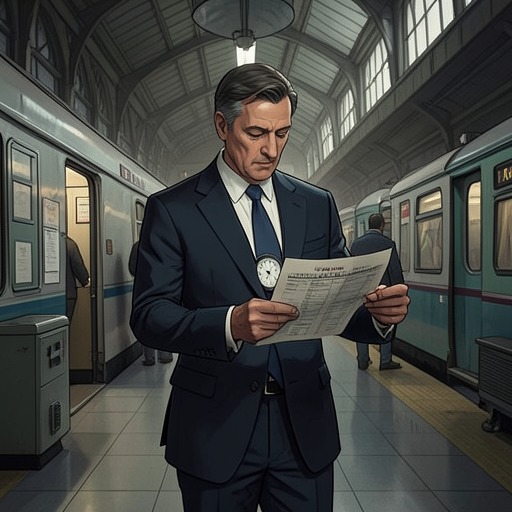
At forty minutes past two, Fogg asks whether an express train is about to leave for London. It has departed thirty-five minutes earlier, at 2:05. He therefore orders a special train. Although several rapid locomotives are available, railway arrangements prevent it from leaving until three o’clock. Fogg offers the engineer a generous reward to stimulate him, and the special train finally sets out with Aouda and his faithful servant. A six-hour journey from that departure would bring them to London at about nine, only fifteen minutes before the Reform Club deadline.
Narrative Significance
Liverpool concentrates the novel’s final reversals in a small number of specific places and times. The quay announces that the sea crossing has succeeded; the Custom House converts apparent arrival into imprisonment; the station restores movement, but only after the express has gone. Each threshold changes what the remaining minutes can mean. The city is not presented through a broad account of its streets or inhabitants; its role in the journey is defined by these tightly linked actions and the clock that governs them.
The episode also places Fix’s warrant against the deadline that has organized Fogg’s travels. His arrest appears to make the wager unattainable precisely when Fogg is within six hours of London, and his stillness on the Custom House bench gives that danger a visible form. Once the party reaches the station, the missed express supplies a second obstacle, answered not by a scheduled service but by Fogg’s order for a special train. Liverpool thus becomes the hinge between the apparent end of the attempt and its renewed, precarious continuation toward London.