Medicine Bow
Around the World in Eighty DaysMedicine Bow is the next stopping place on the American railway journey of Phileas Fogg and his companions, but its name becomes associated less with arrival than with a bridge that the train cannot safely cross. The episode exposes the material limits beneath the railway’s promise of speed: a damaged span, swollen water, and inadequate alternatives briefly place the timetable beyond the travelers’ control, until the train makes a perilous crossing and the bridge collapses behind it.
Railway Setting
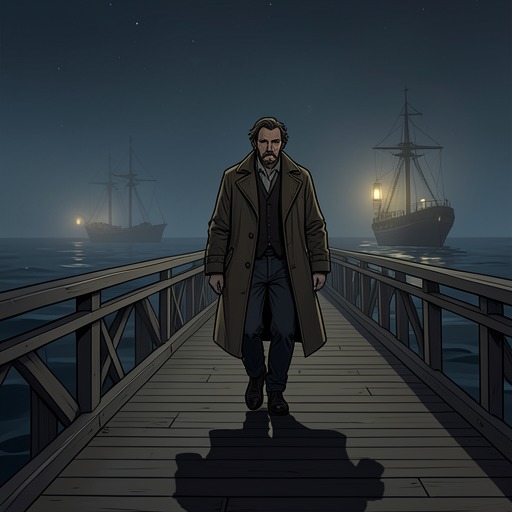
Medicine Bow enters the journey as a destination beyond a sudden halt. A red signal stops the train before it reaches the bridge, and the signalman sent ahead from the station at Medicine Bow reports that the structure is too unstable to bear the train. The suspension bridge lies about a mile from the place where the passengers have been stopped; it spans rapids, and several of its iron wires are broken. The warning is not presented as needless caution: the account stresses that the bridge is genuinely ruinous.
The railway’s connection to Medicine Bow offers no quick way around the obstruction. The conductor says that a replacement train has been requested from Omaha, but it will take about six hours to reach Medicine Bow. Walking there would take the passengers roughly as long. Nor can they simply cross the water by boat. Rain has swollen the creek into a rapid, and the available ford lies only after a circuit of ten miles to the north. The location therefore becomes a bottleneck formed by several linked conditions: the damaged bridge, the dangerous water, the distance to a ford, and the delay involved in bringing another train.
The Bridge Emergency
The stoppage draws the passengers out of the carriages and into a discussion with the railway staff. Colonel Stamp Proctor is prominent among those gathered, while Passepartout joins them and hears the signalman’s warning directly. The prospect of waiting for hours, then walking to Medicine Bow, provokes anger and disbelief. Passepartout is furious too, and the obstruction makes clear that Phileas Fogg’s money cannot simply purchase a way through every delay. Here, the barrier is not a fare or a service to be bought; the water and the weakened bridge impose a physical limit.
Inside the carriage, Aouda and Fix fear that Fogg may decide to get out himself. Instead, he remains there and instructs Passepartout to see what is happening. Passepartout’s investigation brings the danger back to the group: he learns that the bridge cannot safely support the train, yet does not dare to tell his master what he has heard. The contrast is characteristic of the crisis. Fogg delegates the immediate inquiry, while the people outside the carriage confront the consequences of a transport system that has stopped functioning as promised.
The Crossing and Collapse
Rather than wait for the replacement train or attempt the long detour to the ford, the engineer turns the locomotive back for nearly a mile, using the distance to build up speed. The train then rushes forward at an estimated hundred miles an hour. Its motion is so violent that it seems barely to bear on the rails; passengers perceive the crossing almost as a leap from one bank to the other. The train clears the bridge, and the engineer cannot stop it until it has gone five miles beyond the station.
The passage succeeds, but it does not restore the bridge. As soon as the train has crossed the river, the weakened structure falls with a crash into the rapids. The sequence turns the obstacle into an irreversible event: the train escapes the immediate danger, while the route it has just traversed is destroyed. The crossing is thus both a narrow deliverance and evidence of how close the railway came to losing its passage altogether.
Narrative Significance
Medicine Bow’s episode places speed in tension with infrastructure. The passengers have been moving by a system whose schedules imply dependable continuity, yet one unstable bridge interrupts the journey and makes the advertised advantages of rail travel contingent on inspection, maintenance, and safe connections. The solution is not a smooth adjustment to the timetable but an extreme maneuver that risks the train and leaves the bridge in ruins.
The novel has already shown a different kind of railway discontinuity in India, where the line ends at Kholby and a gap of about fifty miles remains before it begins again at Allahabad. That unfinished stretch and the damaged bridge at Medicine Bow are distinct obstacles, but together they qualify the idea that a railway map guarantees an uninterrupted journey. Later, in New York, Fogg searches among vessels on the Hudson for a way to continue toward Europe, again confronting the practical dependence of travel on available routes and departures. Medicine Bow is therefore a compact episode in the larger journey: the timetable matters, but the travelers remain subject to the material conditions that make movement possible.