Pacific Railroad
Around the World in Eighty DaysThe Pacific Railroad is the transcontinental route that carries the novel’s travelers across the United States and gives material force to the claim that the world has grown smaller. Its promise is dramatic: New York and San Francisco are joined by a continuous railway connection, and a journey that once took at least six months can now be made in seven days. Yet the route is not simply speed made visible. Its geography, construction, connections and hazards show how much coordination and infrastructure that speed requires.
Definition and Network
The name refers to a system divided into two principal lines: the Central Pacific Railroad, running between San Francisco and Ogden, and the Union Pacific Railroad, between Ogden and Omaha. From Omaha, five main lines connect onward to New York. Together, these links form what the narration calls an uninterrupted metal ribbon, stretching 3,786 miles between the Pacific coast and the eastern network. The Pacific Railroad is therefore both a specific transcontinental route and one part of a larger chain of rail connections; the journey’s reach depends on transfer points beyond its own terminus.
That network represents a striking contraction of travel time. Under the most favourable earlier conditions, the journey from New York to San Francisco took at least six months; the railway reduced it to seven days. In the opening discussion of the wager, the newly opened connection between Rothal and Allahabad is likewise presented as evidence that the world has grown smaller. The Pacific Railroad extends that argument across the American continent: distance remains immense, but schedules and connected lines make it newly traversable within a fixed itinerary.
Route and Terrain
From Omaha the line follows the Platte River region, then bends through the Laramie territory and the Wahsatch Mountains. It turns around the Great Salt Lake, passes Salt Lake City, and continues across the Tuilla Valley, the American Desert, the Cedar and Humboldt Mountains, and the Sierra Nevada before descending by way of Sacramento to the Pacific. Even on the Rocky Mountains, its grade does not exceed 112 feet to the mile. The route’s description makes the railway legible as a sequence of engineered passages through sharply varied landscapes, rather than a straight line drawn across an empty map.
The account of the travelers’ west-to-east passage gives that geography a changing, close-up scale. After leaving Oakland at six in the evening, the train runs through the night; the 120 miles between San Francisco and Sacramento take six hours, and the travelers sleep through Sacramento. In the morning, after passing ‘Cisco, the train winds through the Sierra Nevada, approaching mountain sides, curving around precipices and entering narrow defiles. The railway follows the contours rather than forcing the shortest route through them: the narration notes that there are few bridges or tunnels on this stretch. After entering Nevada through Carson Valley, the train reaches Reno around midday, where it pauses for twenty minutes for breakfast.
Construction and Physical Limits
The railway’s construction is presented as both ambitious and rapid. In 1862, despite opposition from Southern members of Congress who wanted a more southerly route, the line was assigned a course between the forty-first and forty-second parallels; President Lincoln fixed Omaha as its eastern endpoint. Work advanced across the prairies at a reported rate of a mile and a half a day. A locomotive carried rails laid the previous evening toward the next day’s work, moving forward as the track was extended. The account praises the speed of construction while asserting that it did not damage the quality of the work.
The mountainous section east of Ogden makes the costs of that achievement more explicit. There, engineers faced the most formidable difficulties in laying the road, and the government subsidy rose to $48,000 per mile, compared with $16,000 for work on the plains. Rather than cut directly through the rocks, the engineers wound around them; one tunnel, 14,000 feet long, was pierced to reach the great basin. From the Great Salt Lake, the track descends toward Bitter Creek Valley, rises again to the watershed between the Atlantic and Pacific, and crosses creeks on culverts. The route’s apparent continuity is thus the outcome of costly decisions about where to bend, tunnel and bridge.
The Railway in Use
The passengers experience the railway not as a map but as a moving sequence of timetables, changing views and bodily routines. At departure from Oakland, the train averages no more than twenty miles an hour when its stops are counted, yet that pace is considered sufficient to reach Omaha on schedule. Snow begins soon after departure but does not obstruct the train. At eight o’clock, the seats are converted into berths: beds are rolled out, curtains give passengers privacy, and the car becomes a dormitory while the train crosses California. The sleeping car makes the long-distance schedule possible as a sustained journey, not merely a theoretical speed between endpoints.
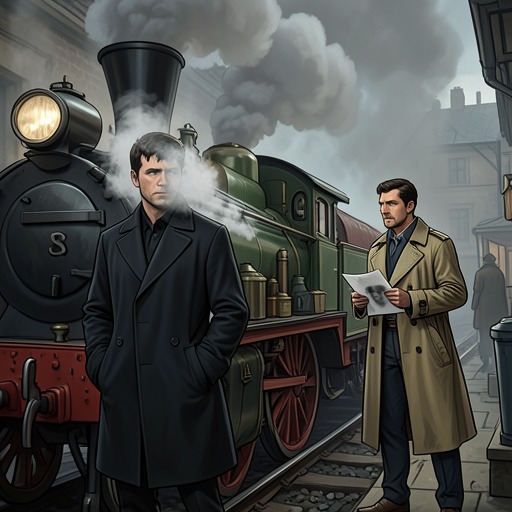
The line’s practical boundaries become visible at Omaha. The Pacific Railroad proper ends at this Nebraska town, where the party must connect with the Chicago and Rock Island Railroad for the journey east. A train is ready when Phileas Fogg, Aouda, Passepartout and Fix reach the station, and they have time only to board it. Their onward passage crosses Iowa, the Mississippi at Davenport and Illinois before reaching Chicago. The transcontinental route’s achievement therefore depends on transfers, station timing and the railways that continue beyond its own terminus.
The narrative also sets the timetable against the possibility of interruption. At Medicine Bow, a red signal stops the train because a signalman reports that a suspension bridge over rapids is shaky and cannot bear its weight; several iron wires are broken. The scene exposes the material vulnerability behind the schedule: a line may be planned as continuous, but its operation depends on structures remaining safe to pass. Later, after the train journey has been interrupted by the Sioux, Fogg is told that he is twenty hours behind and must recover eight hours if he is to make up time. The railway’s speed cannot erase every delay; the missed time has to be reckoned against a precise timetable and recovered by other means.
Narrative Significance
The Pacific Railroad is the novel’s clearest American emblem of compressed space, but its significance lies in the tension between promise and dependence. Its advertised seven-day crossing is made credible by connected lines, scheduled departures, sleeping berths and an immense construction effort; its smooth passage remains vulnerable to terrain, damaged infrastructure and interruption. The account repeatedly measures mobility through concrete thresholds—miles, hours, grades, subsidies and transfer points—so that the world’s supposed smallness is not an abstraction. It is an effect produced by rails and connections, and one that can be unsettled whenever a bridge, a timetable or a link in the route fails.