Pagoda of Pillaji
Around the World in Eighty DaysThe Pagoda of Pillaji is the central site of the attempt to save Aouda from a forced suttee. She is imprisoned there overnight before the sacrifice planned for dawn, and the pagoda’s position among trees, near a stream and a prepared pyre, turns the rescue into a contest of timing and access. The place matters not simply as a destination: its doors, walls, guards, and surrounding ground determine what Phileas Fogg and his companions can try, and when.
Setting and Approach
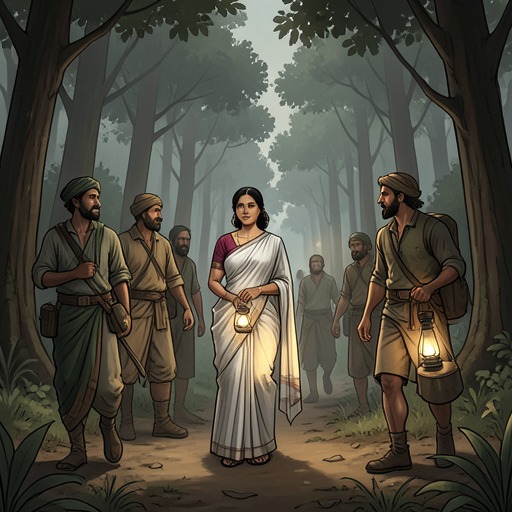
A Parsee guide tells Phileas Fogg and his companions that Aouda has been taken to the Pagoda of Pillaji, two miles away, and will remain there through the night. The group approaches by elephant and halts in a copse about five hundred feet from the pagoda, concealed but close enough to hear the groans and cries of the fakirs. The account gives the site a concrete geography: trees screen the party, a small stream lies between them and the temple, and the pagoda stands roughly a hundred steps beyond the stream.
At dusk, the guide leads the group through the wood toward the water. By the light of rosin torches, they see a pyre of wood beside the stream, with the embalmed body of the old rajah on top. The Pagoda of Pillaji rises beyond it, its minarets visible above the trees. The proximity of temple, stream, and pyre makes the intended route of the ceremony legible to the rescuers: Aouda is to be brought from her confinement to the place where she will be burned with her husband.
Captivity and the Planned Ceremony
Aouda’s presence at the pagoda is the consequence of a forced marriage and an attempted escape. The guide describes her as a Parsee woman, the orphaned daughter of a wealthy Bombay merchant, educated in English and married against her will to the old rajah of Bundelcund. After she escaped, the rajah’s relatives, who had an interest in her death, recaptured her and devoted her to the sacrifice. The pagoda is therefore presented as the place of her confinement immediately before the ritual, not as a refuge she has chosen.
The ceremony is scheduled for first light. Its attendants and guards make the building difficult to enter: the party considers whether they might get through a door while those around the pagoda sleep, or whether they must breach a wall. The surrounding crowd has been prepared for the event through intoxication. As night falls, the Indians are described as surrendering to a drunkenness caused by liquid opium mixed with hemp; the cries of the fakirs then cease. The apparent opportunity does not last. By midnight the guards have not fallen asleep, so the rescuers cannot rely on them yielding to exhaustion.
The Pagoda as a Tactical Obstacle
The failure of the first plan makes the pagoda’s physical arrangement decisive. After a final consultation, the guide leads the party by a roundabout route to the rear, reaching the walls at about half past midnight without meeting anyone. There is no guard at that side, but there are also no windows or doors. The unguarded wall offers concealment without an entrance, leaving the group to face the difficulty of getting inside while Aouda remains under watch elsewhere.
The darkness briefly favors the approach. The moon is waning and obscured by heavy clouds, while the height of the trees deepens the shadows around the pagoda. Yet concealment does not resolve the central problem: the sacrifice is due at dawn, and the group has already established that the guarded entrance cannot simply be left to chance. The location’s layout creates suspense through a specific mismatch—an accessible rear wall that cannot be entered, and a usable approach whose guards have not gone to sleep.
Dawn and Narrative Significance
At dawn, the pagoda’s doors swing open and bright light emerges from within. Fogg and Sir Francis Cromarty see Aouda, apparently shaken from her stupor and struggling to escape her executioner. She is drugged again and carried among the fakirs as the crowd moves toward the pyre. Fogg and his companions follow behind the procession to the stream, where Aouda is laid senseless beside the rajah’s body and the oil-soaked wood is set alight. The pagoda is the starting point of this final movement from captivity to the pyre; the action outside its walls makes the danger visible and immediate.
The episode makes the Pagoda of Pillaji a tightly organized rescue setting. Its distance from the group’s hiding place, its rear wall, its doors, and the route past the stream all shape the sequence of watching, reconnaissance, failed access, and pursuit. It also concentrates the story’s contrast between the ceremonial preparation for Aouda’s death and the companions’ attempt to intervene. The building is not given an independent history or description beyond what the rescue requires; its significance lies in how its enclosure and surroundings make the impending sacrifice—and the narrow time available to prevent it—tangible.