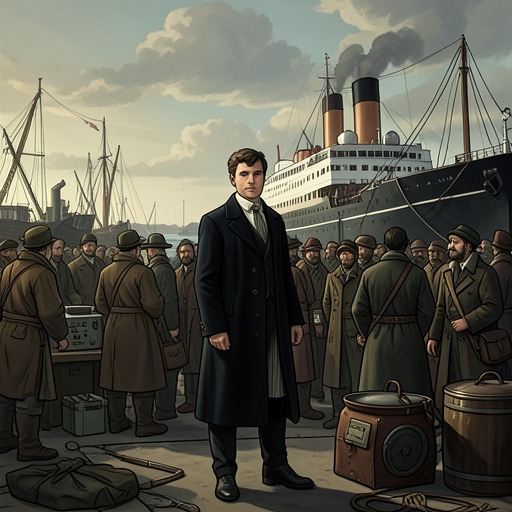
Passepartout boards the Carnatic alone
Around the World in Eighty DaysPassepartout’s solitary boarding of the Carnatic turns an interrupted duty into a separation with immediate consequences: he reaches the ship as it is leaving Hong Kong, but Phileas Fogg and Aouda are not aboard, and he realizes that his failure to alert them has cost them their passage.
The Delayed Departure
After Fix left the opium den, two waiters carried the unconscious Passepartout to a bed reserved for smokers. Three hours later, he awoke still under the narcotic’s influence, but the thought of an unfinished duty broke through his torpor. He stumbled out, steadying himself against walls, falling and getting up again, driven by the need to reach the Carnatic. The ship was already alongside the quay and on the point of departure. Passepartout rushed across the plank and collapsed unconscious on deck as the Carnatic moved off. Sailors carried him to the second cabin, where he remained asleep until the vessel was one hundred and fifty miles from China. The crossing therefore began not as a deliberate choice to leave his companions, but as the outcome of a desperate, barely conscious effort to catch the ship.
Recognition at Sea
The next morning, the sea air began to clear Passepartout’s head. He pieced together the previous evening, including Fix’s revelation and the opium-house episode, and initially feared that he had boarded the wrong vessel. He learned that the ship was indeed the Carnatic and was bound for Yokohama—but Phileas Fogg was not on board. That absence brought the practical mistake into focus. The Carnatic’s sailing time had been changed, and Passepartout had failed to tell his master. He understood that Phileas Fogg and Aouda had missed the steamer because of his omission. The scene reverses the apparent success of his last-minute dash: Passepartout has caught the ship, but the very act that carries him onward separates him from the party he meant to serve.
Fix’s Deception and the Cost of Separation
Passepartout also recognized Fix’s part in the separation. He concluded that the detective had lured him into getting drunk in order to keep him away from Phileas Fogg and detain the latter in Hong Kong. In his alarm, Passepartout believed the wager was lost and feared that his master might be arrested and imprisoned; his anger at Fix rose from the knowledge that the separation had been engineered as well as from his own failure to pass on the changed departure time. Once his first despair subsided, Passepartout took stock of his position. He was bound for Japan without his companions and had no money in his pocket—not even a penny. His passage had, fortunately, already been paid, leaving him five or six days to decide what to do next. His meals offered a small, comic counterpoint to his distress: he ate as if providing for himself, Phileas Fogg, and Aouda, and as if Japan were a desert with no food to be found. The episode leaves him physically carried onward by the voyage but uncertain how to rejoin the journey from which he has been cut off.