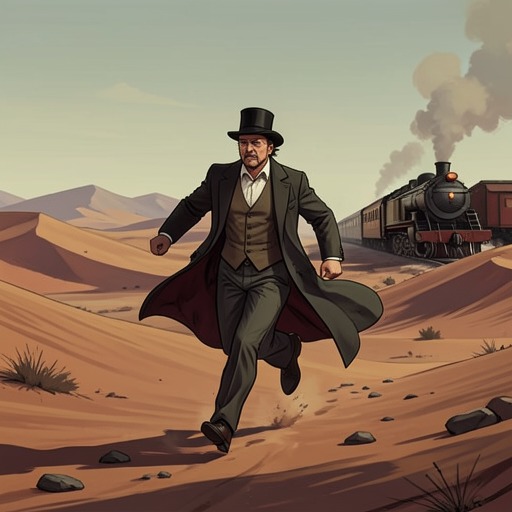
Passepartout uncouples the train from its locomotive
Around the World in Eighty DaysPassepartout uncouples the train from its locomotive during a Sioux attack, turning his acrobatic skill into a desperate means of stopping the cars before they pass the safety of Fort Kearney. The maneuver halts the train near the garrison and gives the soldiers a chance to drive off the attackers, though Passepartout himself is missing when the passengers regroup.
The Emergency on the Train
The attack has lasted ten minutes, and the danger is increasing. Fort Kearney, where a garrison is stationed, lies only two miles ahead; beyond it, the Sioux raiders would control the stretch of line between the fort and the next station. The conductor, fighting beside Phileas Fogg, is shot and falls. He warns that unless the train is stopped within five minutes, the passengers are lost.
Fogg prepares to leave the car and stop the train himself. Passepartout intervenes, volunteering to go in his place. His decision comes at a moment when the immediate stakes are the passengers’ lives and the remaining distance to the fort has become a deadline.
The Uncoupling
Passepartout slips through a door without being noticed by the attackers and gets beneath the cars while the fighting continues above him. Drawing on his old acrobatic experience, he moves along the underside of the train, holding the chains and using the brakes and edges of the sashes to make his way from car to car. The route takes him to the front, where he hangs by one hand between the baggage-car and the tender.
With his other hand he loosens the safety chains. The train’s traction makes it impossible for him to unscrew the yoking-bar, but a violent concussion jolts the bar free. The cars are detached: the locomotive rushes forward at increased speed, while the train remains behind, still carrying the force it has already gathered.
The Halt and Its Consequences
The separated train continues to roll for several minutes. The brakes are then applied, and the cars finally stop less than a hundred feet from Kearney station. The action does not bring the train to an instant standstill; it creates the separation that allows the cars to lose momentum and stop near the garrison rather than continue beyond it.
Drawn by the gunfire, the fort’s soldiers hurry to the train. The Sioux raiders had not expected their arrival and retreat before the cars have entirely stopped. When the passengers count themselves on the station platform, however, Passepartout is among those missing. His intervention has helped bring the train within reach of protection, but the scene ends with the rescuer’s own whereabouts unknown.
Narrative Significance
The episode reverses the train’s momentum as a source of danger into a means of survival. The locomotive cannot be stopped in time by a direct assault from inside the cars, so Passepartout acts on the mechanical connection between engine and train; the jolt that frees the yoking-bar completes what his strength alone could not. His agility and technical improvisation turn a narrow five-minute warning into an escape from the immediate attack, while his disappearance leaves the rescue incomplete from the passengers’ point of view.