Queenstown
Around the World in Eighty DaysQueenstown is the Irish port where the final leg of Phileas Fogg’s journey changes from a race across the Atlantic into a relay between ship, train, and steamer. The established mail connection through Dublin offers a way to gain twelve hours just as the Henrietta is running out of fuel; Queenstown therefore becomes not merely a point on the route but the opening to one last attempt to reach London in time.
Port and Position
The narrative identifies Queenstown as the Irish port at which transatlantic steamers stop to put off the mails. Its importance lies in the connections radiating from the harbor: mail is carried by express train to Dublin, then sent onward to Liverpool by the most rapid boats. This arrangement gains twelve hours over continuing across the Atlantic by steamer. Queenstown’s place in the journey is thus defined less by a description of the town than by its role within a working transport network.
That network has its own timetable and physical conditions. The Henrietta cannot enter the harbor until high tide, and Captain Speedy tells Phileas Fogg that entry will not be possible for at least three hours. The port offers a faster onward route, but access to it is not instantaneous: the tide still governs when the ship can reach shore. The scene sets an engineered timetable against a natural constraint, making the transfer depend on both.
The Mail Route Through Dublin
Queenstown’s mail service supplies the model for Fogg’s plan. Rather than wait to reach Liverpool aboard the Henrietta, he intends to use the same sequence as the mails: transfer at Queenstown, take the express train to Dublin, and continue by boat to Liverpool. The route’s value is specific—the mail connection is said to gain twelve hours—and its stages make that saved time usable for a traveler with a London deadline.
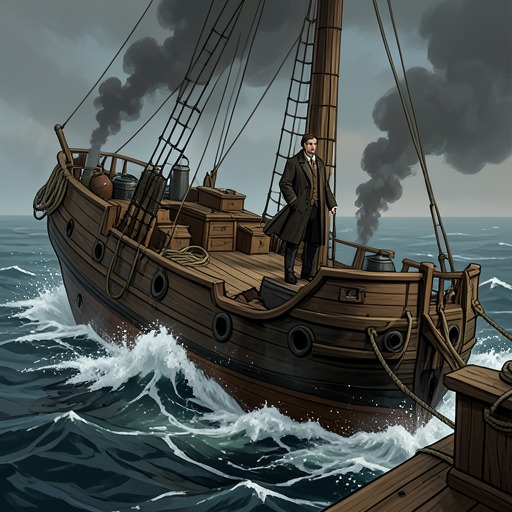
The episode distinguishes a fast journey from a single fast vehicle. Earlier, the Henrietta has been kept moving through the destruction of its fittings and structure for fuel; by the time the Irish coast and Fastnet Light are sighted, the ship is nearly out of steam. Queenstown makes another kind of speed possible, not by restoring the vessel but by linking it to other transport. The journey’s progress now depends on transferring between systems at precisely the right moment.
Arrival and Transfer
By ten in the evening, the party is passing Queenstown, with only twenty-four hours left for Fogg to reach London. Captain Speedy, now deeply interested in Fogg’s attempt, commiserates with him: the ship is only opposite Queenstown, and harbor entry must wait for high tide. Fogg asks whether the lights they can see mark the town and whether the harbor can be entered. He remains calm as he considers the alternative route.
The Henrietta enters the harbor at one o’clock in the morning, when the tide is high. Fogg leaves Captain Speedy aboard the vessel, now a levelled hulk; it is still worth half what Speedy sold it for. The party goes ashore at once, and the next available stages follow quickly: they board a train at half-past one, reach Dublin at dawn, and lose no time embarking on a steamer bound onward. Queenstown is the hinge between the exhausting Atlantic passage and this tightly timed sequence.
Narrative Significance
The port’s importance is made legible through exact time and connection: ten in the evening off Queenstown, entry at one in the morning, a train at half-past one, and Dublin at dawn. These details turn the mail route into a practical alternative rather than a general promise of speed. The twelve hours available through the transfer matter because Fogg has so little time remaining, while the tide and the train’s departure impose limits he cannot simply disregard.
Queenstown is also the setting for a consequential pause in Fix’s pursuit. Once ashore, Fix is strongly tempted to arrest Fogg but does not do so; the group continues together to the train. The narrative does not settle Fix’s inner struggle at this point, but the choice changes what happens next: rather than interrupting the transfer at the Irish port, he remains with the party as it proceeds toward Dublin and Liverpool. Queenstown consequently marks both a logistical turning point and a moment when the pursuit is allowed to continue along Fogg’s final route to London.